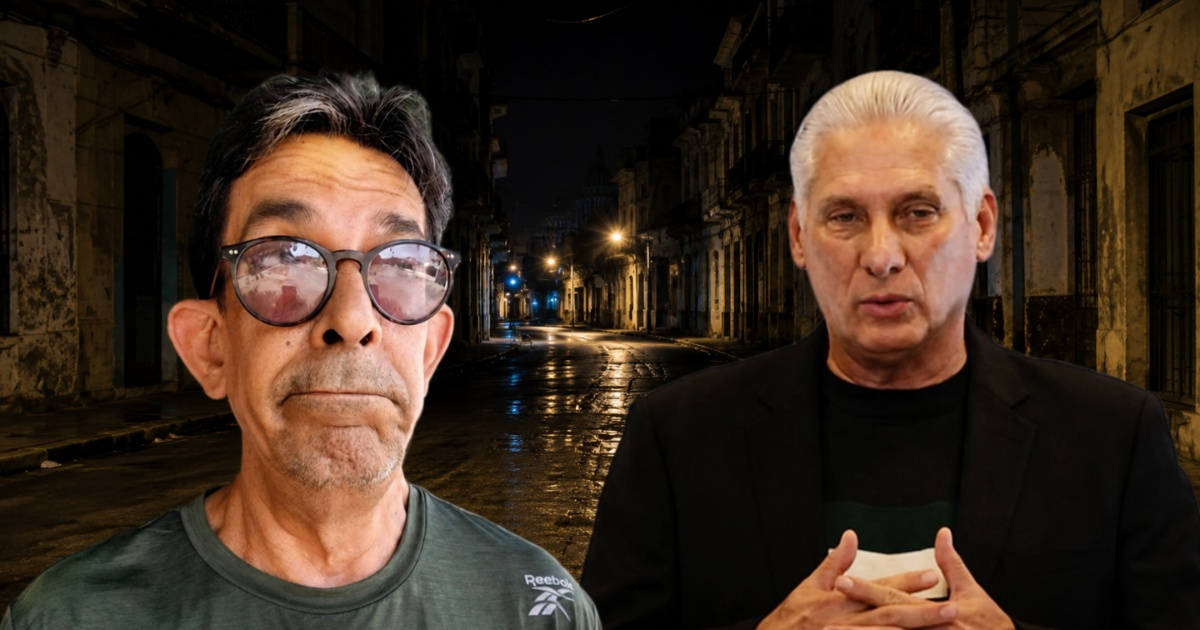
The Cuban comedian and actor Ulises Toirac responded with sarcasm to the philosophical metaphor used by Miguel Díaz-Canel to discuss the crisis in Cuba, turning the promise of a "utopia" into the image of a country aimlessly moving toward a "dog blackout."
Last Monday, in an interview with Russia Today (RT), Díaz-Canel referenced a phrase popularized by Uruguayan writer Eduardo Galeano —who in turn attributed it to Argentine filmmaker Fernando Birri— to respond to whether Cuba has a way out of its crisis: "The utopia is on the horizon... What is the purpose of utopia? To walk. I would say that hope is the same."
The response was met with indignation and sarcasm from thousands of Cubans, who interpreted it as a philosophical evasion in the face of a lack of concrete solutions.
Toirac did not take long to respond. On his Facebook profile, the actor posted a text that directly parodies the words of the ruler: "With my characteristic walk, breaking through mountains and cities. If I keep eating nonsense, I won’t reach the utopian house where an achievable blackout dog awaits me. One step forward and one step back..."
The mockery subverts the original metaphor: the promised horizon becomes an unattainable "utopian house," and what awaits at the end of the road is not hope but a blackout.
The context in which this irony arises could not be more serious. In July 2026, Cuba has experienced five total collapses of the National Electric System so far this year, with record generation deficits: on July 10, only 935 MW were available against a demand of 3,100 MW.
In areas like Matanzas, there have been accumulations of up to 87 consecutive hours without electricity, while in Havana, power outages average around 15 hours daily.
The popular reaction to Díaz-Canel's words was striking. According to CiberCuba the following day, Cubans erupted after the metaphor of utopia, with comments such as "That's an evasion; there’s no hope for anything in Cuba."
The phrase that Díaz-Canel borrowed from Galeano has a fuller version that is even more revealing in this context: "I take two steps, she moves away two steps. I take ten steps and the horizon shifts ten steps further away. No matter how far I walk, I will never reach her."
Its use by the ruler was seen as an attempt to appropriate a progressive discourse to justify inaction.
This is not the first time Toirac has directly targeted Díaz-Canel. On July 18, the actor challenged Cuban leaders to give up their privileges and move to neighborhoods like Old Havana, without cars or special advantages.
On July 12, he described life under blackouts as a "nightmare". And last February, he responded sarcastically to the ruling leader's speech about "difficult times," noting that in Cuba that phrase should include a "more" because they have endured "67 years" of hardships.
In the same interview where he spoke about utopia, Díaz-Canel promised to implement 121 out of more than 170 economic transformations before the end of July, prioritizing retirees and vulnerable individuals, as reported by the state-run Granma.
For millions of Cubans who have been without electricity for weeks, that promise sounds, as Toirac wrote, like another "step forward and step back."
Related videos:
Filed under: