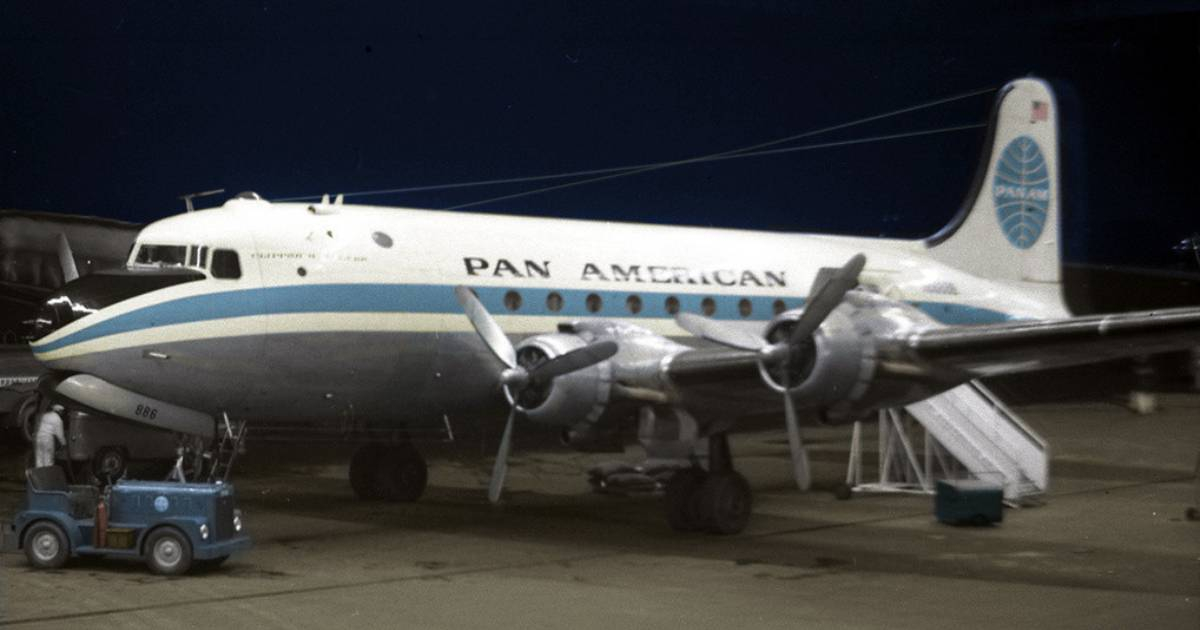
The remains of the Clipper Endeavor, the Pan American World Airways plane that sank off the coast of Puerto Rico in 1952, were located at nearly 600 meters deep, bringing an end to one of the greatest mysteries of commercial aviation in the Caribbean.
The discovery was made on June 2nd and was exclusively reported by the TODAY program from NBC, featuring images obtained during an expedition supported by Discovery Channel.
The aircraft, a Douglas DC-4 operating flight Pan Am 526A between San Juan and New York, rests in the Atlantic Ocean a few kilometers off the northern coast of Puerto Rico, where it fell just minutes after takeoff on April 11, 1952.
The search was led by the Air/Sea Heritage Foundation, which had been trying to locate the aircraft since 2019, along with the companies Deep Sea Vision and Eco Minerals, with the support of Discovery Channel.
An autonomous underwater vehicle was used for the expedition, a technology commonly employed in the exploration of marine deposits.
"We were racing against the clock and knew we had a fairly well-defined search area," explained Tony Romeo, CEO of Eco Minerals.
The confirmation came when the images captured by the drone revealed that the fuselage, although split in two, still bore the name "Endeavor" and the iconic winged logo of Pan Am.
The "Good Friday Tragedy"
The accident, known in Puerto Rico as the "Good Friday Tragedy," remains one of the worst aviation disasters in the island's history.
That day, there were 69 people on board: 64 passengers, including six children, and five crew members.
A few minutes after taking off from Isla Grande airport, two engines on the right wing failed.
In the face of the emergency, Captain John C. Burn, a pilot with extensive experience in transoceanic flights, decided to make a water landing to prevent the plane from crashing into populated areas or reefs.
All occupants survived the initial impact with the sea.
However, the fuselage fractured and sank in less than three minutes.
Fifty-two people drowned, while only 17 managed to survive. Of the victims, only 39 bodies could be recovered.
A tragedy that changed aviation
The official investigation concluded that many of the deaths could have been prevented, according to BBC Mundo.
According to the report from the then U.S. Civil Aeronautics Board, the crew did not explain to the passengers where the life vests were located or how to use them before the water landing.
In addition, only one of the three inflatable rafts managed to deploy correctly.
"There was no indication of where the exits were or where the flotation devices were located. In the midst of chaos and panic, 52 people drowned inside and around the plane," explained Josh Gates, host of Expedition Unknown.
The conclusions of the case prompted significant changes in aviation security. In 1965, the United States mandated the requirement to provide safety instructions before each flight, a practice that was later adopted as an international standard.
An underwater tomb
The officials in charge of the expedition ruled out recovering the aircraft's wreckage.
The site will be treated as a maritime grave, and the team is working with the Government of Puerto Rico to protect the area and promote the creation of a memorial in honor of the victims.
"Every time someone boards a plane, whether for vacation, work, or to return home, they have a debt to what happened on the Clipper Endeavor," Gates stated.
Related videos:
Filed under: