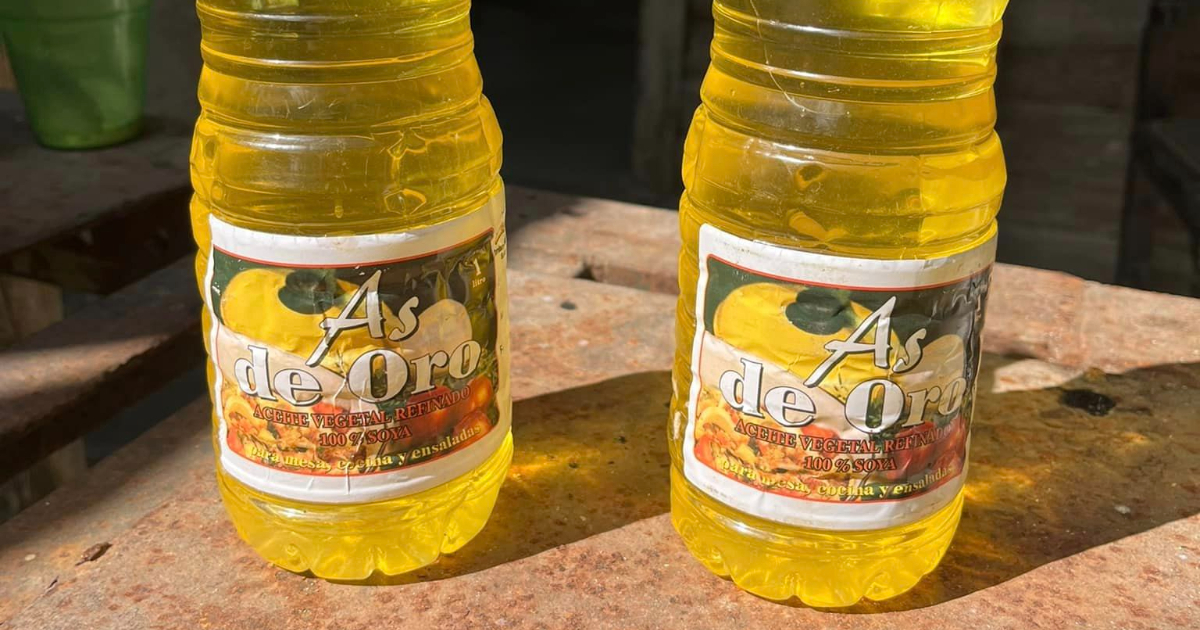
The price of a liter of vegetable oil went from 2,000 to 3,000 pesos in less than 24 hours in Sancti Spíritus, according to a report by Yosdany Morejón Ortega, a journalist for Radio Sancti Spíritus.
The increase of 1,000 pesos in a single day represents a 50% rise, without any official explanation.
«We still haven't received the announced salary increase... and it's already starting to disappear,» wrote Morejón, pointing directly to the contradiction between the new minimum wage of 3,210 pesos —effective since July 1 but payable only in August— and the price of oil, which already consumes nearly that entire income with just a liter.
"There are no explanations. There is no one to defend the consumer. All that's left is to take out the calculator again and cross another item off the shopping list," the journalist declared.
In his post, the official spokesperson illustrated the text with a photo from Revolico when the oil cost 1,300 pesos per liter, and added bitterly: "It seems like millennia have passed since then."
"Prices are in a race without a finish line. Today it was oil. Tomorrow it will be something else," he warned.
"The most concerning thing is not just the price. It is the sense of vulnerability that is increasingly settling on our tables," concluded Morejón Ortega, in a statement that encapsulates the experiences of millions of Cubans facing an inflation rate that independent estimates place around 70% year-on-year.
The case of Sancti Spíritus is not isolated. The liter of sunflower oil had already reached 2,500 pesos in Havana on Tuesday, a day before Morejón Ortega's publication, and exceeded 3,000 in several provinces.
In Isla de la Juventud, 2,800 pesos were recorded; in Trinidad, 2,650; in Holguín and San Luis, 2,350; in Marianao, 2,050.
The rise is staggering: in April, the liter was around 1,500 pesos; in June, it fluctuated between 1,800 and 2,000.
The structural trigger was the Resolution 150/2026, signed on June 20, which eliminated price caps on imported cooking oils, repealing Resolution 225/2024, which set a maximum of 990 pesos per liter.
This is compounded by the fact that oil has not appeared in the supply ledger for months. The Minister of Food Industry, Alberto López Díaz, admitted in June that in 2026 no oil, chicken, or yogurt had been distributed through that channel, leaving the informal market as the only access for the majority of Cubans.
The oil crisis has an extreme dimension as well: in May, cases of Cubans using sunflower oil as a substitute for diesel in tractors and buses were documented due to the total fuel scarcity, which the citizens themselves pointed out as an additional factor putting pressure on prices.
In a long-term response, the regime announced a program for soybean cultivation in Guantánamo to produce yogurt, with only 15 hectares currently active and edible oil production designated as a "long-term objective."
Related videos:
Filed under: