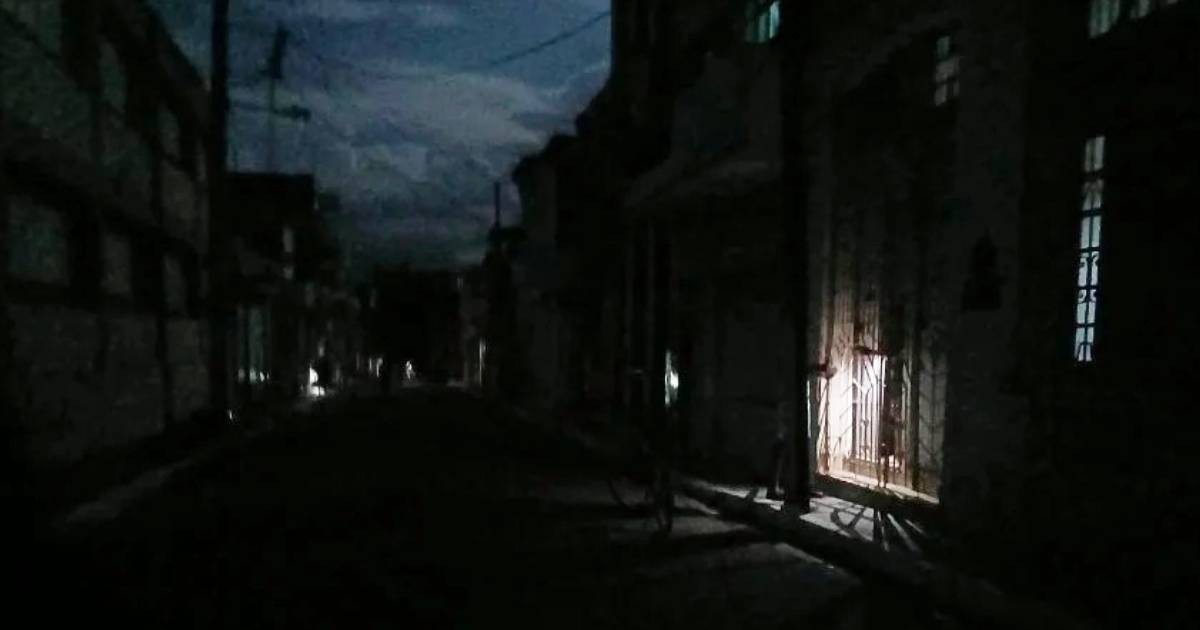
The Cuban electrical system once again approached its historical maximum this Thursday: the impact reached 2,315 MW at 9:10 PM, according to the informative report from the Unión Eléctrica published this Friday.
The service was interrupted for 24 hours a day, including the early morning, affecting all provinces of the country.
The figure dangerously approaches the all-time historical record of 2,341 MW, recorded on July 8, when nearly 73% of the territory was left without electricity simultaneously.
July 2026 thus emerges as the most critical month in Cuba's electrical history, with deficit levels far exceeding the peaks of the summer of 2024, when outages ranged between 1,500 and 1,900 MW.
For this Friday, the Electric Union forecasts an impact of 2,160 MW during peak hours, with a generation availability of only 1,070 MW against an expected maximum demand of 3,200 MW.
The condition of the thermal power plants largely explains the extent of the collapse. Five units are out of service: Unit 6 of Máximo Gómez in Mariel, Unit 1 of Ernesto Guevara De La Serna in Santa Cruz, Unit 6 of Diez de Octubre in Nuevitas, Unit 2 of Lidio Ramón Pérez in Felton, and Unit 3 of Antonio Maceo in Renté.
Four other units are under maintenance: Unit 3 of Ernesto Guevara De La Serna, Units 5 and 6 of Antonio Maceo, and Unit 5 of Diez de Octubre.
This is compounded by the fact that 106 distributed generation plants remain out of service due to a lack of fuel, including the Patana de Regla, the Patana de Melones, the Central Fuel de Mariel, and the Central Fuel de Moa.
The 54 photovoltaic solar parks generated 4,467 MW/hour on Thursday, with a maximum power output of 694 MW. This contribution is insufficient to compensate for the nighttime deficit, which is precisely when the highest demand peaks occur.
The crisis has structural roots that the regime has neither been able to—nor willing to—resolve: thermoelectric plants with over forty years of operation without significant maintenance, a critical shortage of fuel, and a growing accumulation of breakdowns that worsens month by month.
The Antonio Guiteras thermoelectric plant, the most powerful in the country with nearly 10% of the system's capacity, has not undergone comprehensive repairs since 2010 and has experienced 17 outages just in 2026.
The historic record of 2,341 MW was reached on July 8, and since then the system has experienced five total blackouts in less than three weeks: on July 6, 10, and 14, leaving approximately 9.6 million people without power on each occasion.
The only improvement expected for this Friday is the entry of Unit 6 of the Diez de Octubre Thermoelectric Plant, which would contribute an additional 80 MW, a marginal figure compared to a projected deficit of over 2,100 MW.
It is estimated that Cubans have endured over 44,300 hours without electricity since the onset of the current energy crisis, a figure that reflects the extent of a collapse that the regime has been unable to stop.
Related videos:
Filed under: