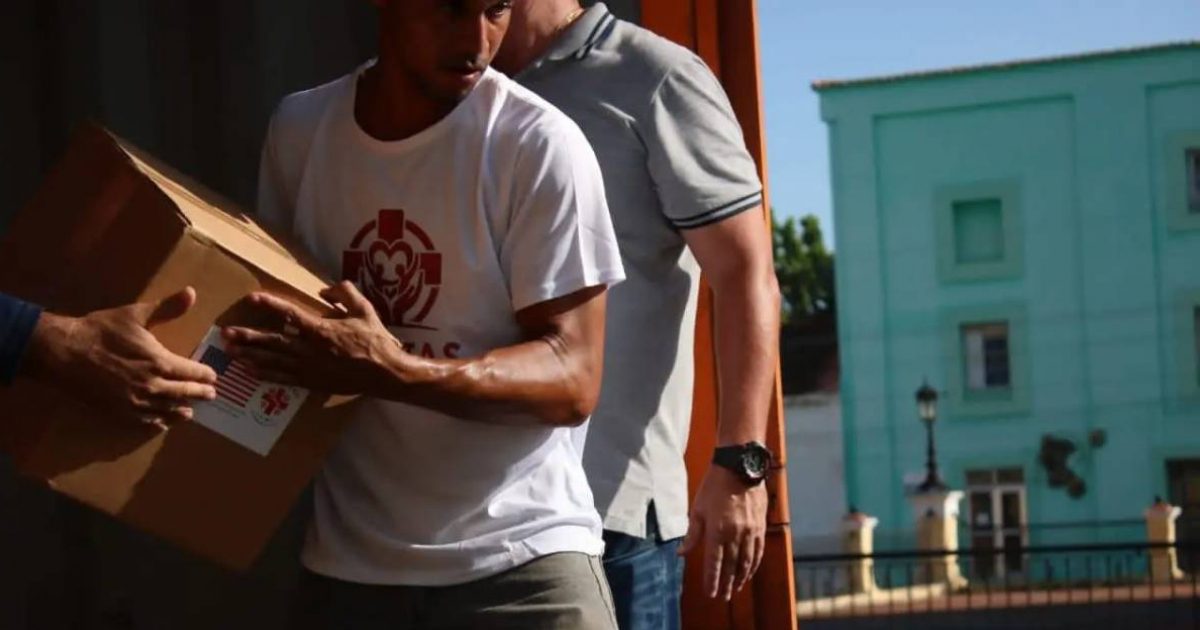
Vulnerable Cuban families have begun to receive humanitarian assistance modules funded by the United States government, with distribution starting on Wednesday in the municipalities of Bejucal in Mayabeque and Alquízar in Artemisa.
Cáritas Cuba informed that each package consists of two distinct blocks: one for food and the other for hygiene and household essentials, designed to meet the immediate needs of the beneficiary households.
In the food block, each module includes 10 pounds of rice, 10 pounds of beans, one gallon of oil, one pound of brown sugar, three pounds of pasta, six cans of sardines in tomato sauce, and five cans of tuna in water.
The hygiene kit includes four bath soaps, one package of laundry detergent, two tubes of toothpaste, four toothbrushes, a jar of water purification tablets, two packs of sanitary pads, a plastic bucket with a lid, a 20-liter container for storing water, and a rechargeable lamp.
The selection of beneficiaries is managed by parish teams and volunteers from Cáritas in each diocese, who conduct home visits applying vulnerability criteria established by the donor.
Priority is given to elderly individuals living alone, pregnant women or those in the breastfeeding period, people with disabilities or bedridden, and families with children under five years old in at-risk situations.
This distribution is part of the 100 million dollar package announced by Secretary of State Marco Rubio on May 8, 2026, of which 60 million is being channeled through the Catholic Church and Cáritas Cuba with the support of Catholic Relief Services (CRS).
The remaining 40 million are managed by other independent non-governmental organizations.
The first humanitarian flight under this commitment departed from Miami on July 21, carrying 18 tons of food and hygiene supplies, enough to assist approximately 700 families in the first phase corresponding to the Archdiocese of Havana.
The plan encompasses all the dioceses across the national territory, from Pinar del Río to Camagüey, and aims to benefit between 100,000 and 200,000 families throughout the island in the coming months.
At the same time, the delivery of supplies to the eastern provinces affected by Hurricane Melissa continues. The hurricane struck eastern Cuba between October and November 2025, leaving more than 60,000 homes destroyed or damaged. Initial funding of three to six million dollars was allocated for these areas in previous stages.
Cáritas Cuba openly acknowledged the limitations of the program. "We are fully aware that we cannot reach everyone. Therefore, we provide this aid 'which is not extensive in its coverage', with our hearts dedicated to those who, amidst the current humanitarian crisis, face greater vulnerability."
The initiative has generated doubts and public debate about whether assistance of this magnitude can make a real difference in light of the depth of the structural crisis that Cuba faces after decades of dictatorship.
Cáritas concluded its statement with a quote from Mother Teresa of Calcutta that summarizes its stance on the program's limitations: "Sometimes we feel that what we do is just a drop in the ocean, but the ocean would be less if it lacked a drop."
Related videos:
Filed under: