The state media Cubadebate published a report titled "A Shorter Path to the Checkbook" on Thursday, presenting the new mechanism by which private small and medium-sized enterprises (mipymes) and self-employed workers deliver pensions in cash to retirees near their businesses as a progress.
The popular reaction, however, swings between relief and skepticism: "Let’s hope this path is not like the utopia."
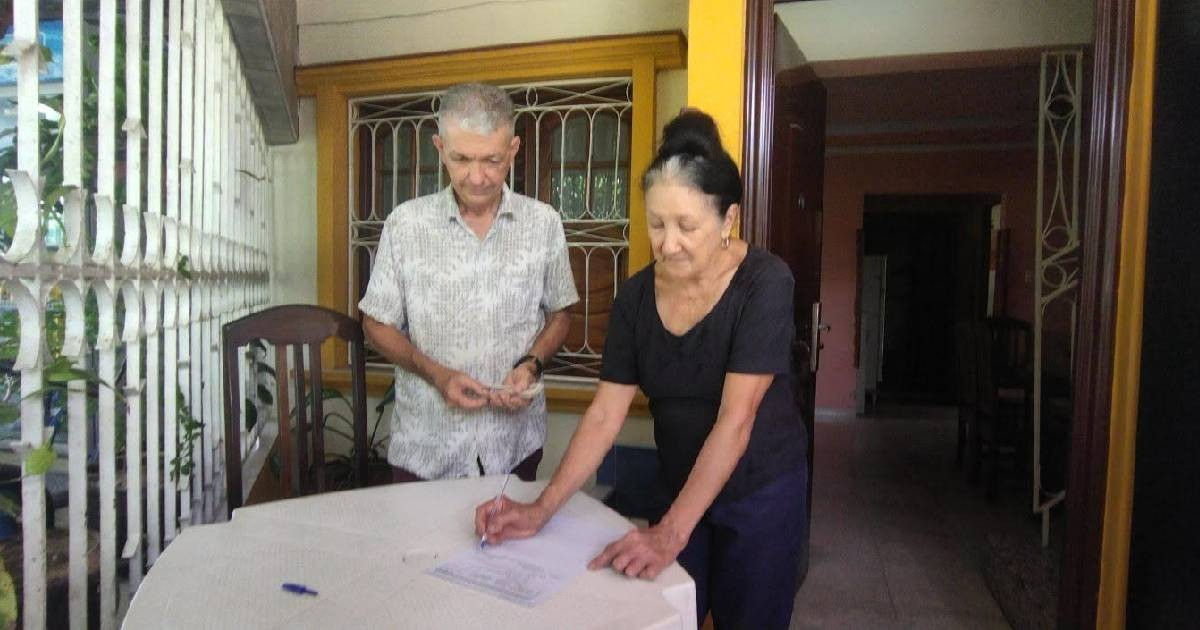
The report from the official media focuses on Deisy Rodríguez, an 84-year-old woman who no longer has to travel long distances to collect her pension. According to the account, the manager of the small business "Los Garajes," Roberto Alejandro González Quintero, hands her the money directly.
The business receives a "nominilla" with the name of the retiree, their identification number, and the exact amount, and has up to 72 hours to submit the documentation to the bank, which automatically reimburses the amount to their account.
In the municipality of Colón, about 40 retirees are already benefiting from this scheme through a small and medium-sized enterprise and two self-employed workers, according to information from Radio Caibarién.
The system is not new. It started as a pilot plan in April 2026 in four municipalities of Havana—La Lisa, Playa, Plaza de la Revolución, and La Habana Vieja—under the name "Caja Extra."
In May, it expanded to Holguín, where around 20 small and medium enterprises started to pay pensions to about 5,000 retirees, which is equivalent to 9.6% of the total municipal.
On July 17, the Central Bank of Cuba announced a package of 176 emergency economic measures that includes this payment method, the issuance of new 2,000 and 5,000 peso bills, and the indefinite removal of the 5,000 peso limit for cash transactions between economic agents.
The monthly cap for electronic transfers has also risen to 2.5 million pesos, according to the Resolution 74/2026 effective from July 20.
The context surrounding these measures is one of collapse. More than 1.7 million retired Cubans receive pensions of less than 10 dollars a month and must wait in line from dawn to withdraw cash, according to data from Infobae. The minimum pension has been set at 4,000 pesos —about seven or eight dollars— since September 2025.
The situation in the provinces is even more serious. The government of Granma admitted in June that it did not have enough cash to pay over 111,000 retirees. In the same month, the Metropolitan Bank reduced the withdrawal limit from 5,000 to 3,000 pesos per transaction, and in May, more than 50% of the ATMs in the country were not operational.
The forced banking system promoted by the regime has failed in practice. In April, the official press itself acknowledged that “the banking system is not functioning well”, and Cubans reported that “the card is just a keychain.” The banking process promised by the government is sinking due to a lack of cash and citizen distrust.
RTVE described on July 19 "endless lines" to collect pensions of just four euros and pointed out that the Cuban monetary system is "on the brink of collapse," warning that "the retirees are the most affected" by the crisis.
The report from Cubadebate presents the framework with a human and optimistic approach, but the public response accurately summarizes the distrust built up over years of unfulfilled promises: "Let's hope that this path isn't like the utopia."
Related videos:
Filed under: