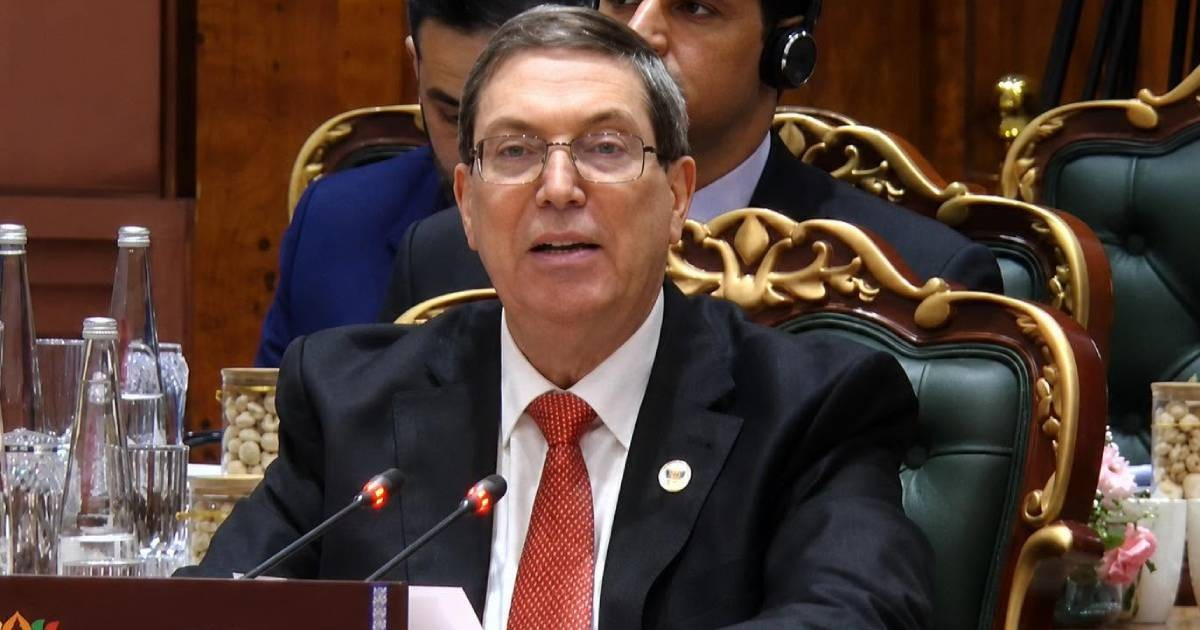
The Cuban Foreign Minister, Bruno Rodríguez Parrilla, responded this Thursday to the new round of sanctions announced by the United States against the Cuban regime and accused Washington of using these measures to impose "collective punishment" on the island's people and to provoke a "humanitarian crisis."
The sanctions, announced by the State Department under Executive Order 14404, signed by President Donald Trump on May 1, 2026, target nine entities and two high-ranking officials linked to the energy sector, the military conglomerate GAESA, and the program for medical missions abroad.
"Every act of aggression by the U.S. government, such as the measures announced on July 23 by the Secretary of State, demonstrates that the aim is to impose collective punishment on the entire Cuban people," Rodríguez wrote on his X account.
The foreign minister went further and asserted that Washington is trying to conceal "its genocidal intentions and the purpose of provoking a humanitarian crisis," a statement that contrasts with the official stance of the State Department, which claims that "the ultimate goal of the sanctions is not to punish, but to promote a positive change in the behavior" of the Cuban regime.
Defend medical missions
One of the main targets of the new round of sanctions is the international medical missions program, which the United States labels as a scheme for forced labor and human trafficking.
Washington sanctioned the Cuban Medical Services Marketing Company S.A. (CSMC), the Central Unit for Medical Cooperation (UCCM), as well as the Minister of Public Health, José Ángel Portal Miranda, and the director of the UCCM, Gretza Sánchez Padrón.
According to the State Department, the Cuban regime retains between 50% and 95% of the salaries that recipient countries pay for the services of health professionals.
Rodríguez rejected those accusations and defended the program as an initiative for international cooperation.
"The attack on Cuban medical cooperation amounts to an aggression against the human right to access health services for hundreds of thousands of people in many parts of the world," he stated.
They also reach the energy sector and GAESA
The new U.S. measures also tighten the restrictions on the Cuban energy sector with the inclusion of CEINPET, ENERSA S.A., and EINARBO S.A., in addition to increasing pressure on the military conglomerate GAESA.
In this latest case, CEIBA Investments Limited and ORBIT S.A., a remittance processing company that Washington considers "almost certainly" controlled by GAESA, were sanctioned.
The State Department also cited the transfer of administration of the Port of Mariel to Coral Marítima S.A. as an example of sanctions evasion, an operation carried out in mid-June that, according to the United States, aimed to protect the assets of the military conglomerate from the existing restrictions.
A recurring response from the regime
The announcement made this Thursday constitutes the fifth round of sanctions imposed by the Trump administration against the Cuban regime since the enforcement of Executive Order 14404.
Bruno Rodríguez has publicly responded to each of those measures. On July 13, he described a previous round of sanctions as "criminal and genocidal" and, weeks earlier, announced that Cuba would request a special session of the UN General Assembly to denounce the tightening of U.S. sanctions.
With his new statement, the chancellor maintains the usual rhetoric of the Cuban government, which blames the embargo and U.S. sanctions for the crisis the island is experiencing, while Washington contends that the measures aim to limit the funding sources of the political, military, and repressive apparatus of the regime.
Related videos:
Filed under: