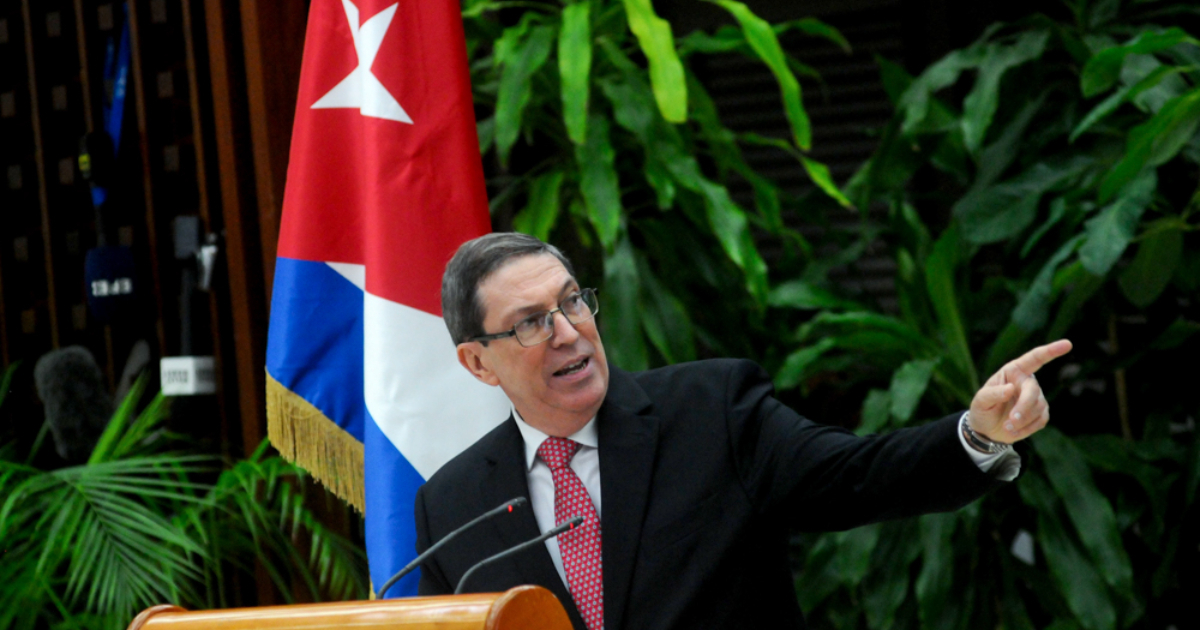
Cuban Foreign Minister Bruno Rodríguez Parrilla labeled the report published by the State Department on Monday as a "slanderous pamphlet" in a message shared on his X account, marking his second public reaction to the document in less than 24 hours.
The document, titled Cuba: the capital of communism in the 21st century and published by the Department of State, presents the U.S. government's interpretation of nearly seven decades of espionage, ideological influence, and subversive activities attributed to Havana.
Rodríguez stated that the report "aims to scare the American public with the supposed danger lurking over the world's greatest nuclear power" and described it as "a curious exercise that mixes deceptive fantasy with doses of admiration."
The chancellor also attributed 3,478 deaths and 2,099 mutilated individuals to acts of violence and terrorism linked to the United States, without providing any tangible evidence.
"Solidarity with those who fight for justice and against oppression and crime is not a threat," wrote Rodríguez, who concluded his message with the phrases "#CubaIsNotAThreat" and "The blockade is."
This was his second reaction to the document. On Monday, Rodríguez had already described the report as a "fallacy" and accused Rubio of creating a pretext to sustain economic pressure and justify a potential military aggression against Cuba.
In another message published that same Monday, the chancellor took a harsher tone and denounced what he described as Rubio's "macabre plan," which he linked to interests that he claimed, without naming individuals or organizations, had previously supported the Secretary of State.
The ruler Miguel Díaz-Canel also reacted this Monday and described Rubio as "corrupt" and linked him to drug traffickers, without presenting evidence to support those accusations.
The report that has the members of the dictatorial elite in Havana furious also claims that Cuba hosts facilities linked to intelligence operations from China and Russia.
Additionally, it mentions cases such as that of Ana Belén Montes, former senior analyst on Cuba for the Defense Intelligence Agency, arrested in 2001, and that of Víctor Manuel Rocha, a former U.S. ambassador who admitted to having clandestinely worked for Cuban intelligence for decades.
Rocha was arrested in December 2023 and sentenced in April 2024 to 15 years in prison. Subsequent investigations by the FBI indicated that his collaboration with Havana began in 1973 and revealed that he had access to the National Security Council, the White House, and other sensitive information from the U.S. government.
The document concludes with the following warning: "Confusing Cuba's poverty with its harmlessness is to completely misunderstand the threat. Its power has always been ideological, subversive, and parasitic."
Related videos:
Filed under: