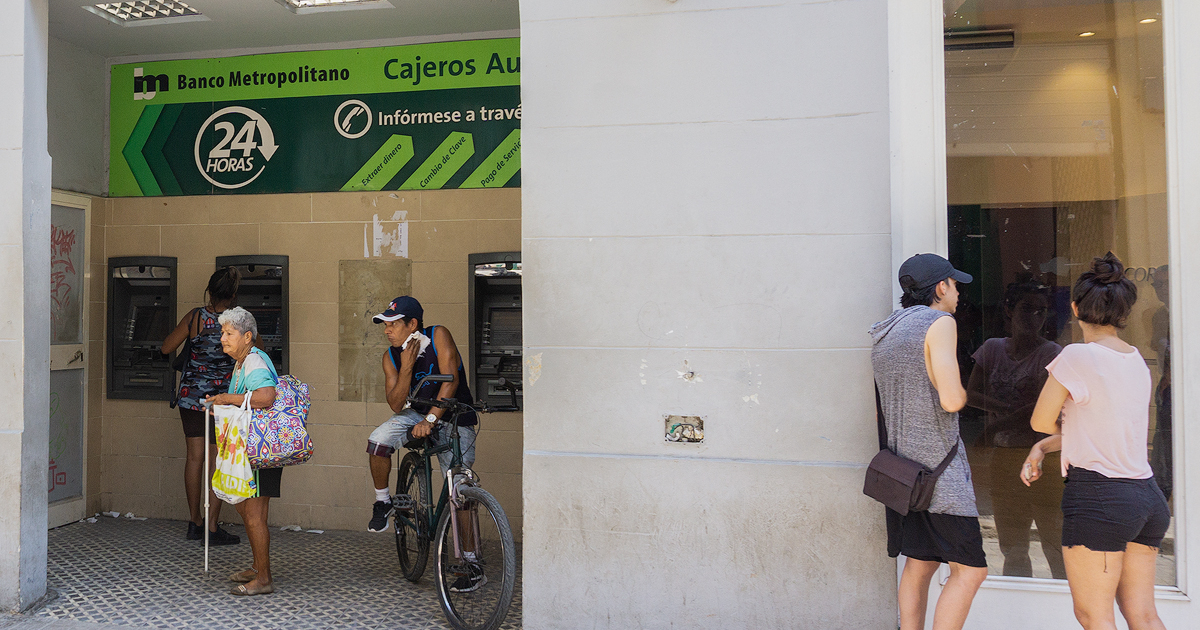
The Banco de Crédito y Comercio (BANDEC) published an infographic announcing a 0.2% fee for each cash withdrawal at the counter, as part of the new measures by the Banco Central de Cuba (BCC) to promote digital payments, and the reaction from Cubans was immediate: mockery, disbelief, and a question that summed up the general sentiment: "Is this a meme?"
The publication explained that for every 100,000 Cuban pesos (CUP) withdrawn, a fee of 200 CUP would be charged, arguing that the measure "acknowledges the costs of production, security, and logistics involved in having cash available."
The irony that Cubans quickly pointed out is striking: the bank intends to charge for withdrawing cash in a country where cash practically does not exist at the counters.
"The fee is already paid after the act of getting to a bank window and at that moment having cash available. It's simpler for life to flourish on this planet of the solar system," wrote a user.
Another comment pointed directly to the contradiction: “What cash do they have for that?”
A third party compared the measure to the informal market: "0.2%, that's so little, when it's at 50% on the street. Just set it at 45% and everything will be fine."
Some warned of the opposite effect: "That gives more reasons to those who charge 40% on the street; now they will demand more."
Structural criticism was also present: "Charging a fee for withdrawing money from an ATM is not a measure to promote transfers or digital payments; it's just another example of the usual strategy of addressing problems in socialism: 1st. Restriction, 2nd. Rationing, 3rd. Repression."
In the face of a barrage of criticism, BANDEC itself published a clarification in the comments: “The measures reported regarding a 0.2% commission for cash withdrawals are directed solely at economic actors (non-state forms of management and relevant entities). This provision does not apply to the general public. Individual customers will continue to conduct their banking operations under the established conditions for the population.”
The measure is part of the Resolution 74/2026 of the BCC, signed on July 10 by Minister President Juana Lilia Delgado Portal and in effect since July 20.
The package also includes a reduction in the commission for merchants for online payments from 1.5% to 0.8%, the elimination of the commission for cash deposits, and the indefinite suspension of the limit of 5,000 CUP for cash collections and payments among economic actors.
The context surrounding the announcement intensifies the perception of absurdity. According to data from a provincial meeting held on July 18, BANDEC in Guantánamo manages to collect only about 35% of the nearly 15 million pesos needed daily. More than 6,000 workers in sectors such as Culture, Sports, and Education had not received their July salary due to a lack of liquidity.
In parallel, the informal market for converting transfers to cash operates with commissions ranging from 30% to 50%, and only 3.77% of transactions in Cuba are digital.
A user summed up the situation accurately: "And in the meantime, ETECSA's infrastructure multiplied by zero makes any transfer unfeasible, no matter what they do. First, they need to ensure that transfers and digital transactions can always be made, and then everything else can follow."
The official Cuban press acknowledged in April 2026 that the banking system "works poorly", partly because private businesses refuse transfers, power outages disable payment terminals, and ATMs frequently crash.
Related videos:
Filed under: