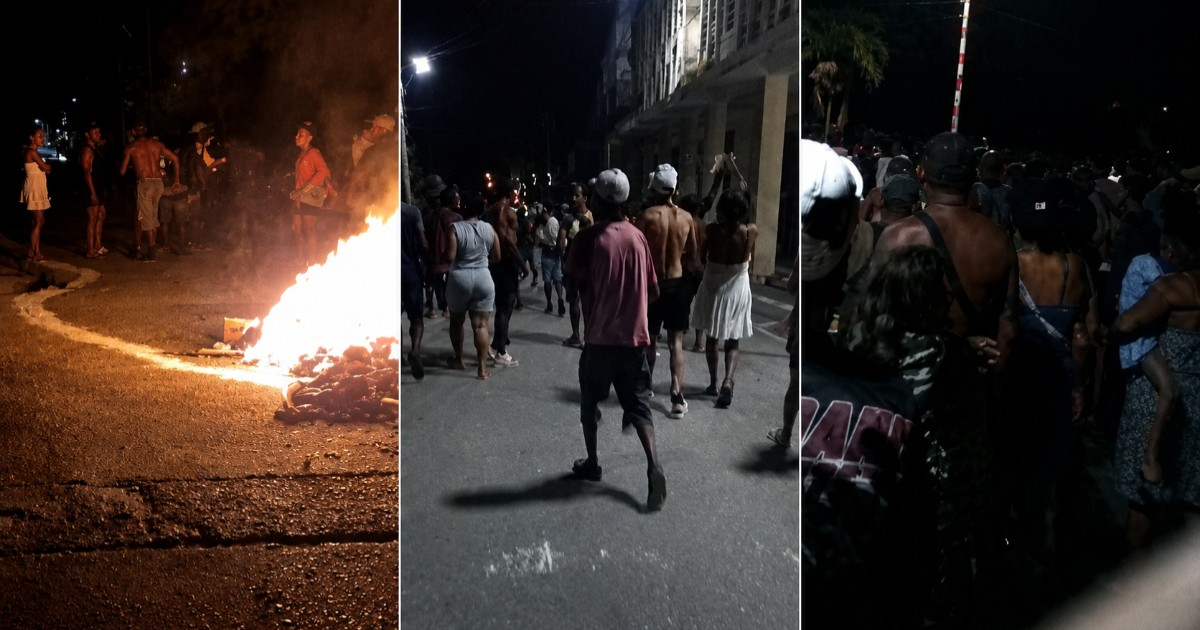
The Cuban political scientist and historian Armando Chaguaceda published a column this week on the website of the Center for Convivial Studies, in which he argues that protests in Cuba are reaching an unprecedented intensity in the last fifty years: "In Cuba today, protests occur every day and every night as never before in the last half century. People are protesting not due to any law or institution of the system, all of which are designed to disguise or suppress. They are protesting in spite of all of them."
Titled "The Power of Authenticity vs. Political Fictions," the text arrives at a moment of maximum tension. On the night of Friday, July 24, just before July 26, the national call for a pot-banging protest left images of strangely illuminated areas and, nonetheless, simultaneous protests in Lawton, San Agustín, La Coronela, La Lisa, Santiago de Cuba, and Cienfuegos.
The regime tried to dissuade the call by simultaneously electrifying entire neighborhoods of Havana that had been without nighttime electricity for weeks, right at the time set for the protests. The maneuver did not work: the electricity lasted only a short while, and protests erupted anyway, with residents from Parque Dolores in Lawton using pots and fire extinguishers to amplify the noise.
The electricity generation deficit from the previous day reached 2,315 MW, almost matching the historical record of 2,341 MW set on July 8, when over 70% of the population simultaneously lost power. Meanwhile, dozens of police officers and MININT personnel were deployed in El Diezmero, San Miguel del Padrón, in response to residents blocking the roadway with branches and debris.
In his article, Chaguaceda directs his criticism in three directions. The first points to Cubans who emigrated claiming persecution and then disconnect from any denunciation actions: "What is not justifiable is the accommodation of those Cubans who escaped the system, received refuge in other countries claiming persecution, but once they are on safe ground, they 'disconnect' from any systematic actions of denouncing, organizing, helping, or protesting." The political scientist qualifies this phenomenon as understandable — a legacy of totalitarianism — but not justifiable.
The second criticism is directed at certain political leaders, journalists, and influencers in exile who do not step outside the "self-absorbed and fanciful comfort of their press conferences or their Facebook broadcasts" to mobilize the diaspora. It notes that the rhetoric coming from "the banks of the Potomac and the window of Versailles" turns into "a repetitive and inconsequential rhetoric."
The third critique points inward toward the island: Chaguaceda questions those who promote the "illusion of a negotiated, possible, and agreed transition" without clarifying their agenda or their real power. For the political scientist, "all those political fictions, whether conscious or unconscious, only serve to feed the regime's propaganda and the distrust of ordinary people in politics."
In contrast to those fictions, the author advocates for everyday resistance: "People only learn the art of freedom by practicing it. In the daily resistance of a pot's clang, a community dining hall, in the presentation of a habeas corpus." It is in these imperfect forms, he argues, that "the contagious strength of the authentic emerges, which despots fear so much."
The data supports their diagnosis. The Cuban Conflict Observatory recorded 107 street protests in June 2026, nearly double the previous record, with 82 in Havana and 18 in Santiago de Cuba. Cubalex reported 319 repressive events and 253 demonstrations in that same month, and its director, Laritza Diversent, was emphatic: “The militarization is not aimed at an external enemy but at the Cuban population itself.”
Chaguaceda concludes his essay with a personal reflection that captures the tone of the text: "For someone who did not have, at the time, the awareness, courage, or desperation that—whatever the reason—his compatriots show today, all that is left is to look with respect at what they are trying to do. And to do the little that is within our means, from our bubbles of privilege, to help bring an end to that regime of disgrace."
Related videos:
Filed under: