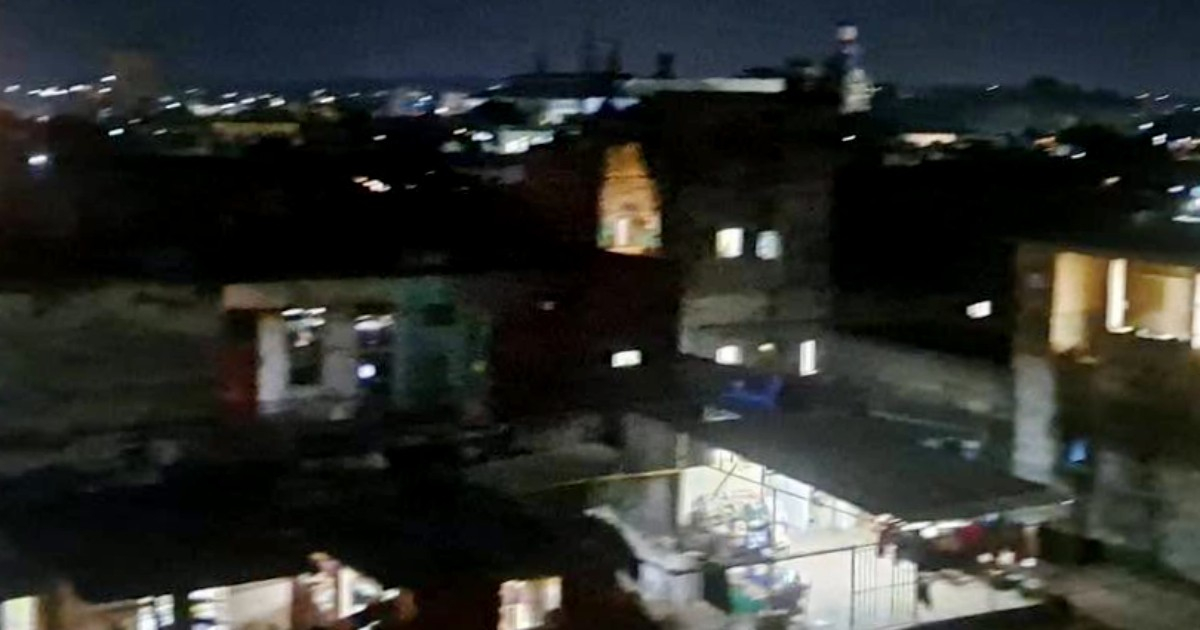
Nighttime photographs taken in Havana on Friday night reveal a phenomenon that many Cubans had not witnessed in weeks: entire neighborhoods of the capital illuminated with electricity at the same time.
The images, captured by the activist Leonardo Romero Negrín and shared on Facebook by journalist and activist Magdiel Jorge Castro, coincided precisely with the time scheduled for the national pot-banging event: 9:00 PM.
The Assembly of the Cuban Resistance had called for protests on Friday, July 24, the eve of July 26, a date of significant political importance for the regime in Havana.
The sudden and simultaneous arrival of electricity to various neighborhoods in the capital was interpreted by Cuban activists as a deliberate maneuver by the regime to demobilize the population before protests began.
"Entire neighborhoods electrified at the same time, after weeks without power during the night. The regime responded this way to the large national call... the electricity lasted little and protests began," wrote Magdiel Jorge Castro in his post.
However, the strategy — if it was indeed one — did not work.
Despite the daylight, the sounds of pots and pans could be heard in multiple areas of Havana: Lawton, San Agustín, La Coronela, and La Lisa, as well as in Santiago de Cuba and Cienfuegos. In the Lawton neighborhood, residents of Dolores Park used pots and fire extinguishers to amplify the noise of the protest.
The electrical context surrounding these images is devastating. On that same Friday, the National Electric Union reported an outage of 2,315 MW at 9:10 PM, nearing the historical record of 2,341 MW recorded on July 8, 2026.
During July, the National Electro-Energetic System experienced at least four total collapses, and in some neighborhoods in Havana, the power outages lasted up to 35 consecutive hours.
Lawton had already been the scene of protests in mid-July, with residents shouting slogans of "Freedom" and "We want electricity." The cacerolazo in El Vedado after 30 hours without electricity and the protests in Guanabacoa on the anniversary of 11J demonstrated that the outrage had been building for weeks prior.
Romero Negrín, who took the photographs circulating on social media, is an activist with a long history of arrests. The most recent one occurred on July 1, 2026, when he was detained during a cacerolazo in Centro Habana due to power outages and water shortages and was released two days later with a fine of 2,000 Cuban pesos.
Magdiel Jorge Castro concluded his post with a call for sustained organization: "Let all of Cuba make itself heard every day at 9 PM, and let the clanging of pots and pans resound. Let’s extend the national protest for every day that a Cuban family suffers injustice, for every prisoner, for every hungry child. The time is now."
Related videos:
Filed under: