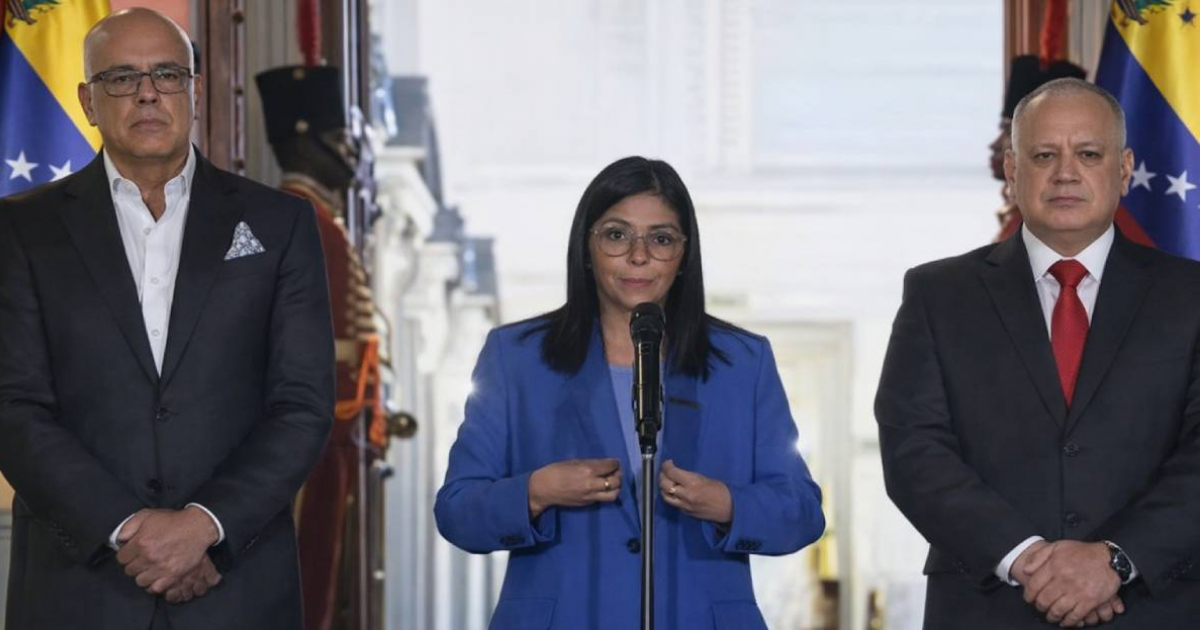
The Venezuelan regime formalized this Friday its break with international criminal justice by announcing its definitive withdrawal from the International Criminal Court (ICC), an organization that investigates alleged crimes against humanity committed in the country since 2017.
The chancellor Félix Plasencia communicated the decision through his social media, indicating that he acted on instructions from the interim president Delcy Rodríguez: «Venezuela has informed the Secretary-General of the UN, António Guterres, of its firm and irrevocable decision to denounce the Rome Statute and initiate its definitive withdrawal from the ICC, in accordance with Article 127».
The official justification of the Venezuelan government points to an alleged bias of the court.
According to Plasencia, the ICC "has disproportionately focused its efforts on African and Latin American countries, to the detriment of the Global South," and has "put its mechanisms at the service of interests that are foreign to justice and the peoples it claims to protect."
The ICC responded with a statement indicating that it had not been officially notified of the decision and lamented that Venezuela wishes to "withdraw from the collective effort to end the impunity for the most serious international crimes.
The withdrawal is not immediate. Article 127 of the Rome Statute states that the denunciation takes effect one year after notification is received by the Secretary-General of the UN, during which period Venezuela remains obligated to cooperate with ongoing investigations.
Experts also warn that leaving the country does not close the open case. Alí Daniels, director of Access to Justice, recalled the precedent of former Philippine president Rodrigo Duterte: "He also denounced the Rome Statute and is currently being tried by the International Criminal Court."
The investigation known as Venezuela I case was formally opened on November 3, 2021, concerning alleged crimes against humanity committed since April 2017: torture, arbitrary detentions, enforced disappearances, and sexual violence during the anti-government protests that resulted in approximately 200 deaths. More than 8,000 victims of political persecution have provided their testimonies.
The process has direct antecedents in international pressure: Argentina, Canada, Colombia, Chile, Paraguay, and Peru filed a formal complaint with the ICC in 2018.
In 2024, the Appeals Chamber rejected the Venezuelan appeal and confirmed the continuation of the process. Venezuela is the first country in Latin America against which a formal case has progressed in this court.
The announcement of the resignation coincided with the dismissal of the chief prosecutor of the ICC, Karim Khan, which occurred the same Friday with 82 votes in favor out of 125 member states, due to serious sexual misconduct. This is the first time in the organization's history that a chief prosecutor has been removed from office.
The movement of the chavista regime also occurs in a context of international pressure against the ICC.
The U.S. Secretary of State Marco Rubio published an article in The Wall Street Journal days earlier, in which he stated: "We will dismantle the ICC, using all the tools at our Government's disposal, working hand in hand with every ally we can join forces with."
For Daniels, the Venezuelan decision represents a historical setback: "It is very regrettable because Venezuela was among the countries that drafted the statute, and this does not help strengthen international justice at all."
Related videos:
Filed under: