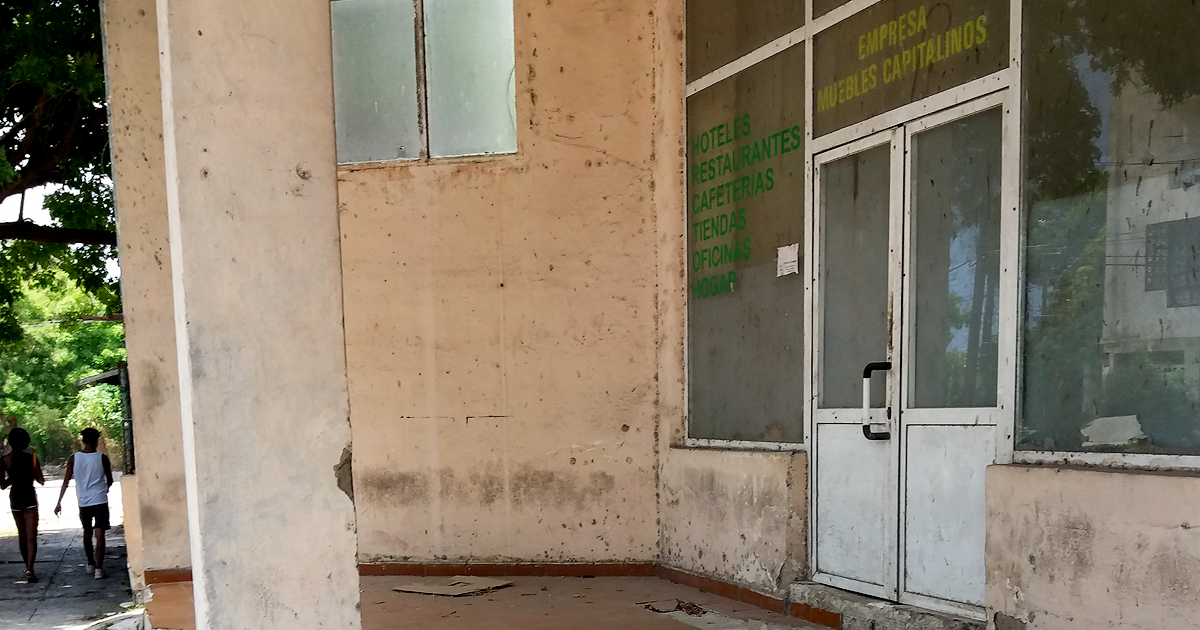
The decline of the Cuban state economy accelerated during the first five months of 2026. By the end of May, 399 companies reported losses, 120 more than in the same period of the previous year, according to the latest report from the National Office of Statistics and Information (ONEI).
The figure represents a year-on-year increase of 43% compared to the 279 deficit entities recorded between January and May 2025. It also means 23 more companies than those registered at the end of April this year, when the total reached 376, a monthly growth of 6.1%.
But the data, on its own, is merely a piece of a much more concerning picture. The official report shows a widespread deterioration of the main indicators of the state business system: sales are falling, production is declining, profits are decreasing, efficiency is dropping, and so is employment.
All of this occurs while the government itself implicitly acknowledges the seriousness of the situation and prepares reforms that, for the first time in decades, include the possibility of liquidating unviable state-owned companies and allowing private capital to enter some of them.
Sales and profits plummet
The ONEI data shows that net sales of goods and services from the business system decreased from 650.311 million pesos between January and May of 2025 to 460.578 million in the same period of this year.
It is a drop of 189.733 million pesos, equivalent to 29.2 %.
The profits before taxes also suffered a decline. They fell from 97,628 million to 66,922 million pesos, a reduction of over 30,700 million, which is a 31.5% decrease compared to the previous year.
Meanwhile, the production of goods and services fell by 11.4%. Within the state-owned enterprise sector, the decline was even greater, nearing 14%, dropping from 397,837 million to 342,087 million pesos.
Gross added value also declined, and the overall efficiency of the business system fell from 50.2% to 45.9%, reflecting that increasingly less wealth is being generated with the available resources.
More companies in the red
The report accounts for 2,774 business entities. Of these, 1,770 show profits and 399 report losses.
However, the information deserves a more careful reading.
The ONEI also classifies 603 companies as "uncategorized", which represents nearly 22% of the total. In other words, one in five entities had not yet officially defined their economic results by the end of the period.
Within the state sector, the outlook is also worsening.
While in 2025 there were 252 state-owned companies operating at a loss, this year the number has risen to 363, representing an increase of nearly 44%.
The total amount of declared losses exceeds 5.3 billion pesos, of which approximately 3.3 billion are directly related to state-owned enterprises.
Although the total amount of state losses is slightly lower than the previous year, the significant increase in the number of loss-making enterprises indicates that the crisis has spread to a larger segment of the public business sector.
Havana has the highest number of loss-making companies
The regional distribution also reflects the extent of the issue.
Havana tops the list with 69 companies reporting losses, accounting for 17.3% of the national total.
They are followed by:
- Matanzas: 33
- Granma: 33
- Villa Clara: 32
- Camagüey: 32
- Holguín: 26
- Santiago de Cuba: 26
- Pinar del Río: 23
- Ciego de Ávila: 23
- Sancti Spíritus: 20
- Cienfuegos: 18
- Artemisa: 17
- Guantánamo: 17
- Mayabeque: 14
- Las Tunas: 13
- Isle of Youth: 3
The five leading provinces account for nearly half of all the loss-making businesses in the country.
However, the absolute number does not allow us to conclude which territories are more efficient, as the ONEI does not report how many state-owned enterprises exist in each province or what percentage they represent that are operating at a loss.
The report itself does reveal another significant fact: Holguín was the only province that ended the period with aggregated pre-tax losses exceeding 101 million pesos.
Fewer workers and lower productivity
The crisis is also reflected in employment.
The number of workers in the business and budgeted system decreased from 2.28 million to 2.14 million, which means over 142,000 fewer jobs than a year ago.
In the business system, the reduction was close to 95,000 workers.
Although the average monthly salary has nominally increased to 8,125 pesos, this increase loses significance in the face of high inflation, the ongoing depreciation of the Cuban peso, and the rising costs of food and basic products.
At the same time, business productivity steadily decreased during the period, while salary expenses per peso of wealth generated increased.
The regime itself acknowledges that the model no longer works
This information comes just weeks after the government announced a change that would have been unthinkable a few years ago.
As reported by CiberCuba, the regime is preparing a package of transformations that will allow the bankruptcy, liquidation, merger, or restructuring of state-owned companies with sustained losses, a measure aimed at reducing the financial burden that hundreds of unproductive entities impose on the public budget.
The reform also includes converting some state-owned enterprises into commercial companies and allowing Cuban residents on the island, emigrants, private actors, and even foreign investors to acquire shares in certain companies, although the State will retain control over sectors deemed strategic.
In practice, the announcement represents an acknowledgment that the state business model, sustained for decades through subsidies and public financing, is facing a structural crisis that the government can no longer conceal.
A crisis that goes far beyond companies
The challenges of the business system cannot be analyzed in isolation.
In recent years, the Cuban economy has experienced a significant contraction marked by prolonged blackouts, fuel shortages, a decline in tourism, a decrease in agricultural and industrial production, a chronic lack of foreign currency, and inflation that has eroded the purchasing power of the population.
State-owned companies operate in an environment characterized by administrative controls, restrictions on importing supplies, difficulties in accessing foreign currency, and a growing depletion of productive infrastructure.
All of this reduces the ability to produce, sell, and generate profits.
The consequence is a vicious cycle: companies that produce less, sell less, generate lower revenue, and increasingly rely on financial support from the state, precisely when public finances are also going through a deep crisis.
The official statistics confirm the decline
For years, the Cuban regime avoided publicly acknowledging the extent of the problems in the state sector. However, the data now published by the ONEI paint a difficult-to-hide scenario.
Not only do companies with losses increase. Sales are also declining, profits are falling, production is reducing, productivity is decreasing, and thousands of jobs are disappearing.
In that context, the reforms announced by Miguel Díaz-Canel's administration seem to address more the need to ease an unsustainable financial burden than to represent a comprehensive economic opening strategy.
The big question is whether allowing the liquidation of certain companies and the limited entry of private capital will be enough to reverse a crisis that affects the entire state economic model, or if it will merely be an attempt to redistribute assets without addressing the structural causes that have led the Cuban business system to its current situation.
Related videos:
Filed under: