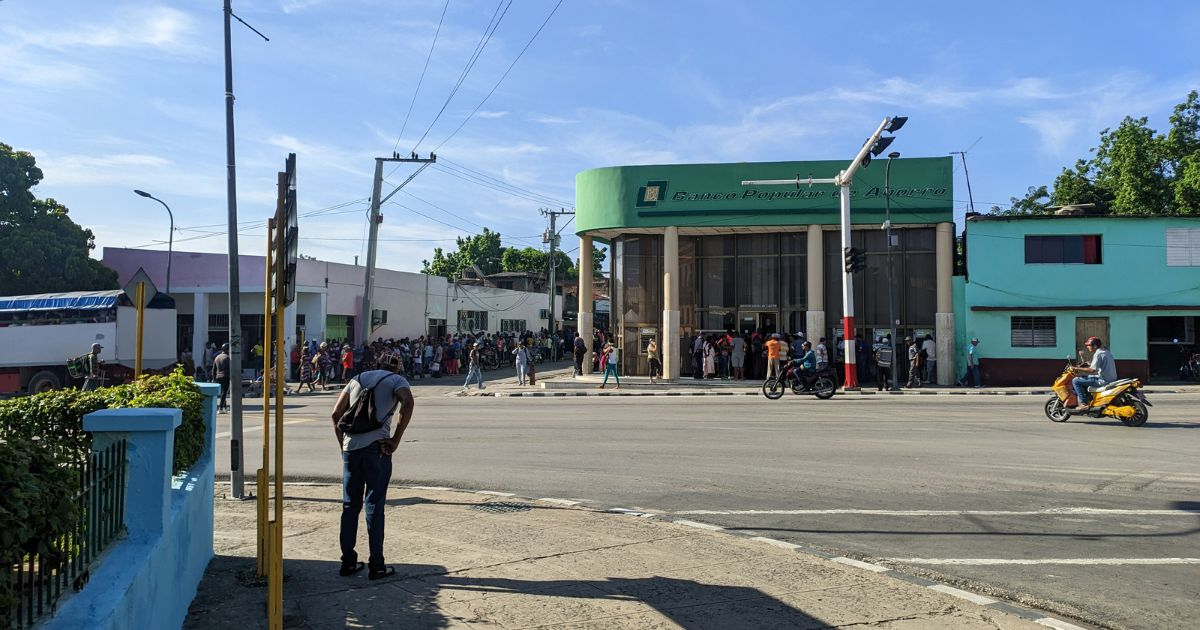
The Credit and Commerce Bank (Bandec) of Santiago de Cuba publicly acknowledged this Tuesday that Cuban retirees must wake up early to access their cash, describing the situation as "a challenge" and presenting the "extra cash" service as a solution in response to bank offices operating without electricity.
The text, signed by "Comunicadores Bandec Santiago", acknowledges that "getting up early in the morning to carry out any procedure at a service-providing entity poses a challenge given the socioeconomic conditions the country is facing."
Additionally, the publication describes the "extra box" scheme as "a solution that is currently yielding results mainly for those in most need; those who wake up early and require cash to pay for their essential products, and find the offices without power."
The mechanism shifts the responsibility of physically delivering pensions to private businesses and small and medium-sized enterprises (mipymes): the establishment receives a list with the name, identity card number, and exact amount for each retiree, provides the cash, and has up to 72 hours to submit the documentation to the bank, which automatically reimburses the money.
However, delegating the payment of pensions to private actors is an admission of the state's failure to fulfill a constitutional obligation.
The scheme was launched as a pilot in April in four municipalities of Havana and expanded in May to Holguín, where about 20 micro, small, and medium enterprises participated in the payment of pensions to around 5,000 retirees, equivalent to 9.6% of the municipal total.
Subsequently, the Central Bank announced the extension of the scheme to the entire country. Business participation in payments to retirees was also included in measure 70 of the 176 economic and social transformation package presented by the regime.
The bank's announcement comes days after dozens of elderly people lined up in long queues in Santiago de Cuba outside the Banco Popular de Ahorro in Plaza de Dolores to collect their pensions, which do not even meet basic needs.
The branch can only serve about 50 retirees per day with priority service, which forces people as old as 80 to start queuing from six in the evening the day before, spending the night on the sidewalks with waits of between four and eight hours.
In Santiago de Cuba, a black market was also documented where a commission of up to 40% is charged to convert electronic transfers into cash: one thousand pesos transferred amounts to just 600 pesos in bills.
Related videos:
Filed under: