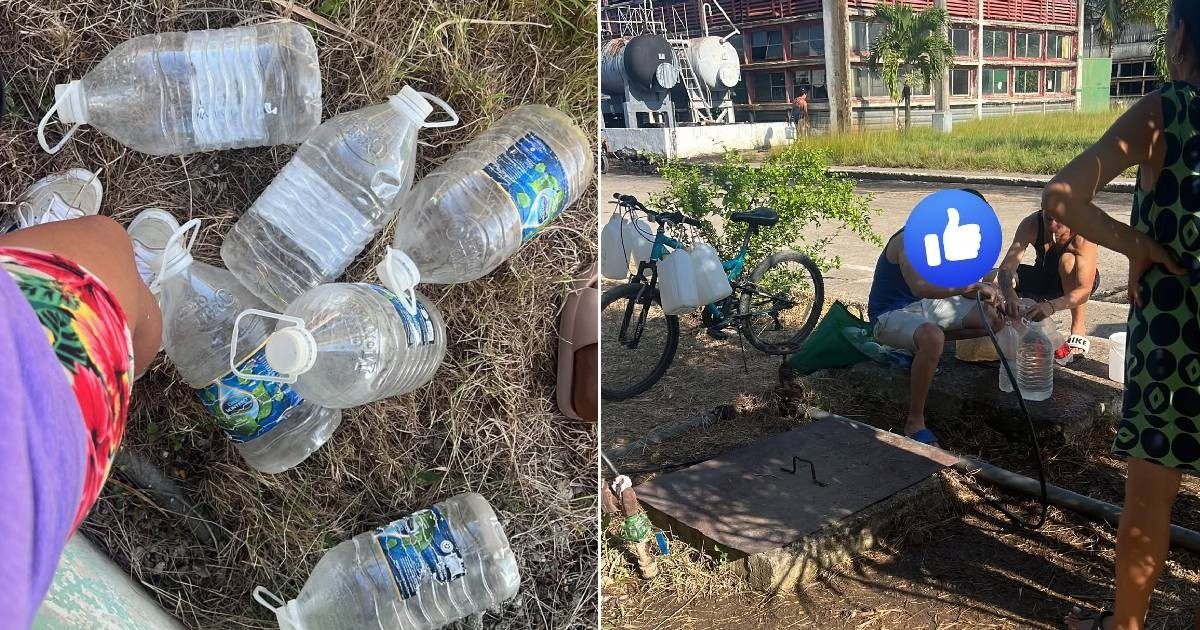
A neighbor from the Alberro neighborhood, in the Havana municipality of El Cotorro, posted this month on Facebook a complaint that encapsulates the exhaustion of thousands of Cubans: building 14 in her community has been without running water for weeks and has been experiencing constant power outages, while the authorities promise water trucks that never arrive.
Mayrobys Martínez described the situation in terms that leave no room for interpretation: “Can someone explain to me or at least tell me how much longer we are going to continue living like dogs?”.
In her post, the woman recounts that residents are forced to walk under the sun, carrying gallons and containers to fetch water for the most basic needs: cooking and bathing. Washing clothes has become an impossible luxury.
"Having to walk under the sun carrying gallons and bottles as if this were Africa... just for the basics like cooking and even bathing, because we can’t even wash our clothes, and with the story that they're going to bring water trucks, building 14 hasn’t seen water in a century; how long and how far are we going to keep enduring like sheep?" wrote Martínez.
In a second video also posted on Facebook, the neighbor rejected the official slogan with a straightforward statement: "The whole homeland or death thing can be taken somewhere else... what I want is to live." The clip, which lasts only seven seconds, features the song They Don't Care About Us by Michael Jackson in the background.
Alberro's complaint is not an isolated case. The distribution is explicitly identified among the areas of Cotorro that are left without water when the pumping stations Cotorro 1, 4, and 5 fail due to electrical instability. Since March 2024, prolonged problems had already been documented in the Buenos Aires community of that same area.
The root of the problem is structural: more than 500,000 Habaneros are suffering from a water crisis in July 2026, according to specialists from Aguas de La Habana, compared to the 200,000 affected reported in April and the 376,055 confirmed in May.
87% of the capital's water system relies on electricity for pumping, and the national generation deficit reaches 2,100 MW compared to a demand of 3,200 MW. On a national scale, around 2.7 million people face daily challenges accessing drinking water.
El Cotorro has been the site of citizen protests so far in 2026. On March 13, there was a pot-banging protest under the slogan "We can’t take it anymore," marking the seventh consecutive day of protests in the capital over the blackouts.
In June, residents of Dulce Nombre took to the streets again amid a blackout that left them without electricity all day.
For those who can afford it, the only real alternative is the informal market: a private water truck ranges between 18,000 and 26,000 Cuban pesos for a load of between 8,000 and 10,000 liters, an amount that is out of reach for most families.
Meanwhile, the regime is providing answers that the residents consider insufficient. Last Friday, Díaz-Canel presented as "progress" the creation of reservoirs and the use of water trucks during a visit to Marianao, while neighborhoods like Alberro remain without a real solution.
On July 2, the first battery bank in Cuba, with a capacity of 50 MW, was inaugurated at the Cotorro 220 substation, but power outages in the area have not stopped.
Related videos:
Filed under: