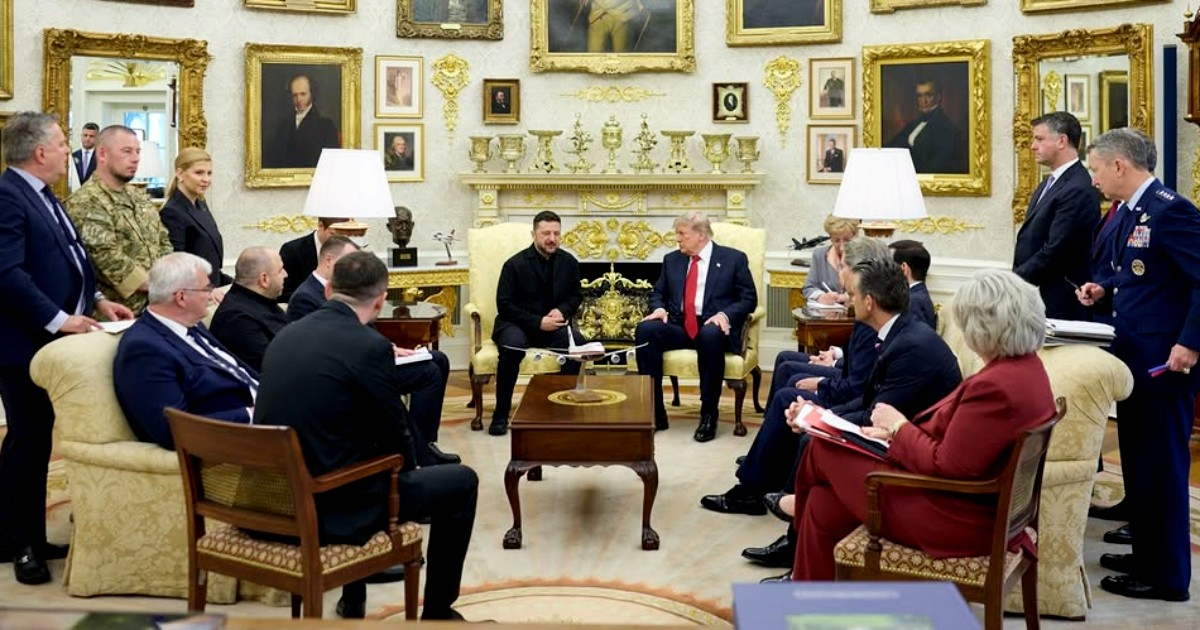
Donald Trump welcomed Ukrainian President Volodymyr Zelensky this Tuesday in the Oval Office of the White House for a closed-door meeting lasting about an hour.
At the end of the meeting, he posted on the official account of the White House on X: «It was a great honor to welcome President Zelensky of Ukraine. Many topics were discussed. The meeting went very well!»
The tone of the presidential message is striking due to the contrast it presents with months of open hostility, public dismissals, and a relationship that reached its lowest point in February 2025.
Zelensky, for his part, described the meeting as a "good meeting" and noted that licenses for the production of Patriot interceptors on Ukrainian territory were discussed, along with "several other ideas."
Both leaders agreed that their teams would continue to coordinate the proposals discussed, although the meeting did not result in any tangible security commitments or a signed peace agreement, according to the BBC.
Zelenski's visit to Washington was also prompted by his attendance at the funeral of Republican Senator Lindsey Graham, one of the staunchest supporters of aid to Ukraine in the Senate, who passed away on July 11, 2026, after returning from a trip to Kiev.
The contrast with the recent past is hard to ignore. On February 28, 2025, Trump, Vice President JD Vance, and Zelensky starred in one of the most spectacular diplomatic clashes of Trump's presidency: a public confrontation in the Oval Office that ended with the lunch and press conference canceled and the Ukrainian leader leaving the White House early.
At that meeting, convened to sign an agreement on Ukrainian minerals that went unsigned, Trump warned Zelensky that he was "playing with World War III," while Vance criticized him for debating in front of the U.S. press.
Days before that clash, on February 19, 2025, Trump had referred to Zelenski as a "dictator without elections" on his social media platform Truth Social, ignoring that the martial law imposed after the Russian invasion in 2022 constitutionally prevents elections from being held in Ukraine. Zelenski responded that Trump lived in a "bubble of misinformation".
After the clash, Trump temporarily suspended military aid to Ukraine as a measure to pressure for negotiations with Russia, although he resumed it weeks later.
Throughout 2025, the relationship evolved in a zigzag manner: a meeting at the Vatican in April described as "very productive," the announcement of the deployment of Patriot missiles in July contingent on European payments, and accusations of "zero gratitude" from Trump in November.
In May 2026, a ceasefire was announced between Russia and Ukraine, facilitated by the Trump administration. This marked the beginning of a new diplomatic phase, with Tuesday's meeting signifying the highest level of cordiality between both leaders since Trump's return to power in January 2025.
Peace negotiations with Russia remain on the table despite the reluctance of Vladimir Putin, and Ukraine is seeking to secure local production of defensive weaponry as a long-term security guarantee, a goal that now seems to have, at least in tone, the support of Washington.
Related videos:
Filed under: