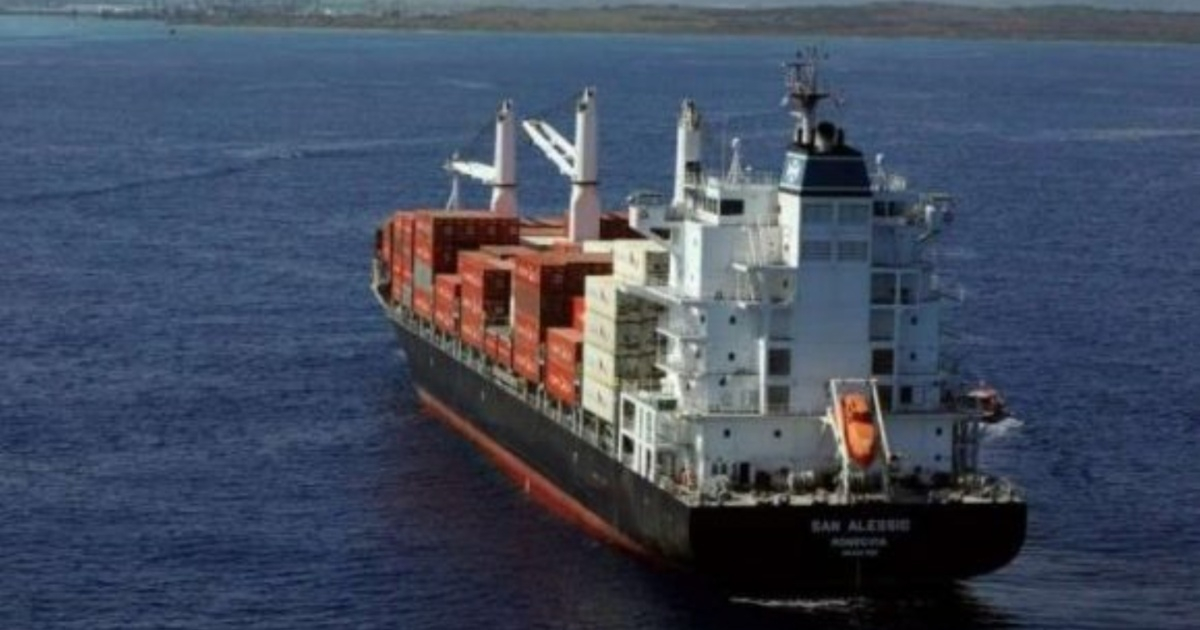
The Cuban regime denounced this Wednesday that over 7,000 containers with goods destined for the island remain held in various Caribbean ports as a result of U.S. sanctions, according to the Deputy Prime Minister and Minister of Foreign Trade, Óscar Pérez-Oliva Fraga, during the National Assembly of People's Power.
According to the official media Cubadebate, Pérez-Oliva Fraga detailed before the deputies that the blocked containers are carrying food, resources for the energy matrix transformation program, supplies for potable water, and vital medicines, all acquired, he stated, in accordance with international trade regulations.
The official noted that "every day more than three million Cubans wake up facing difficulties in accessing this vital resource," referring to drinking water, the scarcity of which is worsened by the halt in the supply of retained goods.
In his remarks, Pérez-Oliva Fraga directly held accountable those who obstruct the arrival of this cargo for the potential humanitarian consequences: "I wanted to take this opportunity to hold responsible those who try to prevent the arrival of this merchandise, those who remain indifferent allowing this genocide to be committed, and those who bend to the interests of the United States in this endeavor, accountable for the loss of innocent lives."
The massive retention of containers is the result of an escalation of sanctions that intensified following Executive Order 14404, signed by President Donald Trump on May 1, 2026, which expanded secondary sanctions against entities linked to the Cuban government in the energy, finance, defense, and security sectors.
As a direct consequence, the shipping companies Hapag-Lloyd and CMA CGM suspended their operations with Cuba between May 14 and 18, 2026, citing regulatory risks associated with GAESA, the military conglomerate that controls a significant portion of the formal Cuban economy.
Specific cases of retention have accumulated in recent months.
MediCuba reported on July 23 that 10 containers of medications and essential supplies have been stalled at ports in Jamaica and Colombia, including five containing nephrology materials, three with blood bags, and two with sodium valproate, an anticonvulsant used in the treatment of epilepsy, which has been held in Cartagena de Indias by Hapag-Lloyd.
A Cuban hospital also reported the detention of over 3.5 million syringes and needles intended for Santiago de Cuba, currently held up in Kingston, Jamaica.
Sanctions have been imposed in successive waves: on July 13, GEMAR, a state-owned company that took control of the Port of Mariel, was sanctioned; on July 23, Marco Rubio announced new measures against nine entities and two officials, including the Minister of Public Health, José Ángel Portal Miranda; and on July 24, Washington directly sanctioned the Mariel Container Terminal and Coral Marítima S.A. for attempting to evade the restrictions.
The humanitarian context is critical and independent of the official version: the UN launched an assistance plan for two million people in Cuba and requested 94 million dollars to cover basic needs, while the water supply system operated with only 37% of the necessary fuel and nearly one million Cubans rely on tanker trucks to obtain drinking water.
Related videos:
Filed under: