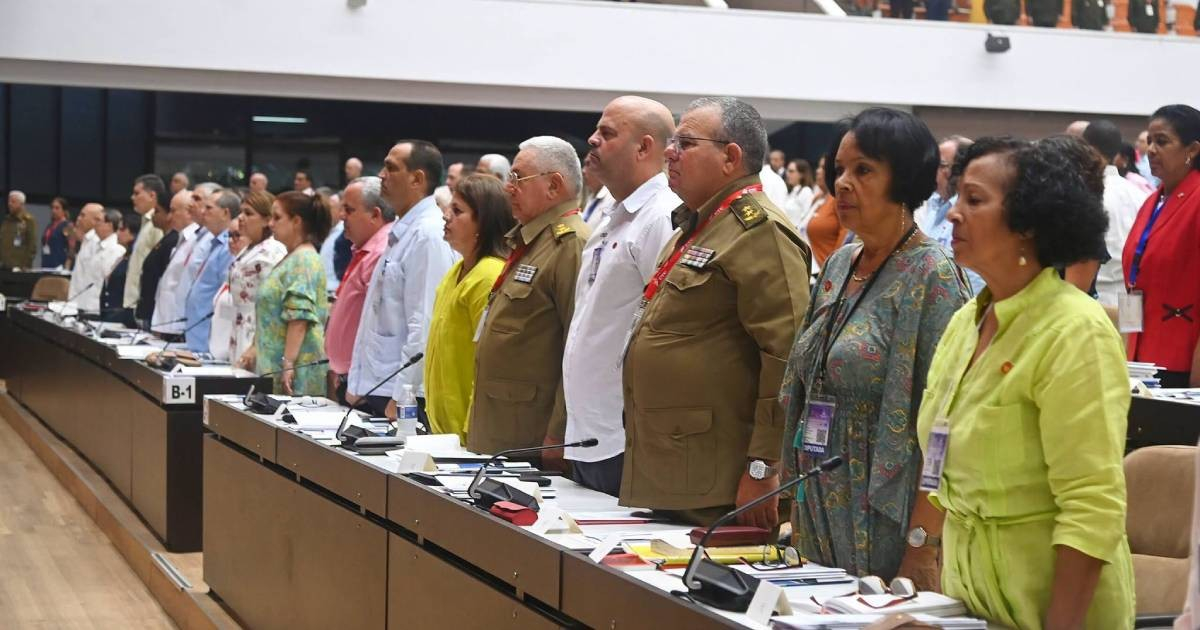
The National Assembly of the Popular Power approved a declaration this Wednesday stating that any military intervention by the United States against Cuba will meet with "unyielding and determined resistance" and emphasizes that the country is ready to defend its sovereignty "to the last consequences."
The declaration, issued during the Seventh Ordinary Period of Sessions of the X Legislature, held at the Palace of Conventions in Havana, intensifies the tone of the official discourse amid the rising tension between Havana and Washington following the tightening of U.S. sanctions.
In the document dated July 29, 2026, the Parliament asserts that any potential U.S. military action would not succeed in subjugating the country.
"It will stumble upon the ironclad and unwavering resistance of the Cuban people, who will not yield an inch of their territory nor the slightest of their sovereign prerogatives. It will provoke death and destruction, leading to a bloodbath, but it will not achieve the goal of subordinating Cuba to the neocolonial dictates of the United States," the statement emphasizes.
The text was presented in a session led by Raúl Castro, Miguel Díaz-Canel, and the president of the National Assembly, Esteban Lazo Hernández.
The message from the Parliament was accompanied by a speech by Foreign Minister Bruno Rodríguez Parrilla, who reiterated that the regime would respond militarily if it believes the country is under attack.
"We have the right and the duty to reject and confront the aggression that punishes and threatens us, and we have the right and the supreme duty to defend ourselves, even with arms, if we are militarily attacked," stated the Minister of Foreign Affairs, as reported by the official media Cubadebate.
Despite the tone of the warning, Rodríguez assured that Havana is not seeking a direct confrontation with Washington.
"Cuba is not a threat to the United States, nor does it wish to be its adversary or enemy," he stated, while reiterating the regime's willingness to engage in a dialogue based on mutual respect.
Havana blames Trump for the escalation
The parliamentary statement attributes the rise in tensions to two decisions made by President Donald Trump's administration.
The first pertains to the executive order of January 29, 2026, through which Washington declared a national emergency concerning Cuba and imposed new restrictions on countries supplying oil to the island. The second is the Executive Order 14404, signed on May 1, which expanded sanctions against strategic sectors of the Cuban economy, including energy, defense, and finance, in addition to incorporating measures aimed at third countries that maintain trade ties with the regime.
The document also rejects the accusation presented in May by the U.S. Department of Justice against Raúl Castro regarding the downing of the Brothers to the Rescue planes in 1996, an action that Havana described as a "political provocation."
The regime links the sanctions to the internal crisis
In its statement, the Parliament asserts that the tightening of sanctions has exacerbated the country's economic and energy situation.
Among the mentioned consequences are the prolonged blackouts recorded in various provinces, the more than 100,000 pending surgeries, as well as the shortage of essential medications—figures that Miguel Díaz-Canel himself referenced during his speech on July 26.
However, economists and independent analysts believe that the current crisis is also due to structural problems that have accumulated over decades, such as low productivity, lack of investment, and the centralized planning model, in addition to the impact of U.S. sanctions.
Call to the international community
The National Assembly also supported Díaz-Canel's statements, who on July 26 described Washington's policy as a "coldly calculated genocide", and called on parliaments around the world to reject any potential military intervention against Cuba.
The document also highlights that on July 7, the United Nations General Assembly approved, with the support of 136 countries, the holding of a debate on the consequences of the embargo and the situation in Cuba, an initiative promoted by the Cuban government.
For his part, Bruno Rodríguez insisted that, in the regime's view, U.S. policy aims to increase pressure on the Cuban population.
"The real goal and the true inclination of the United States government are not manifested through dialogue or diplomacy, nor through the offer of aid, but rather through coercion and the effort to inflict the harshest punishment possible on the Cuban people to achieve their surrender," he stated.
Related videos:
Filed under: