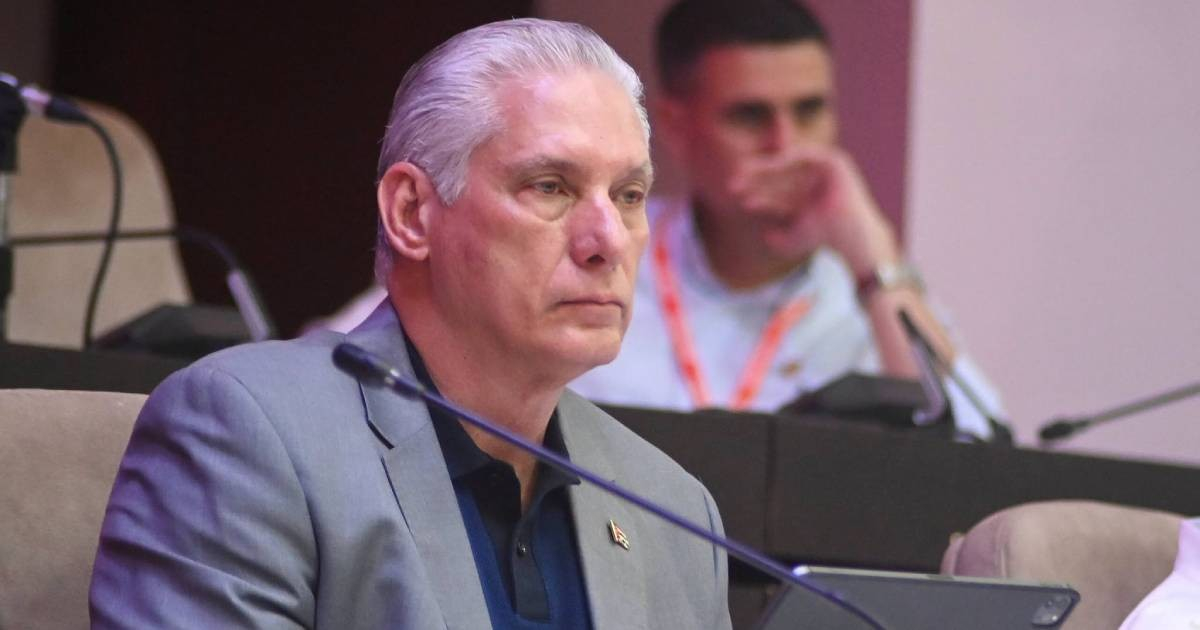
Miguel Díaz-Canel concluded the VII Ordinary Period of Sessions of the National Assembly of People's Power on Thursday with a speech featuring a distinctly ideological tone, in which he lashed out at the United States, defended the socialist model, and asserted that the economic reforms promoted by his government do not signify an opening to capitalism.
During his speech, reported by the official medium Cubadebate, the leader insisted that Cuba will continue on its own path despite pressures from Washington. "We are not a nation in dispute nor a colony. We are a sovereign people who have chosen our destiny," he stated, presenting this message as the central theme of his address.
A large part of his speech was dedicated to criticizing the U.S. administration's policy towards the island. Díaz-Canel described the U.S. government as a "neofascist regime" and even compared it to 20th-century European fascism.
"The neofascist regime currently in place in the United States is reminiscent of attempts to revive some of the horrors unleashed by German fascism in the first half of the 20th century in its quest for expansion," he stated, attributing practices such as xenophobia, cult of personality, and expansionist ambitions to Washington.
He launches an attack against Washington's sanctions
The ruler also denounced the tightening of U.S. sanctions and mentioned two executive orders that, he stated, have worsened Cuba's economic situation.
The first, signed on January 29, 2026, includes measures against countries that supply fuel to the island, a provision that —it was noted— was criticized by United Nations experts, who labeled it a "fuel blockade."
The second one, issued on May 1, 2026, expands the secondary sanctions to companies and individuals from any country that engage in commercial relations with Cuba.
"The executive order of May 1, 2026 threatens individuals and foreign businesses, regardless of their country of origin, with secondary sanctions on their personal accounts, visas to the United States, and other consequences if they maintain any type of commercial relationship with Cuba," he stated.
Díaz-Canel also rejected the report from the Department of State published on July 20, which describes Cuba as the “capital of 21st century communism”. He labeled it a “propaganda pamphlet” and stated that it aims to “turn history upside down.”
The economic reforms, "to defend socialism"
In internal matters, the leader defended the 176 economic measures approved by the National Assembly in June of this year. He reported that 120 are already ready for implementation and explained that five legal norms approved during this session support more than twenty of those transformations.
However, he insisted that the package of reforms does not imply a change in the economic model.
"The transformations we are implementing today are not for more capitalism, but to defend and advance in the construction of socialism. A socialism that places the human being at the center of its work," he assured.
Tribute to Ramiro Valdés and exaltation of Fidel Castro
The speech began with a tribute to the commander of the Revolution Ramiro Valdés Menéndez, who passed away on June 21 at the age of 94. Díaz-Canel described him as one of the main representatives of the so-called "generation of the centenary" and placed him alongside Fidel Castro, Raúl Castro, and Ernesto Che Guevara among the historical figures of the Revolution.
In the final part of his speech, he evoked the upcoming centenary of Fidel Castro's birth, which will be commemorated on August 13, and once again praised his legacy.
"Fidel is no longer just ours; he grows larger and multiplies. Fidel lives and promises to continue fighting battles for a better world," he concluded.
The speech took place in the context of a severe economic and energy crisis in Cuba, characterized by prolonged power outages, food shortages, inflation, and a worsening of living conditions for the population.
Related videos:
Filed under: