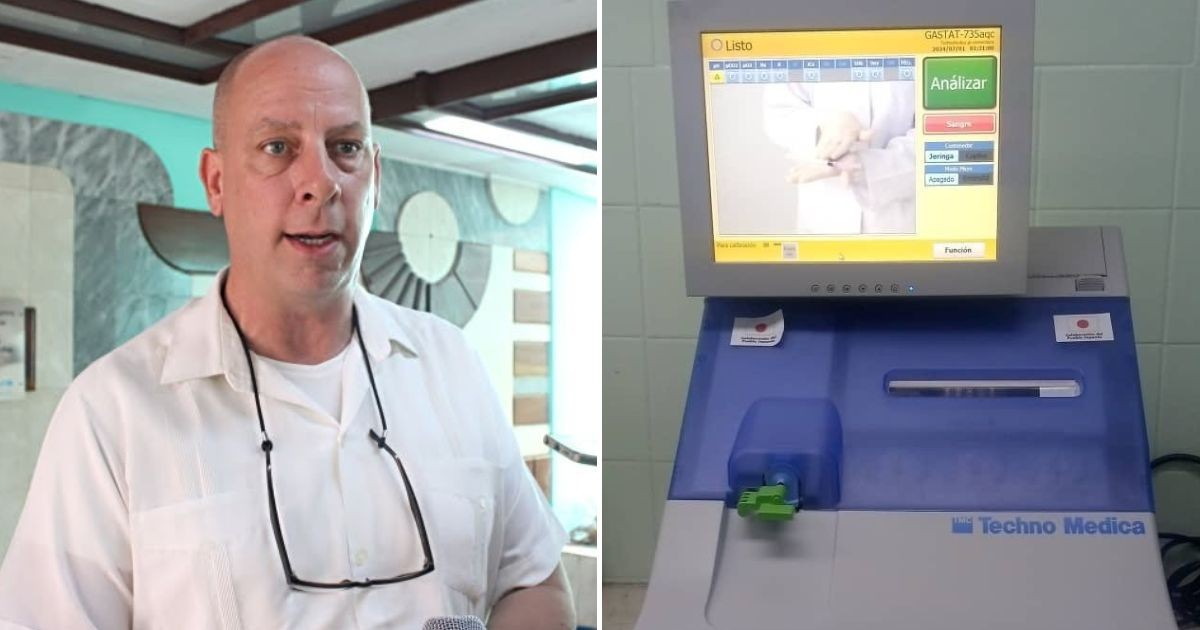
The consumable materials that will allow two gasometers, used daily in hospitals in Santiago de Cuba, to remain operational for a year have already arrived in Havana and are awaiting transportation to their final destination.
The supplies will enable the performance of approximately 13,700 vital analyses on newborns, intensive care patients, and individuals with severe illnesses.
The announcement was made this Thursday by Mark Kuster, founder and director of the Swiss NGO Camaquito.
"Today is a special day for me. The materials have already arrived in Havana. Now I hope they can also reach Santiago de Cuba very soon," he wrote on Facebook.
Kuster explained that the devices are in working condition but require consumables in order to be used.
"Without these supplies, the equipment stops functioning, even if they are in perfect condition," he noted.
"Thanks to the support of Camaquito, we have managed to finance the necessary materials for a full year. This will allow for approximately 13,700 vital analyses, especially for newborns, ICU patients, and individuals with severe illnesses," he detailed.
The director of the NGO summarized the human impact of the project with a straightforward statement: “We are not just talking about disposable material. We are talking about 13,700 opportunities to save a life.”
Kuster also expressed gratitude to the individuals and institutions that made the initiative possible, as well as to the Santiago health authorities for their collaboration.
"I want to express my heartfelt gratitude to all the individuals and institutions that made this project possible, as well as to the health authorities of Santiago de Cuba for their collaboration," he concluded.
Gasometers are blood gas analyzers that allow for the rapid measurement of parameters such as pH, carbon dioxide, oxygen, and electrolytes. Their results are essential for assessing the condition of patients in neonatology, intensive care, and respiratory emergencies.
The gasometers are located at the Dr. Juan Bruno Zayas Alfonso General Hospital and the Dr. Juan de la Cruz Martínez Maceira North Children's Hospital, both in Santiago de Cuba. Although the equipment is operational, it relies on specific consumable materials to carry out the analyses.
In May of last year, Camaquito secured international funding of approximately 17,000 dollars to ensure the supply of these essential materials for a year, after also obtaining authorization from the Santiago health authorities to carry out the project.
The arrival of the materials in Havana now represents a new advancement for that initiative and will prevent both teams from becoming idle due to a lack of supplies.
The project continues a cooperation initiated in March 2023, when Camaquito signed an agreement with the Japanese Embassy in Cuba for 75,068 euros to acquire two diagnostic machines and two incubators intended for the same hospitals in Santiago.
Camaquito is an independent international organization, with no political, religious, or profit-driven motives, founded by Kuster in 2001. In 25 years of work, it has raised over four million euros for health, education, culture, and social inclusion projects in Camagüey and Santiago de Cuba.
In April 2026, Kuster also secured a funding of 50,000 dollars to repair homes affected by Hurricane Melissa in Santiago de Cuba.
That same month, an announced an additional investment of $100,000 in civil infrastructure over the next five years.
Related videos:
Filed under: