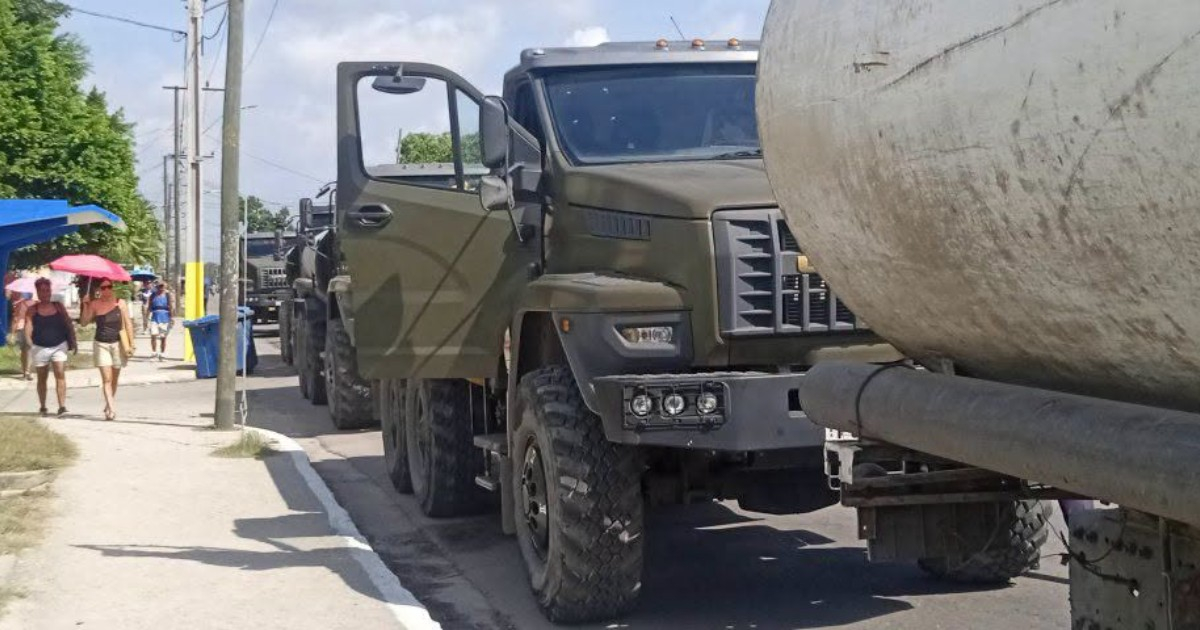
In response to the severe water supply crisis in the Havana municipality of El Cotorro, authorities deployed tank trucks from the Revolutionary Armed Forces (FAR) to distribute water among the population, as reported by the Municipal Assembly of the People's Power on Facebook.
For more than a week now, the trucks from the FAR have been traveling through the streets of the municipality. The operation started in the Alberro neighborhood and, at the time of the report, had already reached seven districts.
The authorities themselves admitted that the measure is "not the definitive solution", but merely "a breather" in the face of the shortage.
The technical situation facing Aguas de La Habana in El Cotorro is critical: motor five has been sent for rewinding and is awaiting reinstallation, while motor two in San Francisco broke down on Sunday. Both failures exacerbate the fragility of the supply system.
As additional measures, the authorities announced that they will bring six manual pumps to the municipality, although they have not yet determined where they will be installed.
They also plan to use the cisterns of primary and secondary schools as reservoirs during the school holidays. The distribution will be carried out in a controlled manner and at times that the defense area will need to communicate to the neighbors.
The desperation among the residents is palpable. Mayrobys Martínez, a neighbor from building 14 in the Alberro neighborhood, had already reported that she had been without running water for weeks and that the promised water trucks were not arriving in her community.
"Having to walk in the sun carrying jugs and bottles as if this were Africa... just to take care of the basics like cooking, or even washing up, because there’s no way to do laundry," Martínez wrote on Facebook.
In another post, Martínez bluntly summed up his exhaustion: "The whole homeland or death thing can be pushed onto someone else... what I want is to live."
Days earlier, the ruler Miguel Díaz-Canel visited Marianao and presented the use of water trucks and the creation of reservoirs as "advances", emergency measures that are now being implemented in El Cotorro without a structural solution in sight.
El Cotorro is not an isolated case. In July, more than 500,000 residents of Havana were experiencing issues with water supply, compared to the 200,000 estimated affected in April and the 376,055 confirmed in May by the president of the National Institute of Hydraulic Resources, Antonio Rodríguez Rodríguez.
At the national level, approximately 2.7 million people face daily challenges in accessing drinking water.
The water crisis is closely linked to the deterioration of the electrical system: 87% of pumping facilities rely on electricity, and only 135 out of the 480 essential stations in the country have protected circuits against blackouts. When the cuts paralyze the pumps, water ceases to reach homes.
El Cotorro has also been a site of repeated protests in 2026. On March 12, a cacerolazo under the slogan "We can’t take it anymore" was reported, and on June 10, residents of Dulce Nombre returned to the streets shouting "Down with the dictatorship".
Related videos:
Filed under: