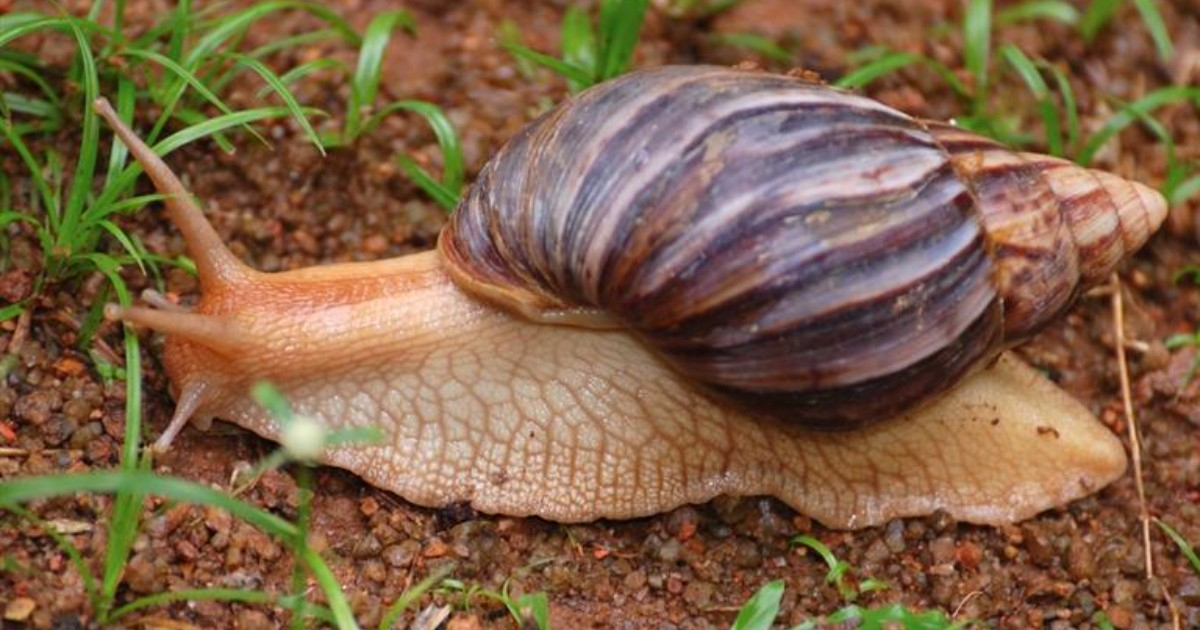
The giant African snail has not disappeared from Cuba; it simply stopped making headlines. A report from the newspaper Girón reveals that the invasive species continues to reproduce uncontrollably in several municipalities of the province of Matanzas, where residents are dealing with the infestation on their own due to the lack of institutional response.
The accumulated crisis of recent years — power outages, scarcity of water and food, economic collapse — displaced the topic from the public agenda, but the issue never stopped advancing.
In the Santa Marta popular council, part of the municipality of Cárdenas, residents live daily with the mollusk as if it were part of the landscape.
Graciela Isaac, a resident of La Emilia, describes the situation bluntly: «They are in my yard and reach up to the front door of the house. From time to time, I gather them up and throw them into a container designated for that; I should put salt on them, but that is impossible, so I manage to use lime. They are eating my plants.»
Isaac also warns about the loss of caution among his neighbors: "They are killed with sticks, they are touched by hand, they are left thrown in the yard. People now see them as normal and have lost their fear of them."
What worries this neighbor the most is the institutional abandonment: "There is no response from the authorities, no one comes here to provide guidance or to say what should be done with them. Before, there was much discussion about this, and Health would stay informed; now it is different."
Ladislao Reyes, from the end of 12th Street in Santa Marta, agrees: "It's like another animal, but the care doesn't matter if others don't know what to do. The number is already concerning, and the population isn't decreasing."
The situation prompted the commencement, last May, of a scientific investigation led by Doctor Enrique Ramón Soto Ramírez, a full professor at the University of Matanzas and a specialist at the provincial CITMA, along with biologist Esteban Pérez Peña.
The study began after a Facebook post by a Journalism student who showed images of the mollusk near the old Bus Terminal in the city.
Soto Ramírez confirmed hotspots in several areas of Matanzas —the neighborhoods Camilo Cienfuegos and Armando Mestre (Naranjal), and the area of the old Terminal— as well as in other municipalities in the province: Cárdenas, Colón, Jovellanos, Santa Marta, and the central Humberto Álvarez.
The CITMA had already issued a warning in June about the presence of the species in Matanzas city, expressing concern about a possible spread towards Varadero.
The health risk is serious. According to Soto Ramírez, «it transmits very dangerous diseases to humans, such as various types of meningitis, diseases that can affect the nervous system, and conditions that particularly disrupt those with immune system impairments».
The specialist recommends using gloves and a face mask when handling it, avoiding contact with the eyes and nose, and washing hands after any contact.
To eliminate it, it is advised to submerge it in water —it suffocates because it breathes through lungs— and then bury it. It also warns that consuming it, even if cooked, "is not advisable."
The plague was first detected in Cuba in 2014, and by October 2020, it was already affecting 14 of the 16 provinces, with over 1,000 active hotspots in 59 municipalities.
In 2025, new alerts were recorded in Jaruco and Camagüey, and in April 2026, the plague reached Manzanillo, Granma.
The giant African land snail (Lissachatina fulica) is native to East Africa, hermaphroditic, and capable of reproducing without mating. It can lay up to six clutches annually of about 500 eggs each, with a hatching rate exceeding 90%. In its adult state, its shell can reach 30 centimeters.
Related videos:
Filed under: