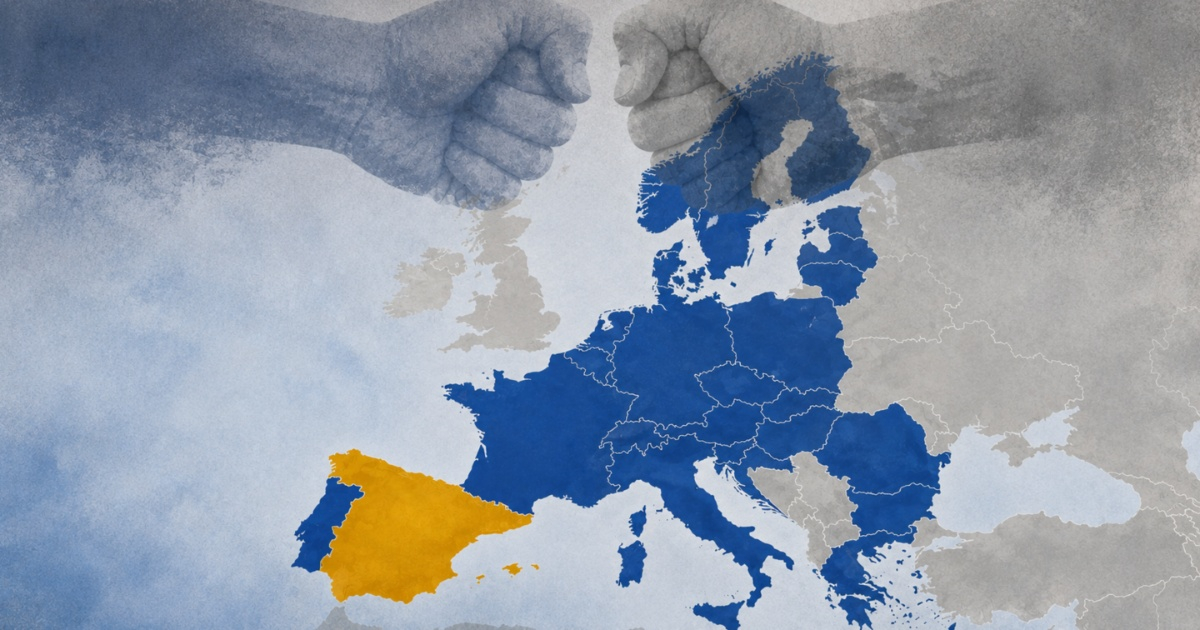
Italy announced on Friday the reintroduction of controls at ports and airports for travelers coming from Spain, in a measure that the Government of Rome presents as a temporary suspension of the Schengen free movement agreement, triggered by the migration crisis in Ceuta following the massive influx of tens of thousands of people from Morocco.
According to the information from the EFE agency, the decision was made by the Italian Minister of the Interior, Matteo Piantedosi, following a meeting of the Committee for the Analysis of Immigration and Border Security.
For the moment, it has not been specified how long the checks will last or what exactly they will mean for travelers, although it is most likely that the police will conduct random document checks to prevent long lines at the entrances.
Antonio Tajani, Vice President of the Italian Government and Minister of Foreign Affairs, supported the measure on his social media.
"The temporary suspension of the Schengen area with Spain is a necessary decision to safeguard the security of our citizens and defend European borders. It is a measure outlined in the treaties and has now become inevitable," he wrote.
However, legal experts and high-ranking European figures immediately warned that the Italian rhetoric goes beyond what EU law allows. Josep Borrell, former EU High Representative for Foreign Affairs, was blunt on X: "Under EU law, no member state can unilaterally suspend another's participation in Schengen."
The law professor Marie-Laure Basilien-Gainche, from the University of Lyon 3, explained it clearly to AFP: "Within the framework of Schengen, there is no provision for this type of action. A state cannot unilaterally expel another from the space."
What European regulations do allow for is the temporary reintroduction of border controls in response to a serious threat to internal security or in the case of sudden and large-scale unauthorized movements of nationals from third countries, which is precisely what Italy has activated. However, its official statement referred to a "closure of borders," a phrasing that Jordi Barcia, the correspondent for Radio Nacional de España in Rome, described as imprecise: "Italy cannot close its borders with another country within Schengen."
Finland and Denmark also joined the debate. The Finnish Minister of the Interior, Mari Rantanen, and the Danish Prime Minister, Mette Frederiksen, raised the possibility of excluding Spain from the Schengen area, although they also lack the legal authority to do so, according to an analysis by Cadena SER.
Parallely, Italy and France agreed to strengthen controls along their shared land border. The French Minister of the Interior, Laurent Nuñez, announced the deployment of additional resources at the border with Spain, with plans to triple personnel and reach 334 agents, in addition to drone surveillance.
The crisis erupted on Wednesday following the massive arrival of people from Morocco to Ceuta. Police estimates indicate over 20,000 entries in just one day; Moroccan media raised the figure to more than 30,000.
The legal trigger was a ruling by the Spanish Supreme Court on June 29 that prohibited immediate returns for those who enter by swimming.
At the close of this Friday, the Spanish Ministry of the Interior reported that around 48,300 of the estimated 50,000 people had already returned to Morocco, while RTVE reported at least 19 dead during the incident.
The President of the European Commission, Ursula von der Leyen, described the images from Ceuta as "unacceptable" and offered support to Spain through Frontex, while the German Chancellor Friedrich Merz expressed support for Spain's intention to prevent irregular entry into European territory.
Currently, there are enhanced controls at the internal borders of Austria, France, Germany, Italy, the Netherlands, Poland, Sweden, Denmark, and Norway for immigration or security reasons, with none of these countries having exited the Schengen Area or excluded their neighbors.
Related videos:
Filed under: