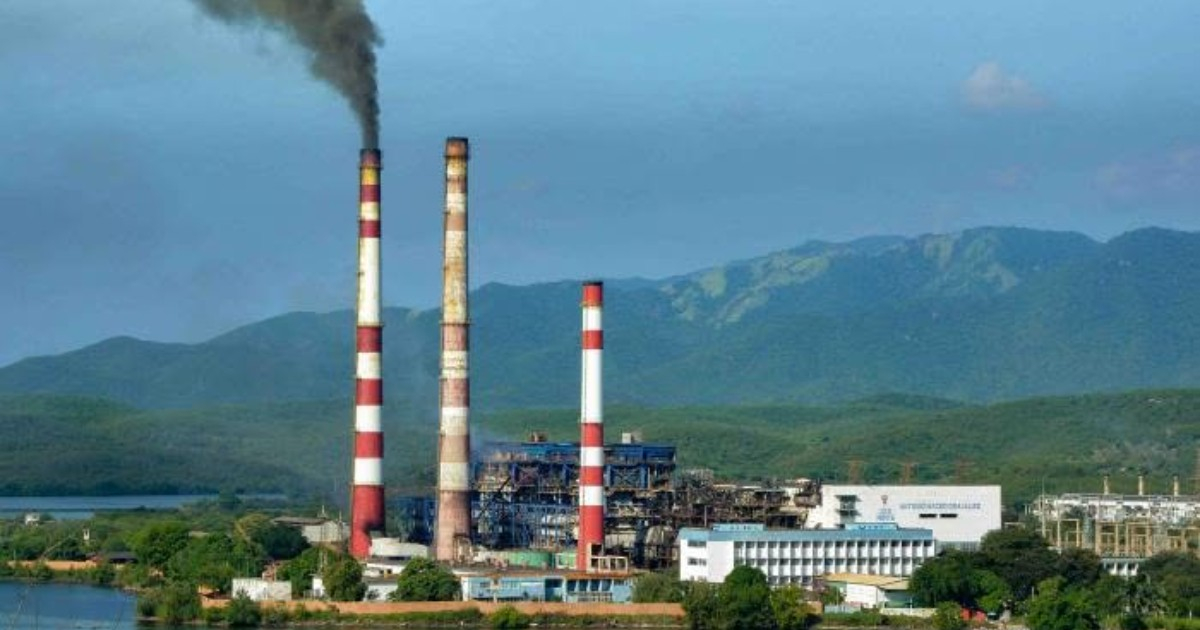
The Electric Union (UNE) announced this Saturday that Unit 3 of the Antonio Maceo Thermal Power Plant (CTE) has come online, according to an official post on Facebook by the state entity.
The news came hours after the National Electroenergetic System (SEN) collapsed in the western region of the country.
At 18:07, a simultaneous shot on the 220 kV lines connecting Matanzas to Cienfuegos and Matanzas to Santa Clara split the SEN and left Pinar del Río, Artemisa, Mayabeque, Havana, and Matanzas without electricity.
The collapse occurred in a system that had already been experiencing critical conditions since early morning: at 6:00 a.m., the availability was only 895 MW against a demand of 2,825 MW, with 1,930 MW affected before the collapse.
The UNE reported that, during the restoration efforts, hospitals and essential facilities were already receiving electrical service.
"In this moment, restoration efforts are continuing according to the established procedure. Hospitals and vital centers are operational. Generation units in the western area are being prepared for their gradual integration into the SEN," the agency stated in its publication.
The Matanzas Electric Company reported the restoration of the Faustino Pérez Hospital and the Bello water pumping circuit as initial steps in the recovery, with the strategy of starting up the units at the Guanábana 110 kV substation and linking them to other points in the system.
The synchronization of Unit 3 of the Antonio Maceo CTE—known as Renté, located in Santiago de Cuba and operational since 1966—is significant due to its history of instability.
The SEN report for August 1 recorded it as malfunctioning that same morning, with an expected input of only 45 MW.
The plant has accumulated a series of recent failures: outage due to malfunction in September 2025, resynchronization in November 2025, new failure in March 2026 and intermittent status during July 2026.
The collapse this Saturday is part of a series of total disconnections that has marked 2026: the general blackout on March 16 lasted 29 hours and 29 minutes; the one on July 6 lasted almost 24 hours; and the system experienced two more failures that same month, on July 11 and July 14.
The structural causes are the same as always: aging thermoelectric plants without proper maintenance, chronic fuel shortages, and decades of underinvestment in the electrical grid, a direct result of the management of the Cuban regime.
For the peak hours this Saturday, the UNE anticipated a capacity of 1,080 MW against a demand of 3,200 MW, with an estimated deficit of 2,120 MW and a projected impact of 2,150 MW.
Related videos:
Filed under: