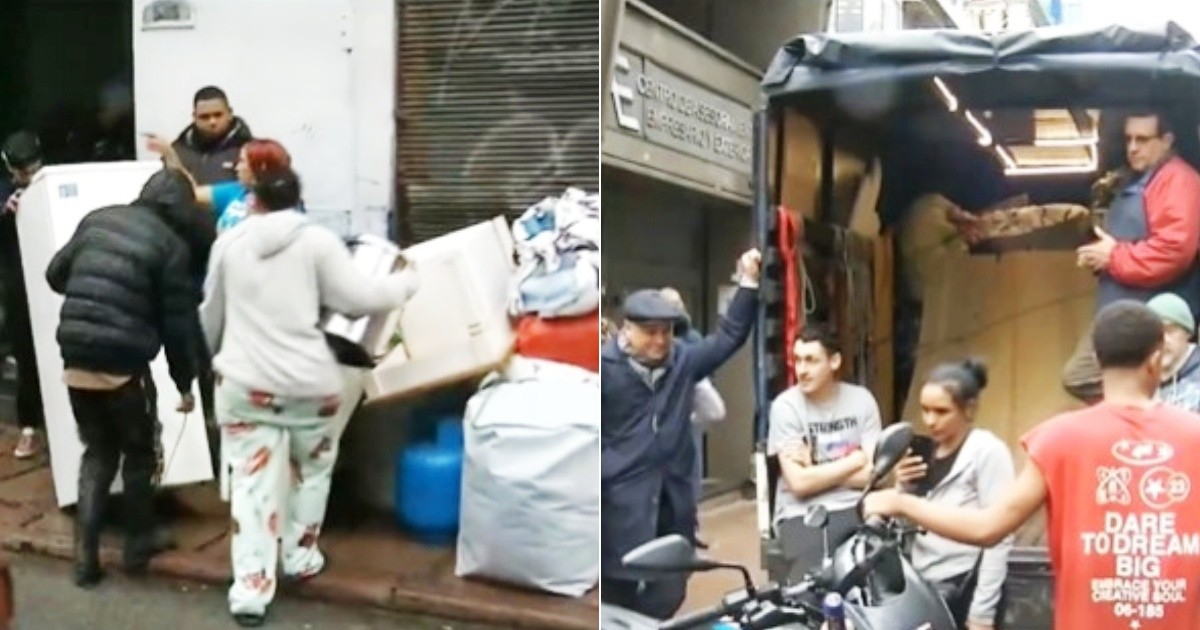
More than 15 families, including several Cuban, Dominican, and Uruguayan migrants, have been left homeless after the eviction of a five-story building in the Ciudad Vieja neighborhood of Montevideo, Uruguay.
The property is located at the corner of 25 de Mayo and Ituzaingó, and the eviction was carried out by the police in compliance with a court order requested by the property owner.
What happened?
According to a report from the Uruguayan outlet Subrayado, the legal process that led to the eviction began six years ago when the owner claimed the property in court.
The police operation began on the morning of this Tuesday and extended past noon, with families waiting on the sidewalk - covered with mattresses, washing machines, furniture, and even refrigerators - for a response from the Ministry of Social Development (MIDES).
Police sources indicated to the mentioned media that the building had been raided several times, as a drug dealing operation was running on its ground floor.
How many Cuban families are affected?
This is one of the questions that still does not have a precise answer. According to local residents, at least 15 families lived in the property, but the authorities have not specified how many are of Cuban origin.
The available information only confirms that among those displaced are Uruguayan, Dominican, and Cuban citizens, without specifying numbers by nationality.
Many immigrants present refused to speak in front of the cameras to avoid exposing their situation to their families in their countries of origin.
The testimonies: Anguish and claims
Anthony, a Uruguayan citizen who had been living in the building for more than nine years with about twenty members of his family—among them nearly 11 children—reported that the agreed-upon deadline was ignored.
“They only gave us 30 minutes to evacuate. The extension was supposed to be three months, but they ended up shortening everything,” he stated.
The man demanded a response from the State: "We are going to stay here until we find a way for someone to notify us or for the government to have a change of heart and lend us a hand because it's for the children."
“We are neither marginalized families nor are we blaming the police for doing their job, but I think they should provide something more for families with children,” she pointed out, and clarified that she was not seeking a confrontation with the authorities.
Bella, a Dominican woman who has lived in the building for four months and has two undocumented children, reported that the MIDES took her information without providing her with an immediate solution.
"They took my data, my documents, my children's names, my phone number, and they told me that in two days, if they haven't called me, I should go see what can be done."
In the meantime, an acquaintance would host her temporarily for two days.
"Something must be done about us; it's not fair," he summarized.
The response from MIDES
The national director of Social Protection, Daniel Gerhard, was present at the site but preferred not to make any statements to the press.
The organization conducted a case-by-case assessment to determine which families would require state assistance, taking into account specific situations such as the presence of children or pregnant women to define the type of temporary shelter.
Some families managed to contact acquaintances and left with their belongings in freight trucks; others remained on the street without an immediate destination.
A context of increasing vulnerability
The episode occurs at a time of significant Cuban presence in Uruguay.
In 2025, over 22,000 Cubans entered the country - a historic record - and 13,852 obtained their Uruguayan ID for the first time, the highest number among all foreign nationalities.
Many of these migrants face serious housing difficulties, with rents ranging from 9,000 to 18,000 Uruguayan pesos per month and barriers to accessing the formal housing market.
The eviction from Ciudad Vieja adds to a series of incidents that have affected the Cuban community in Montevideo in recent days: on Monday, a 28-year-old Cuban was stabbed to death by a Venezuelan citizen in a boarding house in the Paso de la Arena neighborhood, and in April, delivery worker José Eduardo Cuéllar Arteaga, 31, lost his life during a robbery attempt in Carrasco Norte.
On Tuesday, MIDES continued to assess the situation of each family to determine the assistance response, without any clarification yet on the total number of people who would require emergency housing.
Related videos:
Filed under: