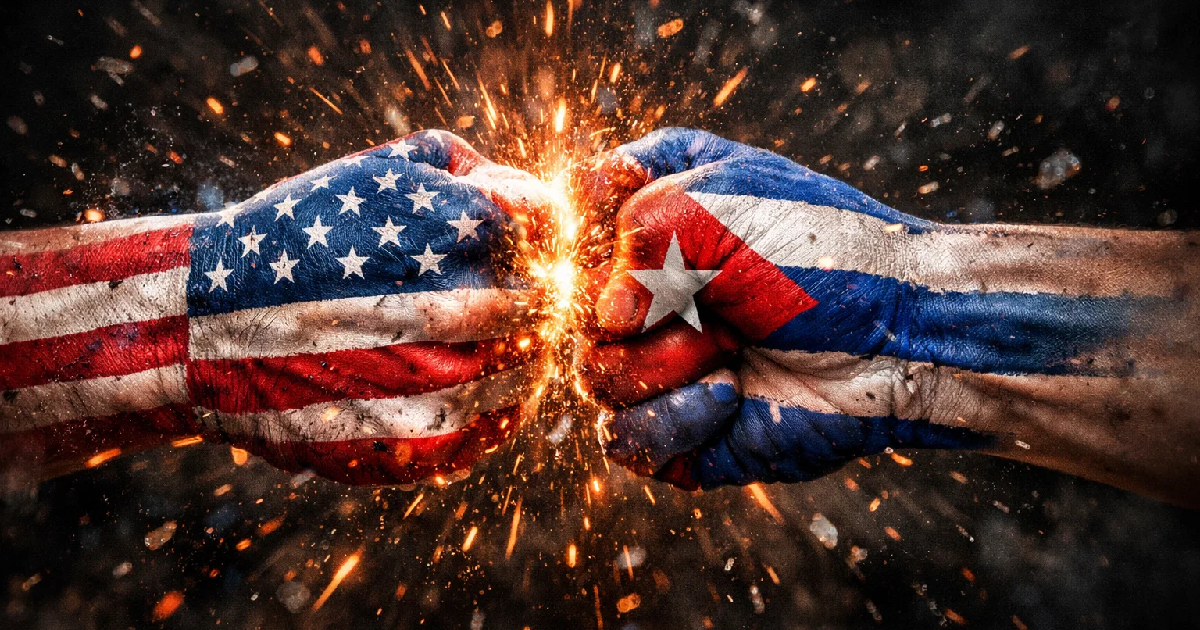
United States has reinforced its intelligence-gathering capabilities in Cuba over the past few months, a measure that increases the pressure from the administration of Donald Trump on the regime in Havana, although there are currently no public indications that Washington has approved a military operation against the island.
The information was revealed this Tuesday by Politico, which consulted two individuals familiar with the plans of the U.S. government. Both spoke on the condition of anonymity due to the sensitive and potentially classified nature of the activities described.
One source reported that the United States recently sent personnel and other intelligence resources to Cuba, but refrained from specifying their number, functions, or the agencies involved to avoid compromising ongoing operations.
The other limited herself to describing the movement as an expansion of the "presence" of the CIA in Cuban territory.
The U.S. intelligence community is made up of 18 civilian and military components, including the CIA, the Defense Intelligence Agency, the National Security Agency, and various branches of the Armed Forces.
Politico could not determine which are involved in the deployment related to Cuba.
However, the increase in intelligence resources alone does not confirm that a military intervention is being prepared, although one of the sources stated that it constitutes a tactical step that could facilitate an operation of that nature, but it also acknowledged that its scope, objectives, and the form it would take are not defined.
The second source placed the movement within a broader strategy to force the Cuban regime to make changes and stated that Washington will use "all conventional tools," including intelligence resources.
He clarified, however, that Trump still "prefers diplomacy" as a means to achieve his goals.
In an internal email obtained by Politico, a senior official from the State Department stated that the Cuban regime is "exporting anti-colonial and third-world resentment" toward U.S. institutions, a formulation that reflects the hardening of Washington's public campaign against Havana.
U.S. military operations are often preceded by an intensification of information gathering, but Politico emphasized that the possibilities arising from the current deployment in Cuba range from increasing understanding of the regime to attempting to recruit officials, military personnel, or citizens willing to collaborate with Washington.
The war with Iran, which is approaching its sixth month, has not shifted Cuba from the administration's priorities. One source stated that Washington does not need to resolve that conflict first and described the island as "a major priority for Rubio," referring to Secretary of State Marco Rubio.
The CIA declined to comment on the report. The White House, the Defense Intelligence Agency, and the Office of the Director of National Intelligence also did not respond to requests from Politico.
The event that heightened attention on these movements is the capture of Nicolás Maduro on January 3, 2026. U.S. intelligence played a crucial role in locating the then Venezuelan leader prior to the military operation that led to his transfer to the United States.
Furthermore, the reinforcement occurs after the CIA director, John Ratcliffe, traveled to Havana on May 14 and conveyed to Cuban officials that the United States was willing to seriously address economic and security issues, but only if the regime made "fundamental changes."
Subsequently, the Department of Justice made public a superseding indictment against Raúl Castro and five others for their alleged involvement in the downing of two civilian aircraft from Brothers to the Rescue on February 24, 1996, resulting in the deaths of four individuals. The charges are accusations and the defendants maintain the presumption of innocence.
Human intelligence activities are complemented by the technical surveillance deployed around the island. Since February, P-8A Poseidon, RC-135V Rivet Joint, and MQ-4C Triton aircraft have accumulated over 150 hours of reconnaissance missions around Cuba, according to tracking data previously cited by U.S. media.
Related videos:
Filed under: