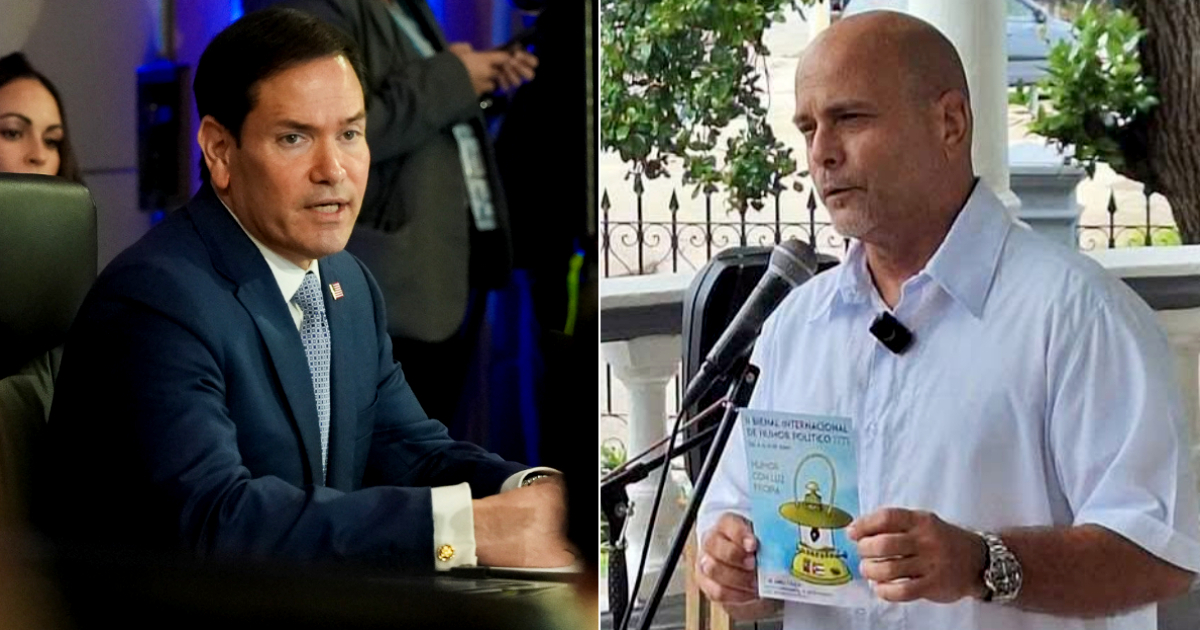
The latest post by Gerardo Hernández on Facebook, in which he attempted to discredit the statements of the U.S. Secretary of State, Marco Rubio, regarding Cuba, ended up provoking a flood of responses that reflect much more than a political disagreement.
The hundreds of comments posted under the post reveal a growing dissatisfaction with one of the most visible figures in the Cuban power structure and an increasingly outspoken rejection of the official narrative.
The central idea of the convicted spy from the Red Avispa was simple: if Cuba is a threat to the United States, then it cannot simultaneously be classified as a failed state. However, that reasoning was precisely what dozens of users questioned.
"One thing does not exclude the other", summarized one of the most supported comments. Others elaborated on the idea more deeply: a state can maintain a monopoly on force within its borders while simultaneously failing in its essential function of ensuring welfare, economic stability, and basic rights for its population.
Several went further and recalled that, precisely, failed states tend to become hotspots of regional and international instability.
In this regard, they argued that institutional collapse, humanitarian crises, mass migrations, the rise of organized crime, drug trafficking, terrorism, and human trafficking often turn these countries into threats to the security of other states.
"Failed states are a problem for everyone," wrote one user. "Precisely because they generate migrations, violence, and destabilization," added another.
Many recalled that numerous international policy documents consider state fragility to be a risk to global security, which is why they deemed the dilemma posed by Hernández to be false.
Other comments shifted the discussion to the specific Cuban case.
"Cuba can be both: a state unable to provide decent living conditions for its citizens and a security problem due to its alliance with hostile governments, its role in intelligence operations, or the waves of migration it causes," summed up an internet user.
There were also those who insisted that the concept of "failed state" does not depend solely on the loss of territorial control. "Just because the government controls the country doesn't mean it is functioning," wrote a commentator. "What has collapsed is the economy, public services, and the quality of life," added another.
That argument sparked one of the most extensive discussions of the entire conversation. Some participants argued that Cuba cannot be considered a failed state because the regime maintains control over the institutions, the military, and the national territory. They even compared the reality in Cuba to that of countries like Somalia, Libya, or Haiti to support their claim that there are clear differences.
However, most of the responses rejected that interpretation. Several users pointed out that the existence of a strong state apparatus does not negate the deep deterioration of a country when the population lives under blackouts, food shortages, a health crisis, mass emigration, and a lack of economic prospects.
The debate ultimately shifted towards a much broader critique of Hernández's role within the system.
Many comments questioned why one of the regime's top leaders spends time on propaganda publications while millions of Cubans face a daily crisis marked by inflation, blackouts, and shortages. The prevailing perception was that of a leader disconnected from the reality of most citizens and a beneficiary of the privileges of power.
They do not live the life that an ordinary Cuban lives, summarized one of the participants. Others stated that those in the political elite "cling to power while the people pay the price".
Although personal attacks were rampant —including references to aspects of Hernández's private life that have been circulating on social media for years— the volume of these comments also reflects the level of animosity that figures associated with the political apparatus of the regime evoke.
Beyond the tone used, the conversation reveals a deterioration in the public image of leaders who have been shielded from open criticism for decades. This is not the first time it has happened. In recent months, nearly all of Hernández's social media posts have turned into platforms for citizen response.
Whether attempting to ironize the U.S. military presence,
That dynamic does not seem casual. Hernández has built a profile on social media in recent years based on confrontation and political provocation, a strategy that often results in the opposite effect intended and turns each post into a thermometer of citizen discontent.
There were also voices that supported the leader's stance. Some users argued that the United States deliberately exaggerates the situation in Cuba to justify a more aggressive policy towards the island and defended that Cuba maintains its institutions and sovereignty intact. Others insisted that U.S. sanctions account for a significant part of the economic crisis and rejected the label of a failed state.
However, those arguments met with an equally strong response. Numerous participants countered that the economic and social decline precedes many of Washington's recent measures and that reducing the crisis solely to external factors overlooks decades of inefficiency, political control, and a lack of structural reforms.
For these commentators, the real problem is not Marco Rubio's rhetoric, but the Cuban government's inability to provide solutions for a population that has been enduring blackouts, shortages, and unprecedented emigration for years.
The conversation brings a clear conclusion: rather than debating an academic definition of what constitutes a failed state, many Cubans seized the opportunity of Gerardo Hernández's publication to express their accumulated frustration with those they hold responsible for the country's situation.
And that fatigue, increasingly visible on social media, ultimately overshadows any attempt by official propaganda to control the narrative.
Related videos:
Filed under: