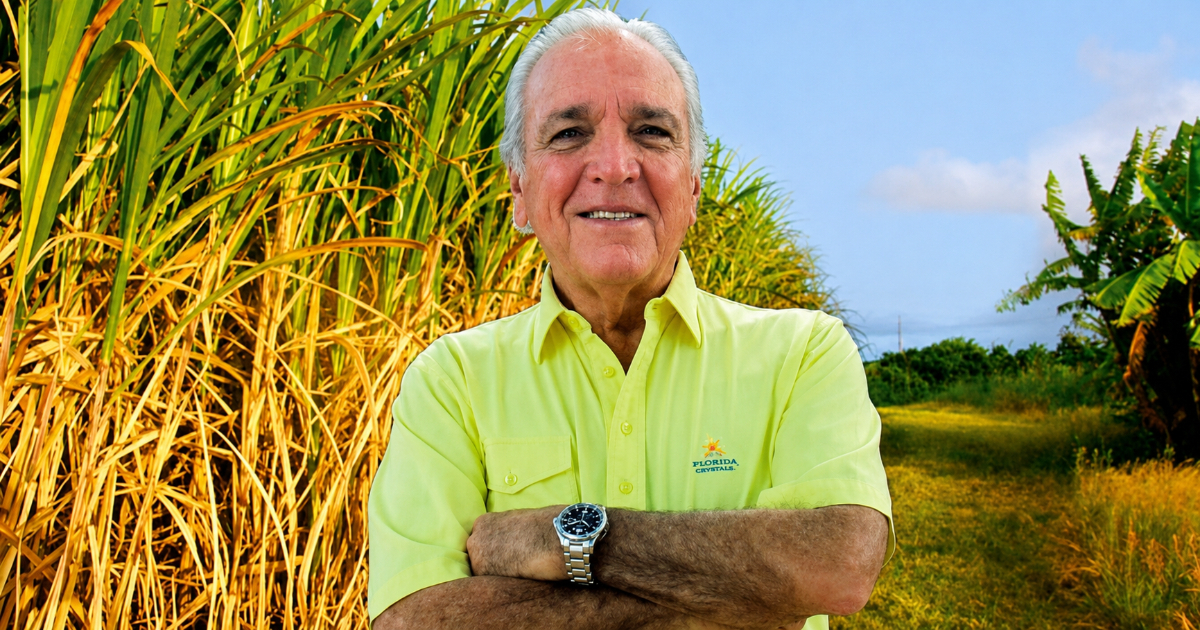
The businessman and philanthropist Alfonso "Alfy" Fanjul Gómez-Mena, one of the most influential Cuban-American entrepreneurs of the past few decades and a key figure in the reconstruction of Florida's sugar industry following the Cuban exile, passed away this Monday in Palm Beach at the age of 89.
The journalist Wilfredo Cancio Isla reported on Facebook that the businessman passed away in Palm Beach and highlighted his legacy at the helm of Florida Crystals, the company he founded with his brother José "Pepe" Fanjul, which became one of the pillars of the sugar industry in the United States.
According to information released by Cancio, the newspaper noted that Fanjul "helped redefine the sugar industry in Florida and the southern United States for generations," while also leaving a profound impact on Palm Beach through his business, civic, and philanthropic activities.
Born in Havana in 1937, Alfonso Fanjul belonged to one of the most powerful sugar families of republican Cuba. Before 1959, the Fanjul family controlled extensive plantations and mills on the island, but the victory of the revolution led by Fidel Castro resulted in the expropriation of all their properties and the exile of the family.
Initially established in New York and later in Florida, Alfonso and his brothers began the reconstruction of the family business practically from scratch. In 1960, they launched a new sugar mill in Pahokee and, over the decades, transformed that venture into a global business conglomerate.
Under the leadership of Alfonso "Alfy" Fanjul and José "Pepe" Fanjul, Florida Crystals Corporation has established itself as one of the leading sugar producers in the United States.
Subsequently, the expansion of American Sugar Refining (ASR Group) made the family the owner of the largest sugar refiner in the world, with well-known brands such as Domino Sugar and C&H, as well as operations in the United States, the Dominican Republic, Canada, Mexico, and Europe.
Their business success made the Fanjuls one of the richest families in the Cuban exile and one of the largest fortunes in the U.S. agro-industrial sector. At the same time, Fanjul developed a vigorous philanthropic effort in Palm Beach and maintained a prominent presence in business and political circles in the United States.
In addition to his well-known relationship with president Donald Trump and other American leaders, Fanjul maintained a close friendship with the emeritus king Juan Carlos I of Spain, who visited Casa de Campo, the exclusive resort complex owned by the family in the Dominican Republic, on numerous occasions.
This network of relationships turned the Cuban-American businessman into a regular figure within the economic and social elites of the United States, Spain, and Latin America.
The Fanjul who most advocated for an approach to Cuba
Although he was identified with the Cuban exile for decades, Alfonso "Alfy" Fanjul ultimately became the most outspoken voice of his family regarding a potential normalization of relations between the United States and Cuba.
In 2014, it emerged that he had traveled discreetly to the island to meet with Cuban authorities and explore the new landscape that was beginning to take shape after the contacts between Washington and Havana.
Unlike other members of his family and a significant portion of the historical exile, Fanjul publicly advocated for dialogue and expressed support for the idea that Cuban-American entrepreneurs could one day participate in the economic reconstruction of Cuba.
When then-president Barack Obama announced the reestablishment of diplomatic relations with Havana in December 2014, Fanjul supported the rapprochement process. In several interviews, he maintained that isolation had not led to any changes in Cuba and that the opening presented a different opportunity.
"If there is any way for our family's flag to return to Cuba, I would be happy to do it," he stated to the newspaper El País, making it clear that his desire was to return one day to the country where he was born, as long as there were conditions that provided legal security for investment and a different political environment.
His stance generated criticism among some sectors of the Cuban exile community, who felt that any economic rapprochement was premature while the regime remained in power. However, Fanjul insisted that commercial openness and increased exchanges could help accelerate transformations on the island.
Although he never invested in Cuba and the subsequent deterioration of bilateral relations during the following administrations ultimately froze any business possibilities, Alfonso Fanjul was identified as the family member most willing to build bridges with the island during the so-called "thaw."
While he defended that strategy, his brother José "Pepe" Fanjul held a position much closer to the traditional sectors of the exile community and the Republican Party, reflecting the differing sensitivities that exist even within one of the most prominent business families in the Cuban-American community.
So far, the causes of Alfonso "Alfy" Fanjul's death and details about the funeral ceremonies have not been disclosed.
With his death comes the end of one of the most influential Cuban-American entrepreneurs of the last fifty years. His career was marked by the reconstruction of the family sugar empire after exile, his significant influence on the U.S. economy, and his role in one of the most meaningful gestures of business rapprochement with Cuba during the thaw initiated by the Obama administration.
Related videos:
Filed under: