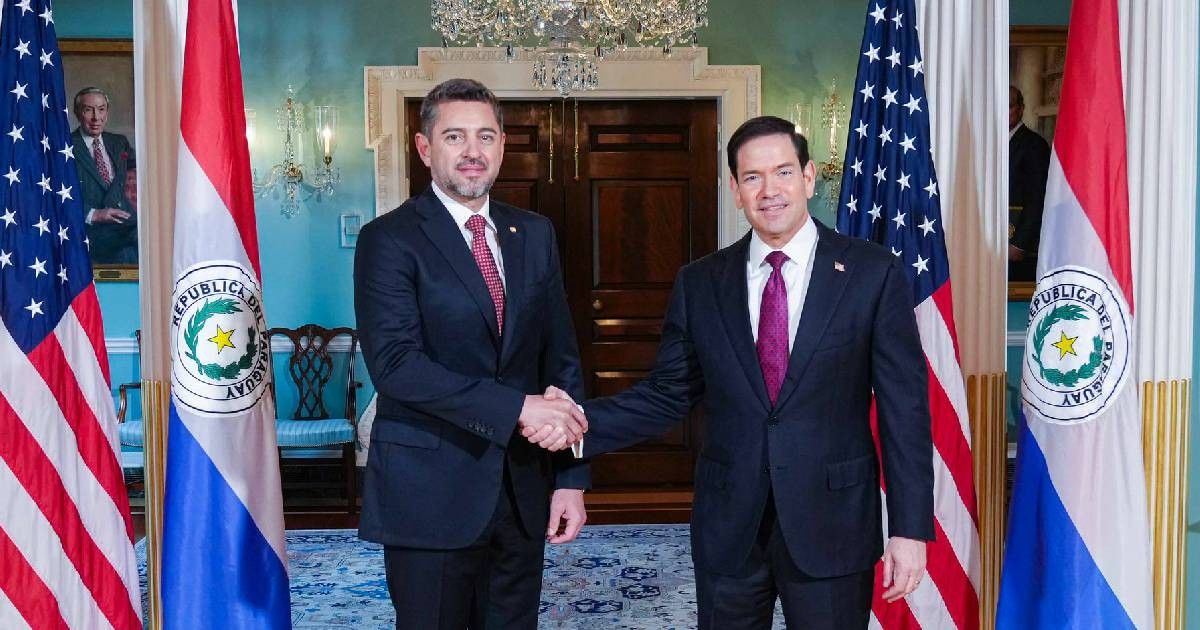
The U.S. Secretary of State, Marco Rubio, met this Tuesday with the Vice President of Paraguay, Pedro Alliana, at the Department of State in Washington D.C., in a meeting that concluded with the signing of a memorandum of understanding on strategic cooperation in civilian nuclear matters, according to spokesperson Tommy Pigott.
The bilateral agenda encompassed the deepening of cooperation in security to counteract transnational criminal and terrorist threats, as well as shared regional challenges, with Venezuela being one of the central topics of discussion.
Rubio thanked Alliana for "Paraguay's continued leadership in addressing shared regional challenges, including Venezuela," and praised the Paraguayan vice president's willingness to advance on these priorities.
After the meeting, Rubio and the Paraguayan chancellor Rubén Ramírez signed the memorandum of understanding on strategic cooperation in civil nuclear matters, an agreement that the State Department described as evidence of "the historic expansion of ties between the U.S. and Paraguay."
The document reaffirms the commitment of both governments to the advancement of civilian nuclear energy projects under the highest standards of safety, security, and non-proliferation.
Alliana valued the meeting with enthusiasm. "The bilateral relationship with the United States is going through an extraordinary moment," declared the Paraguayan vice president, as reported by Infobae.
On his social media, he described the meeting as "an important and pleasant encounter" in which they discussed "the broad bilateral agenda" to "ratify the strategic alliance based on democratic principles and values."
This Tuesday's meeting is part of a series of accelerated diplomatic engagements between Washington and Asunción since 2025.
In August of that year, both countries signed a safe third country agreement that allows rejected asylum seekers in U.S. territory to be transferred to Paraguay for their cases to be evaluated there.
In February 2026, the two governments signed a declaration of cooperation in security and defense focused on drug trafficking and transnational crime. Months later, in June, Rubio and President Santiago Peña held a bilateral meeting during the World Cup held in the United States.
Paraguay is considered one of Washington's closest partners in South America. The country broke diplomatic relations with Venezuela in January 2019 and maintains a critical stance towards chavismo, making it a natural ally of the pressure policy that the Trump administration is promoting in the region.
The Triple Frontier between Paraguay, Argentina, and Brazil remains an area of concern for the United States due to transnational organized crime and drug trafficking, with illicit flows estimated between 12 and 15 billion dollars annually according to security reports from 2026.
The civil nuclear agreement signed this Tuesday represents the most concrete step so far in the expansion of the bilateral alliance, and paves the way for atomic energy projects for peaceful purposes under international supervision.
Related videos:
Filed under: