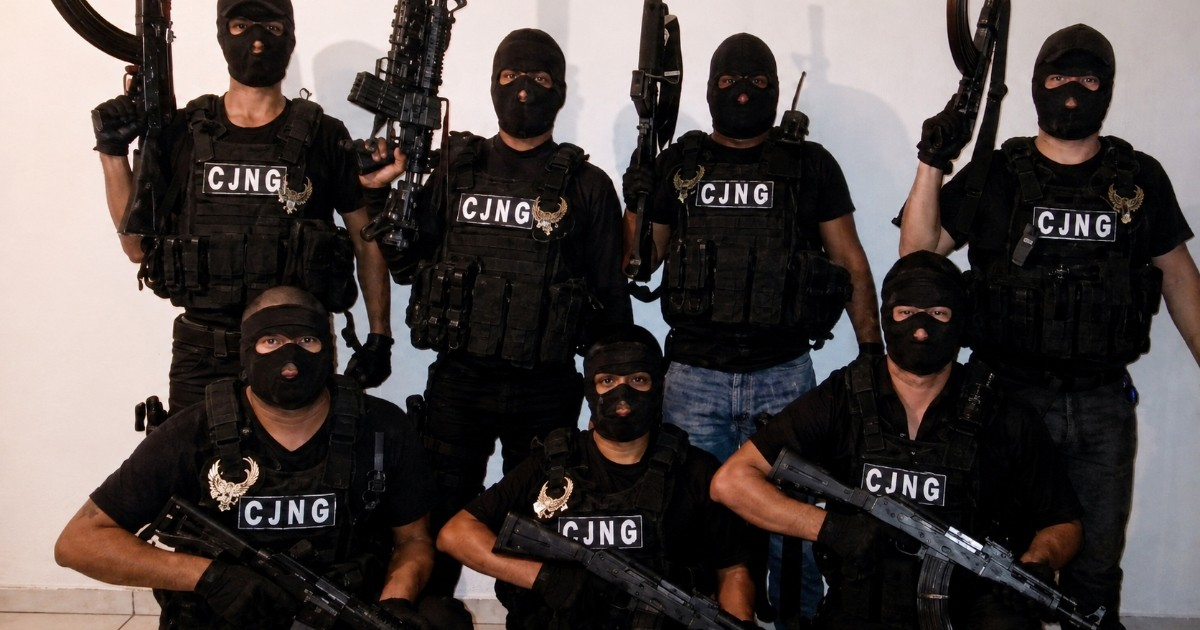
The U.S. State Department launched its largest public offensive against the Jalisco New Generation Cartel (CJNG) this Wednesday, announcing rewards totaling up to 102 million dollars for information leading to the arrest or conviction of eight leaders and associates of the organization, in addition to visa restrictions against 65 individuals linked to the cartel.
The Secretary of State Marco Rubio summarized the action in strong terms: "The United States is hunting, dismantling, and destroying the Jalisco New Generation Cartel," he wrote on his official account, where he also confirmed the revocation of 26 visas for family members and associates of cartel members.
The highest reward —up to 25 million dollars, five times the previous amount of five million— is offered for Juan Carlos Valencia González, known as "Pelón," identified as the new leader of the CJNG following the death of his stepfather and founder of the organization, Nemesio Rubén Oseguera Cervantes, "El Mencho," killed in February 2026 during a Mexican Army operation in Tapalpa, Jalisco.
The remaining rewards are distributed among seven other targets: up to 15 million for Audias Flores Silva ("Jardinero"), whose amount was also tripled; 15 million each for Gonzalo Mendoza Gaytán ("Sapo") and Julio Alberto Castillo Rodríguez ("Chorro"), son-in-law of El Mencho; 10 million each for Ricardo Ruiz Velasco ("Tripa"), Julio César Montero Pinzón ("El Tarjetas"), and Carlos Andrés Rivera Varela ("La Firma"); and up to two million for Griselda Margarita Arredondo Pinzón.
In parallel, the Department of Justice revealed on Wednesday federal charges against five of those targets — Mendoza Gaytán, Castillo Rodríguez, Ruiz Velasco, Montero Pinzón, and Rivera Varela — in a coordinated action with the DEA, FBI, Homeland Security Investigations (HSI), the IRS, and Customs and Border Protection (CBP).
The official statement from the Department of State described the CJNG as “one of the most violent and dangerous narcoterrorist organizations in the hemisphere,” which “poisons American communities with illegal fentanyl, cocaine, heroin, and methamphetamine.”
The offensive is part of a sustained escalation by the Trump administration against Mexican cartels.
In February 2025, Washington designated the CJNG as a Foreign Terrorist Organization, which expanded the legal and financial tools available.
Months later, the Pentagon launched the Southern Spear Operation, a military campaign by Southern Command against narcoterrorist networks in the Caribbean and Eastern Pacific, which has resulted in dozens of lethal attacks against vessels.
In January 2026, Trump declared that the cartels "control Mexico" and warned of possible ground attacks, creating diplomatic tension with President Claudia Sheinbaum. Rubio later clarified that the U.S. would not act unilaterally on Mexican territory without an explicit request from that country's government.
Since the visa restriction policy was announced in June 2025, a total of 93 visas have been revoked for relatives and associates of sanctioned drug traffickers linked to cartels designated as terrorist organizations.
The Narcotics Reward Program, established in 1986 and celebrating its 40th anniversary this year, has brought more than 90 drug traffickers to justice and paid out over 200 million dollars in rewards throughout its history.
Related videos:
Filed under: