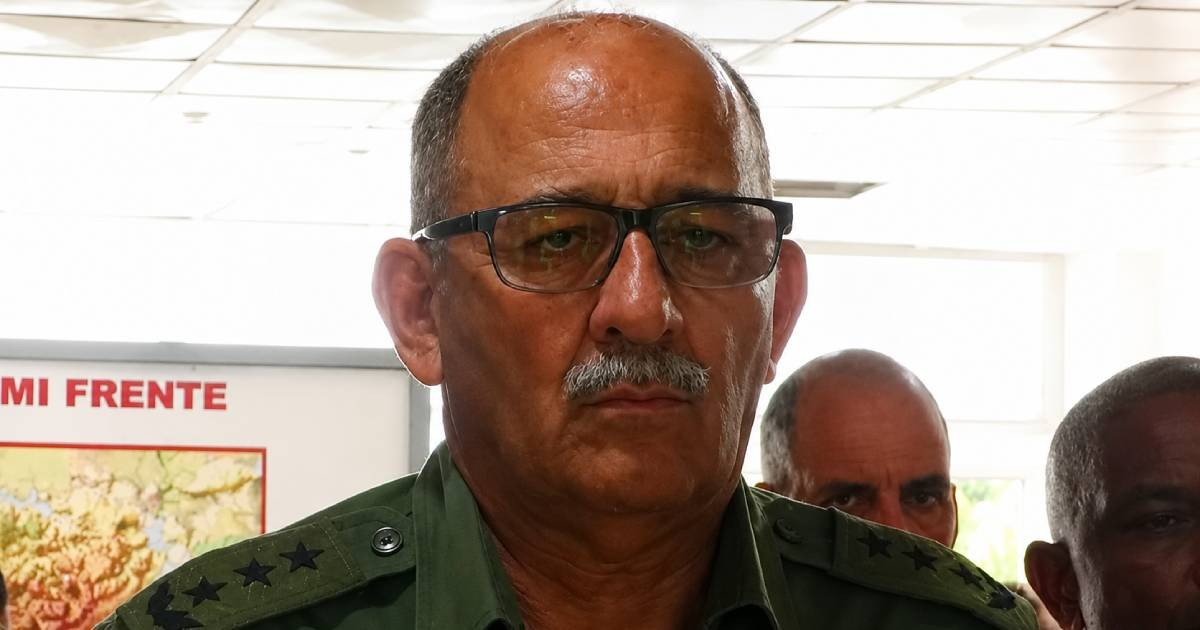
The United States government reinstated sanctions on Thursday against General Roberto Legrá Sotolongo, Chief of the General Staff of the Revolutionary Armed Forces (FAR) and First Vice Minister of the Ministry of Revolutionary Armed Forces (MINFAR), identifying him as a key figure in the acquisition of Russian weaponry and in the Cuban regime's military cooperation with countries deemed adversaries of Washington.
The designation is part of a new round of sanctions announced by the Department of State, which also targeted five entities and another seven officials linked to the Cuban military apparatus.
The measure was adopted under Executive Order 14404, signed by President Donald Trump on May 1, 2026, with the aim of punishing individuals and organizations that contribute to strengthening the military and repressive capabilities of the Cuban regime.
According to the State Department, Legrá Sotolongo played a significant role in efforts to acquire Russian-made weapon systems and in the development of military cooperation between Havana and governments deemed hostile to the United States.
This is not the first sanction
This is not the first time that Washington has placed the Cuban military high command on its sanctions list.
On August 19, 2021, the Office of Foreign Assets Control (OFAC) of the Department of the Treasury had already included him in the list of Specially Designated Nationals (SDN) under the Global Magnitsky Act, holding him accountable for his involvement in the crackdown on the historic protests of July 11, 2021.
The new designation does not replace that sanction but rather expands it. With this, Washington strengthens the restrictions on any property or interest of the military individual under U.S. jurisdiction and further intensifies the pressure on one of the most significant figures within the military structure of the regime.
Legrá Sotolongo was officially appointed head of the General Staff in 2021, and three years later, in December 2025, he joined the Political Bureau of the Communist Party of Cuba, consolidating his position within the inner circle of the ruling elite.
Their inclusion in this new round of sanctions reflects the Trump administration's interest in targeting those who are in charge of modernizing and supplying the Cuban Armed Forces.
Other high-ranking officials were also sanctioned
Alongside Legrá Sotolongo, the State Department has once again sanctioned the Minister of the Armed Forces, Álvaro López Miera, who had already been included on the sanctions list by the Treasury Department in July 2021 following the repression of the protests on July 11.
The new list also includes José Antonio Remón Rodríguez, head of the Foreign Relations Directorate of MINFAR; Óscar Enrique Biosca Gallego, head of the Economic Directorate; Mónica Milián Gómez, military attaché of Cuba in Russia; Waldo Pérez Cortés, military attaché in China; Roberto Jesús Viciana Mousset, general director of the Military Industry Union and brigadier general; and Heriberto Sánchez Alleyne, general director of TECNOIMPORT.
Companies linked to the military apparatus
The U.S. offensive also targeted five companies identified as supporting the strengthening of the military capabilities of the regime.
The sanctioned entities are TECNOIMPORT, DUNA S.A., the Unión de Industria Militar (UIM), the Yuri Gagarin Military Industrial Company, and TECNOTEX, all of which are related, according to Washington, to the import, production, repair, or modernization of weaponry for the FAR.
The State Department claims that these companies have facilitated the incorporation of military equipment of Russian and Chinese origin into the Cuban arsenal. In the case of TECNOTEX, it also points to a history of cooperation with North Korea on projects related to the defense sector.
A strategy of increasing pressure
The new sanctions are based on the report from the State Department "Cuba: The Capital of 21st Century Communism," published on July 20th, in which Washington accuses the regime of deepening its military cooperation with Russia and China, receiving weapons and surveillance technology from these countries, and serving as a platform for intelligence operations aimed at the United States.
The decision is part of the maximum pressure strategy promoted by the Trump administration since May 2026. In recent months, Washington has sanctioned GAESA, MINFAR, MININT, the ruling Miguel Díaz-Canel, the Mariel Container Terminal, and now, the network responsible for managing the procurement of arms for the Cuban Armed Forces.
When announcing the new measures, Secretary of State Marco Rubio reiterated the White House's stance toward the Cuban regime: "President Trump's determination is unwavering: the United States will not tolerate a pariah state hosting military, intelligence, and terrorist operations just ninety miles from U.S. territory."
Related videos:
Filed under: