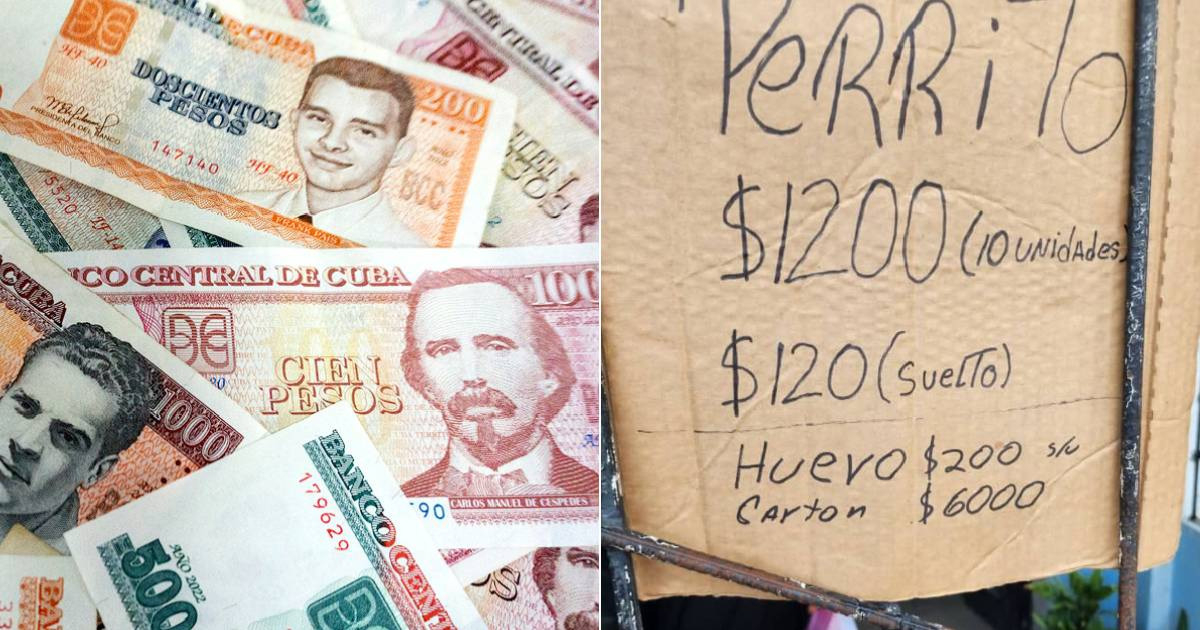
Cubans from different provinces are reacting on social media to the prices of eggs, which have reached 300 pesos per unit, and oil, which costs 9,000 pesos for two 900-milliliter bottles.
A post this Friday on the Facebook page "Madres Cubanas Luchadoras" 2 showed the case of Placetas, Villa Clara, where an egg is sold for 200 pesos, accompanied by the phrase "Thank you for everything, Fidel," referring to the dictator Fidel Castro (1926-2016).
The comments reflected that the price is not exclusive to that municipality. One internet user stated that in Santiago de Cuba, eggs cost between 250 and 300 pesos, while others mentioned prices of 250 pesos in Santos Suárez, Havana, and Alamar, as well as 180 pesos in other areas of the capital.
In Holguín, another user placed the price between 150 and 200 pesos. The responses indicate a trend that affects various regions and has turned a basic food item into a product that is increasingly difficult for households to obtain.
The price of oil is also on the rise. A Cuban recounted that she had just bought two bottles of 900 milliliters for 9,000 pesos and asked, in an ironic tone, "Who do I have to thank?"
Another commentator summed up their perception of the situation by stating that there is "misery throughout Cuba" and questioning the low wages.
The increase occurs after Resolution 150/2026 from the Ministry of Finance and Prices eliminated price caps in June for imported cooking oils, chicken, powdered milk, and other products.
Since then, the price of oil increased from about 1,500 pesos in April to over 4,000 pesos in August, with prices reaching up to 7,000 pesos in some areas.
Egg prices have also seen significant increases. In Santiago de Cuba, they sell for between 250 and 300 pesos each, while in Havana the price ranges from 180 to 250 pesos, and in Holguín, it varies between 150 and 200 pesos. A carton of 30 units can reach up to 7,500 pesos in Santiago de Cuba.
In Placetas, a viral video recently documented how the price of eggs skyrocketed from 40 to 200 pesos per unit overnight. "If we wake up tomorrow and have something to eat, it’s thanks to the great mercy of God. Because we are eating ourselves alive, consuming money, and it’s money that isn’t coming in," said the content creator during the tour.
Economists estimate that a person in Cuba needs around 96,000 pesos per month to cover basic needs, of which more than 70,000 would be solely for food. This amount is 30 times the official minimum wage of 3,210 pesos.
Under social pressure, some municipalities have once again resorted to so-called reference prices. The Administration Council of San Luis, in Santiago de Cuba, set indicative prices of up to 2,200 pesos for oil, 120 pesos for eggs, and 600 pesos for a pound of chicken.
Guantánamo set the same reference price for oil a few days earlier. The reaction on social media was once again characterized by distrust. "I'll believe it when I see it," wrote one user, while another demanded that the measures be enforced and not just remain rhetoric.
Skepticism also arises after previous experiences. In February, a similar exercise in Guantánamo resulted in 1,538 fines and 162 forced sales, without prices stabilizing in a lasting way.
The ruling Miguel Díaz-Canel acknowledged in June that the previous price caps had "caused shortages, shifts towards illegal activity, and decreased revenue."
While authorities seek to contain the escalation through new measures, comments from Cubans indicate that the problem is already reflected directly in the price of basic food items and in the inability of many households to afford them.
Related videos:
Filed under: