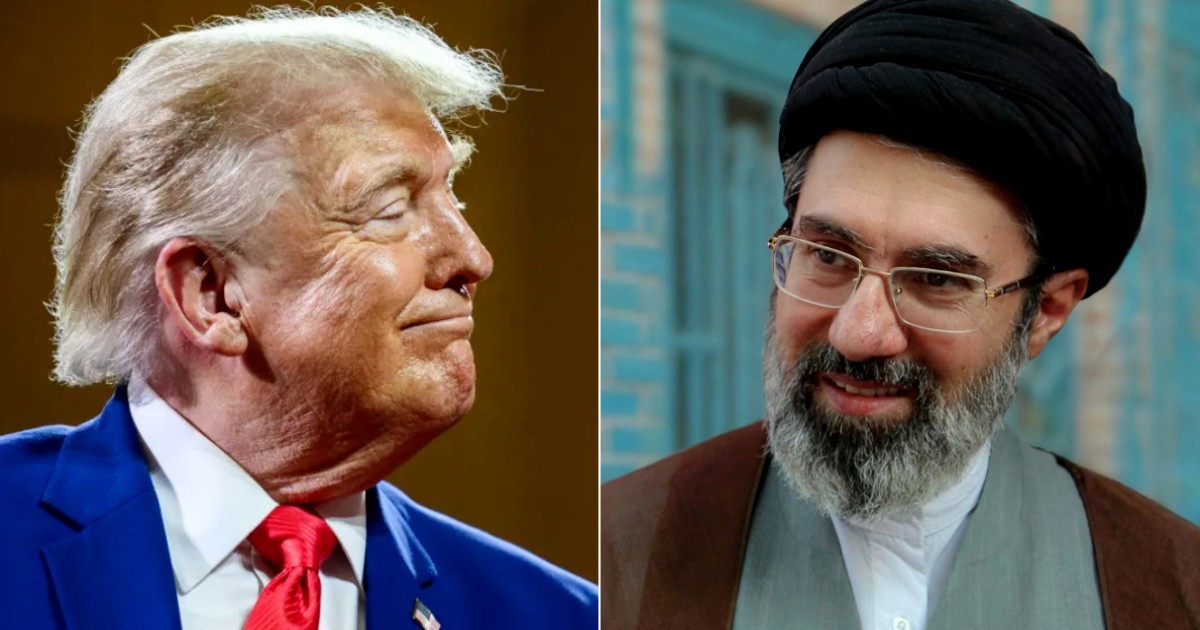
Donald Trump stated this Monday that the United States is willing to let economic pressure do its work against Iran, temporarily forgoing a new large-scale military offensive, according to an interview given to Axios.
"We are taking it easy," the president affirmed in a brief phone call. "We are only semi-negotiating with them. We are simply observing Iran with its huge inflation and the fact that they have no money."
The statement contrasts with the position Trump held just a week ago, when U.S. officials indicated that the president was on the verge of ordering a return to large-scale combat operations against the Iranian regime, but was persuaded to de-escalate.
Trump emphasized that Iran is "in very bad shape" economically and lacks the funds to pay its own troops, a situation that has been considerably worsened by the naval blockade imposed by Washington. With the price of oil just over 75 dollars per barrel, the president considered that American consumers feel less of the impact from the conflict.
It will turn out well. It always turns out well. It's like a game of chess, Trump said regarding the standoff with Tehran.
A U.S. official explained the logic behind this strategy: while Iran is at war, the regime can evade the consequences of the conflict and the economic crisis it has generated. Without active combat, it is forced to confront a reality without real solutions.
The background setting is the Strait of Hormuz, whose full reopening remains blocked. An agreement negotiated between Iran, Oman, and the United States has been pending announcement for several days; mediators from Qatar and Pakistan had hoped to finalize it last Wednesday, but the prospects have been diminishing.
As part of the agreement, Iran would gain partial control over traffic in the strait, something it did not have before the conflict.
On Saturday, the head of the Iranian Supreme National Security Council, Mohammad Bagher Zolghadr, presented a new list of demands that goes far beyond what was negotiated: that the United States “never threaten or insult Iran in any language,” that it permanently end the war against Iran and its allies in Lebanon, Gaza, Yemen, and Iraq, and that it lift the naval blockade.
In addition, it demanded that Washington withdraw its military forces from the region, compensate for war damages, lift all sanctions, and release frozen Iranian funds. The conditions that weeks ago were prerequisites for a nuclear agreement are now presented as the bare minimum just to reopen the strait.
A diplomat from one of the mediating countries attributed that statement to the internal struggles within the Iranian regime. The Iranian president Masoud Pezeshkian advocates for reaching an agreement in light of the risk of economic collapse, while the commander of the Islamic Revolutionary Guard, Ahmad Vahidi, rejects any concessions.
Meanwhile, about 8 million barrels of oil leave every night via the southern route of the strait in coordination with the U.S. Navy, and Washington seeks to increase that flow as long as there is no agreement.
The conflict began on February 28 with Operation Epic Fury, a joint offensive by the United States and Israel against Iranian nuclear and military facilities. Since then, the situation has alternated between air offensives, partial ceasefires, and announcements of agreements that never materialized.
"This is not over. Obviously, we are not at the beginning. We are in the middle of the game, and we are using a whole range of tools—diplomatic, economic, military—to ensure the best outcome for the American people," declared Vice President JD Vance on Fox News on Saturday.
Related videos:
Filed under: