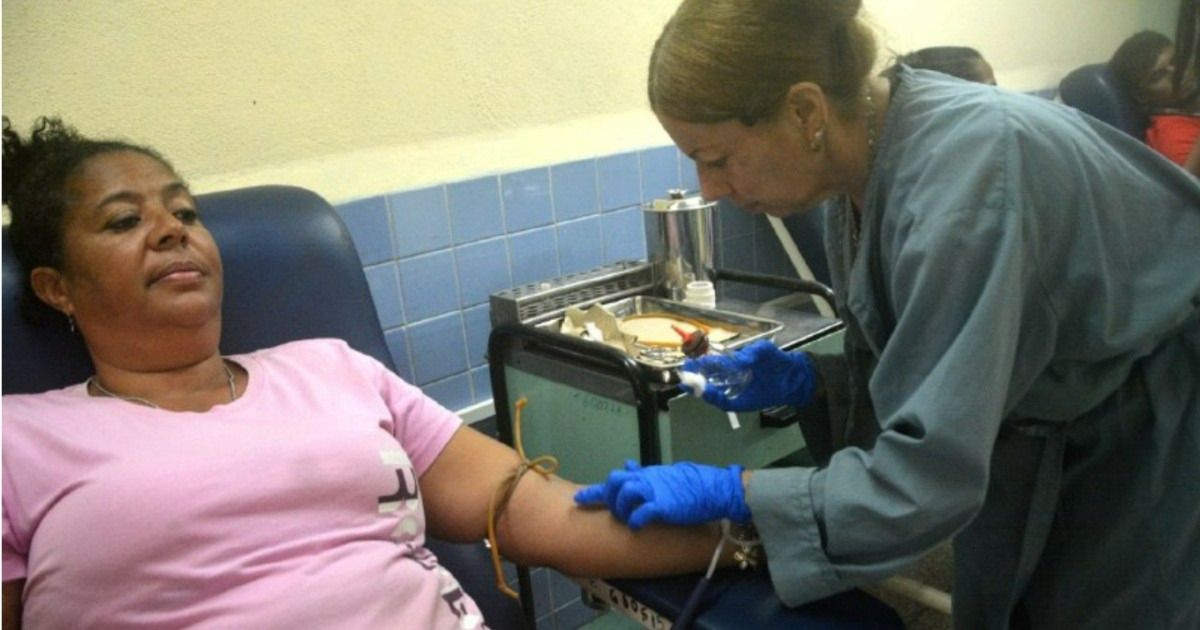
The Provincial Blood Bank of Villa Clara issued a statement this Sunday to refute the claims of shortages circulating on Cuban social media, assuring that the province has guaranteed the supply of blood for its emergency services.
The director of the entity, Dr. Idamis Fernández Jure, stated in comments shared by the state agency ACN, that "despite the emergence of requests on social media for donors, the province is keeping demand for this vital resource under control to provide an immediate response to those arriving at emergency services."
According to the official statement, the bank monitors the inventories of all hospitals in the region daily to verify the availability and expiration dates of blood components. "We check whether the blood present in health institutions is expired or not, as it also has an expiration period, which poses a considerable risk to the patient if not detected," emphasized Fernández Jure.
The deputy director María Elena Infante Pacho added that the province has extraction centers in all 13 municipalities, which prevents donors from having to travel to Santa Clara.
When a patient's family is unable to donate, the bank turns to community mechanisms: the Committees for the Defense of the Revolution, the family doctor, or workplaces serve as channels to mobilize donors.
The institution also produces plasma intended for medications such as albumin and immunoglobulins, and has cooperated with other provinces in emergency situations, as occurred after the explosion at the Saratoga hotel and the fire at the Supertankers Base in Matanzas in 2022.
The official statement contrasts with a documented pattern at the national level. Voluntary blood donations in Cuba decreased by 29% between 2020 and 2023, dropping from 357,665 to 254,845 annually according to the National Office of Statistics and Information. The mass exodus of young people—the primary donor group—is one of the identified factors.
In provinces like Sancti Spíritus, the situation reached extreme levels: in April 2025, the provincial bank reported zero available voluntary donations, and transfusions at the Camilo Cienfuegos Provincial General Hospital relied entirely on blood provided by family members. That same year, the state media reportedan informal blood market on social media, with offers of up to 6,000 pesos for a donation of O negative blood.
The phenomenon of requests on social media that the director from Villa Clara mentions briefly has specific faces. In July of this year, the family of Ramona Gutiérrez Pita, an 80-year-old woman from Ciego de Ávila with a hip fracture, had to turn to Facebook to find three A+ blood donors because the system could not provide them. "She fell, had a hip fracture, and is weak while waiting to be operated on; without the A+ blood donations, they can't take her to the operating room," wrote Guillermo Rodríguez Sánchez, a relative of the patient, on Facebook.
This contradiction is compounded by another, more significant one: in April 2025, the regime officially acknowledged that BioCubaFarma will export blood plasma to the international market through Laboratorios AICA, even having signed an agreement with Brazil, while Cuban donors receive only a snack and a soft drink as compensation.
According to data from the Pan American Health Organization, Cuba recorded a rate of 23 donations per 1,000 inhabitants in 2023, compared to 31 in 2020.
Related videos:
Filed under: