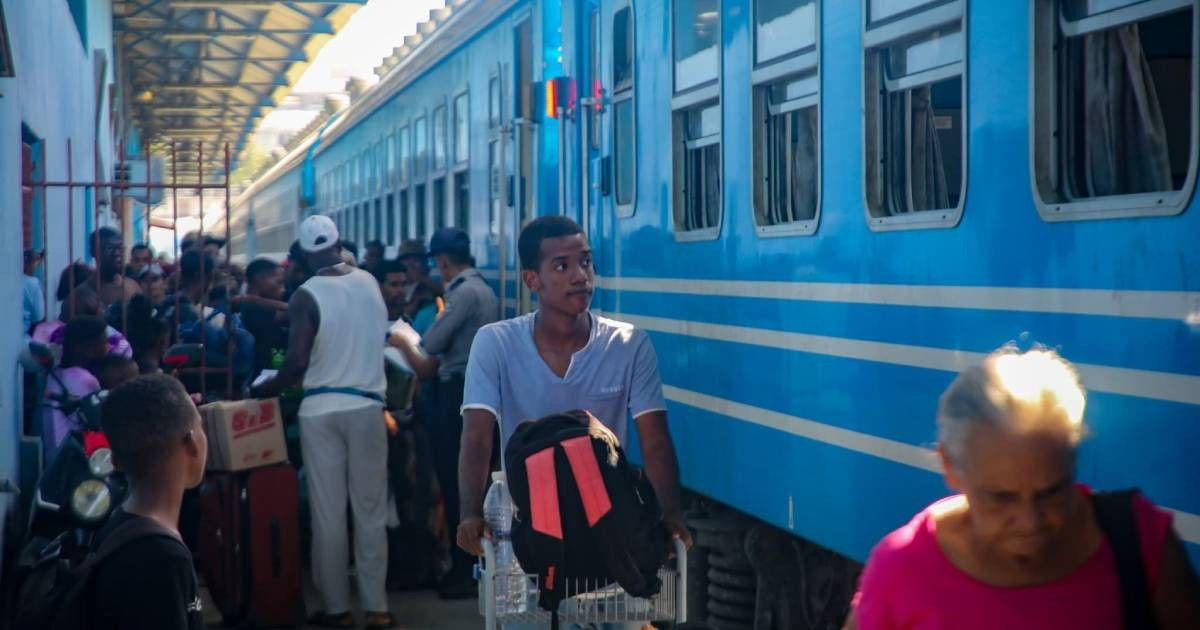
The fuel shortage in Cuba continues to impact interprovincial transportation to the point of causing delays in national trains and disruptions in other services, despite the drastic reduction in frequencies implemented by the government since June to adapt to the limited availability of diesel.
The Ministry of Transportation acknowledged this Monday, in a news release posted on its social media, that it has been unable to ensure the scheduled timings as normal over the past few weeks due to a lack of fuel.
"In recent weeks, there have been disruptions in train schedules and, to a lesser extent, in the departures of vessels and buses, due to not having the necessary fuel for services at the right time," admitted the agency.
The recognition is particularly significant because it comes at a time when national transportation has been operating under extremely reduced frequencies since June 18.
The national trains then operated only one departure every 16 days to Santiago de Cuba, Guantánamo, Holguín, and Bayamo-Manzanillo, while Ómnibus Nacionales was limited to three weekly services from Havana to the provincial capitals.
Even with that minimal scheme, the available fuel is not sufficient to ensure that services run on schedule.
According to data released in July, the cuts represented a 74% decrease in the monthly operations of national trains compared to the peak periods of the Cuban railway.
The consequences of the fuel shortage have fallen directly on travelers.
The Ministry itself acknowledged that the delays forced them to take "actions to ensure the passengers' stay at the stations," a phrasing that indicates that travelers who had already arrived at the terminals had to remain there while waiting for their means of transportation to depart.
The statement, however, does not specify how many trains, buses, or boats were affected, how long passengers had to wait, which routes experienced the most delays, or if any services were ultimately canceled.
It also does not provide a forecast on when the fuel supply might stabilize.
One of the measures announced this Monday precisely reflects the uncertainty surrounding transportation planning: tickets can only be reserved three days in advance.
The Ministry itself acknowledges that the decision is related to "the difficulties with fuel supply to ensure compliance with the scheduled departures."
In practice, the reduction of the timeframe highlights the challenges faced by authorities in ensuring, with greater advance notice, that a train, bus, or vessel will have the necessary fuel to carry out the planned trip.
However, the lack of diesel is not the only issue acknowledged by the organization.
In the same statement, the Ministry acknowledged that the mechanism used since June to distribute the scarce tickets created "causes and conditions for the occurrence of corruption and misconduct in the allocation of capacities."
The irregularities, combined with the "poor management of reservations in some areas," also led to a paradox that's hard to explain in a country where obtaining an interprovincial ticket has become an odyssey: some services departed without filling all their available seats.
The problem mainly occurred in the trains and in the maritime connection with the Isle of Youth.
In light of the accumulated difficulties, the Ministry decided to modify the marketing system again and return the ticket sales to the agencies of the Viajero Company in all municipalities where those offices exist.
Starting Wednesday, August 12, agencies will begin selling capacities for scheduled trips from the 15th. Seats that have not been sold in advance can be purchased on the same day of departure at the relevant stations.
The Viajando application, meanwhile, will remain out of service while technical work is being carried out, with authorities having not announced a date for its reactivation.
Behind the delays, cuts, and uncertainty about departures lies a fuel crisis that has permeated nearly every sector of daily life in Cuba.
In May, the Minister of Energy and Mines, Vicente de la O Levy, acknowledged that Cuba did not have diesel or fuel oil, amid a severe contraction of energy supplies.
A month earlier, the United Nations had warned about the consequences of inadequate fuel for essential services, affecting transportation, health, water supply, and food distribution.
Related videos:
Filed under: