A threat of an Iranian attack deemed "credible" by U.S. intelligence services forced President Donald Trump to leave Turkey on an alternative military aircraft, while the White House publicly claimed he was traveling aboard Air Force One, according to an investigation by The Washington Post published this Monday.
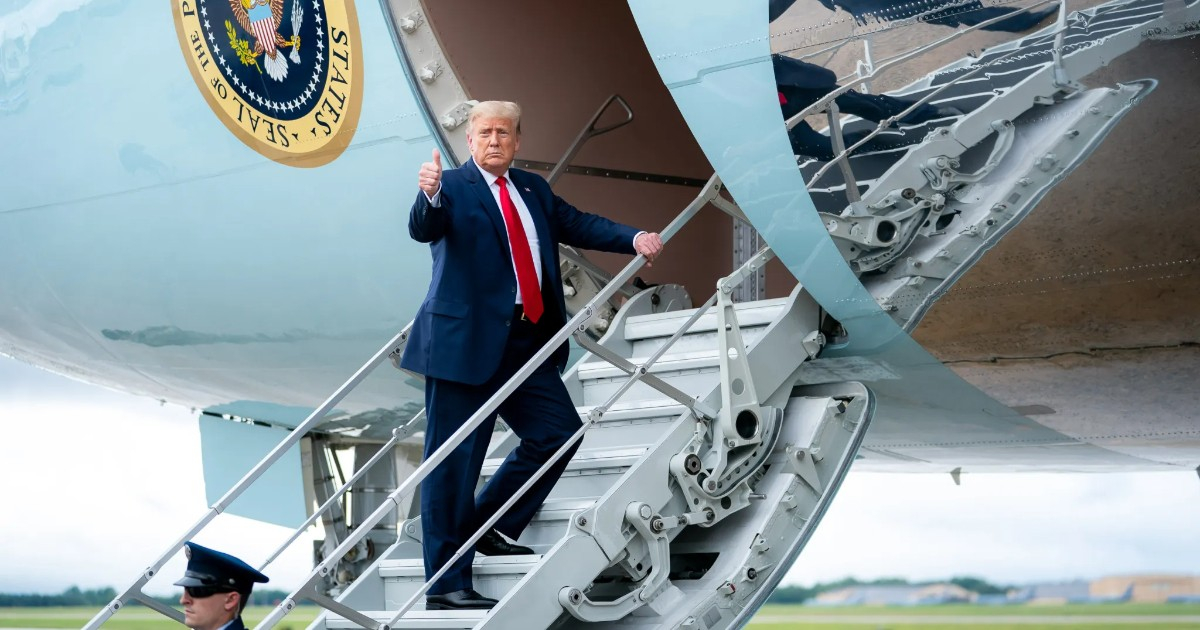
The operation took place at Ankara's Esenboğa Airport, where Trump had participated in the NATO summit on July 7 and 8. In front of the television cameras, the president boarded the historic blue and white Boeing 747 —the classic Air Force One— and waved from the staircase.
Minutes later, without the journalists or part of the White House staff knowing, he was secretly transferred via a catering truck that was hydraulically elevated to the opposite door of the plane, and from there he boarded a C-32A of the Air Force parked nearby.
The C-32A, a modified Boeing 757 for transporting high-ranking government officials, flew to Mildenhall Air Base in Britain, using the discreet call sign "Reach 18" and with tracking systems turned off. The classic Air Force One, carrying journalists and some White House staff on board, operated as a decoy and adopted the call sign "AF1" mid-flight.
The Secretary of Defense Pete Hegseth boarded the C-32A separately using external stairs, as part of the effort to make the flight appear normal, and traveled with Trump to Britain, according to the official who spoke to the Post on condition of anonymity.
The operation took place the night after U.S. forces resumed military strikes against Iran at Trump's order, following the collapse of negotiations between Washington and Tehran.
Iran had attacked commercial vessels in the Strait of Hormuz on July 6 and 7, prompting Trump to declare before NATO that the truce was "over". The provisional truce had been signed in June in Switzerland, with an expected duration of 60 days.
Turkey, the host of the summit, shares a border with Iran, which heightened the perceived risk level for presidential security. Both The New York Times and CBS News had previously reported that intelligence services identified a specific threat against the president or his plane upon leaving the country.
One additional concern was the new Air Force One —the Boeing 747-8 donated by Qatar, valued at around 400 million dollars— that Trump had used to fly to Turkey on July 7. Apparently, the aircraft, operationally incorporated on July 1, lacks some of the defensive countermeasures of the classic presidential plane.
When questioned by journalists about why they were asked to lower the window shades on the plane in Turkey, Trump responded that it was "probably because they are on a dangerous flight because of the scoundrels we have to deal with", and acknowledged that Iran has him at the "top of their target list."
The White House Communications Director, Steven Cheung, responded to the Post with a statement defending the Qatari plane without denying the secret operation: "The new Air Force One is a state-of-the-art aircraft equipped with high-level security protocols that ensure the safety of the president and his staff."
The White House posted that night on social media that Trump had landed in Mildenhall "aboard the old Air Force One," accompanying the message with a photograph of the classic plane.
The former acting director of the Secret Service, Ronald L. Rowe Jr., defended the principle of keeping presidential protection methods confidential: “We need to maintain 'secrecy' in the Secret Service. The public should know what the president does on a daily basis, but the methods by which the Secret Service keeps the president safe must remain out of public view.”
The Trump administration also issued subpoenas to several journalists from the New York Times to identify their sources regarding vulnerabilities in the Qatari aircraft, but later withdrew them acknowledging errors in the process.
Related videos:
Filed under: