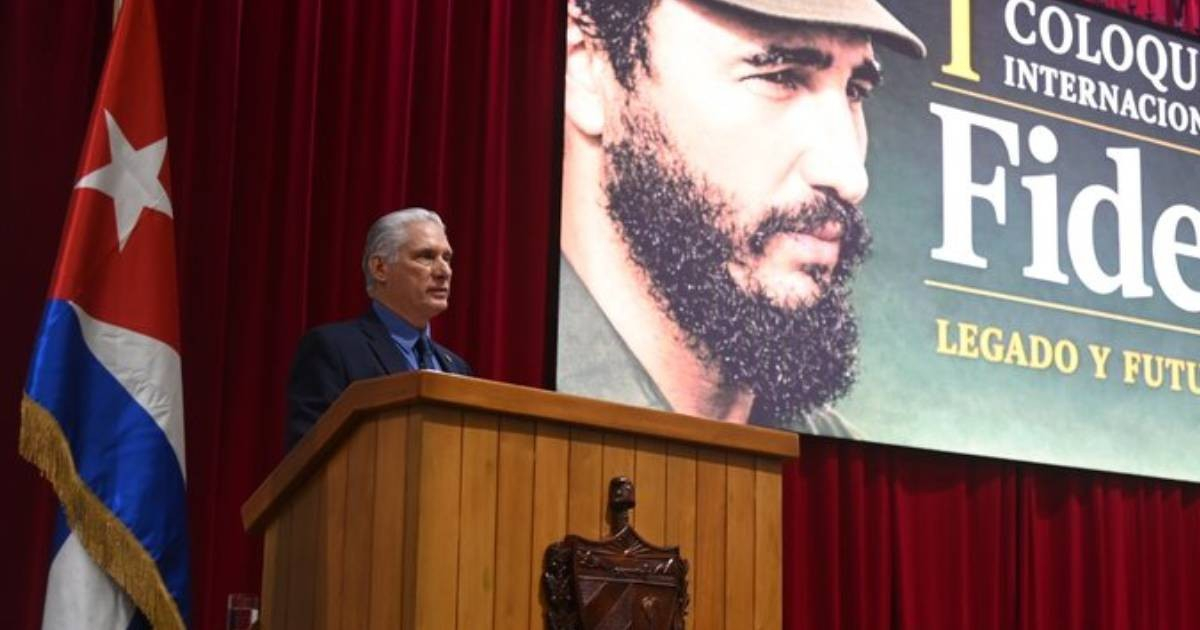
The Cuban leader Miguel Díaz-Canel acknowledged before more than 1,500 delegates from 63 countries that Cuba is experiencing an unprecedented crisis in decades, although he attributed the deterioration solely to external factors.
He did it on Monday at the opening of the I International Colloquium "Fidel: Legacy and Future", held at the Palace of Conventions in Havana as part of the celebrations for the centenary of Fidel Castro's birth.
«I do not exaggerate when I say that this colloquium is taking place at one of the most difficult moments in the history of the Revolution,» the leader stated during his keynote address, in which he also bluntly listed the problems afflicting the population: «We are burdened by blackouts, water shortages, inflation, and long lines,» he said according to the official regime's website.
Far from assuming institutional responsibility for the collapse, Díaz-Canel framed the crisis as the result of a "criminal war that has lasted more than six decades" and the "escalation of the blockade and imperial hostility," referring to U.S. sanctions and pressure from Washington.
The speech on Monday is not an isolated acknowledgment. Throughout 2026, the president has repeated similar statements, always framing the crisis as a phase of resilience and never as a consequence of the economic model.
The seriousness of the situation you describe is verifiable and goes beyond official rhetoric. According to estimates from the Center for Island Economy Studies (CEEC), the Cuban economy has experienced a cumulative GDP decline of over 15% since 2020, with a contraction of nearly 5% projected for 2025.
The electric deficit, on its part, reached a record of 2,341 MW in July, with blackouts lasting up to 20 and 30 consecutive hours in some areas. The Minister of Energy and Mines, Vicente de la O Levy, admitted in May that Cuba has no reserves of fuel oil or diesel. The Cuban peso is trading around 500 per dollar in the informal market.
In July, Díaz-Canel acknowledged that the regime has had to resort to practices typical of capitalism to survive the crisis. In May, on the other hand, he asserted that Cuba "has already overcome the Special Period", a statement that contrasts with the widespread perception of Cubans, who consider the current situation worse than that of the 1990s.
The colloquium, which brings together more than a thousand foreigners arriving in Cuba for the centennial celebrations, will run until August 13. On the same day, the central event is scheduled to take place in Birán, Holguín, the birthplace of Castro, and the official commemorative program will continue until December 4, 2026.
In his remarks, Díaz-Canel called to "save the Cuban Revolution from one of the most serious threats it has faced in 67 years" and presented Fidel Castro's ideas as "the most precise compass we have to navigate the storm the Cuban people are experiencing," a formula that encapsulates the regime's strategy: invoking the founder of the revolution as a response to a crisis that has been deepening for years.
Related videos:
Filed under: