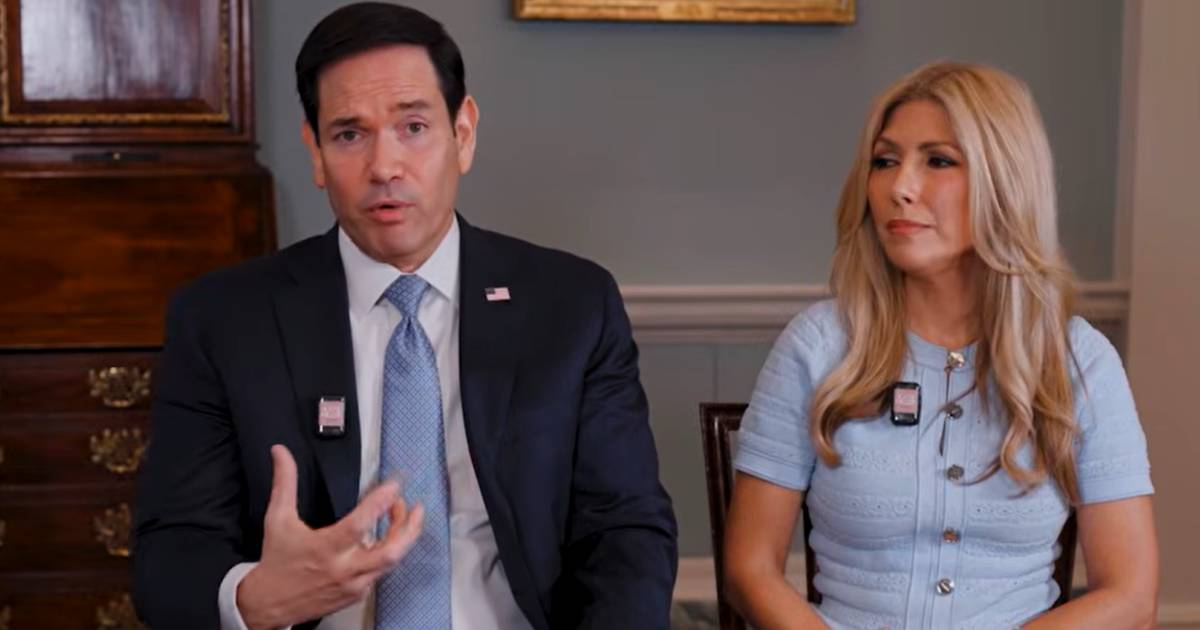
Marco Rubio does not hide the personal significance that Cuba holds in his life and political career. However, in a recent interview, the Secretary of State and the first Hispanic to lead U.S. diplomacy drew a clear line between his roots and his governmental responsibilities.
"I care about Cuba. Obviously, I have a personal connection to it, but I do not work for Cuba. I work for the United States," Rubio stated during an interview granted to Katie Miller at the Department of State, where he was accompanied by his wife, Jeanette.
The statement followed Miller directly asking whether Cuba could be “the next” after the U.S. operation that culminated in the capture of Nicolás Maduro in Venezuela.
Rubio avoided responding in those terms, but he expressed confidence that, before the current administration ends, Cuba will be on an “irreversible” path towards “a very different future”. He also warned that dismantling a system established over decades will require a transition and will not happen overnight.
However, when explaining why Cuba holds a priority position on Washington's agenda, Rubio explicitly distinguished his personal history from his institutional responsibility. "It is in our nation's interest to have a Cuba that is safe, stable, and aligned with the United States," he stated, before extending that same consideration to Venezuela.
When he took office as Secretary of State in January 2025, Rubio spoke in Spanish during his swearing-in ceremony and remembered his parents, Cuban immigrants who came to the United States in 1956. His appointment also made him the first Hispanic to lead U.S. diplomacy.
In April, he argued that Cuba cannot be analyzed in the same way as conflicts in the Middle East or Asia because it is located just 90 miles from Key West and within the American hemisphere. “That's why it matters to us; that's why it's important,” he stated at the time.
This geographic proximity has been further supported by another argument: the presence of Washington's strategic adversaries on the island. Rubio has accused the Cuban regime of hosting intelligence facilities linked to China and Russia, and warned that the United States will not allow foreign military or intelligence apparatus to operate with impunity so close to its shores.
The Secretary of State had already established a similar distinction in May. "The future of Cuba belongs to the Cuban people", he said at that time, while making it clear that Washington would indeed act against what it considers a threat to its national security. He also rejected the notion that U.S. policy aims to become a "nation-building" project from the outside.
Rubio warned at that time that a potential systemic collapse in Cuba could directly affect the United States through a new migration crisis, violence, or instability just miles from its shores.
Her new words seem to precisely reinforce that point.
Related videos:
Filed under: