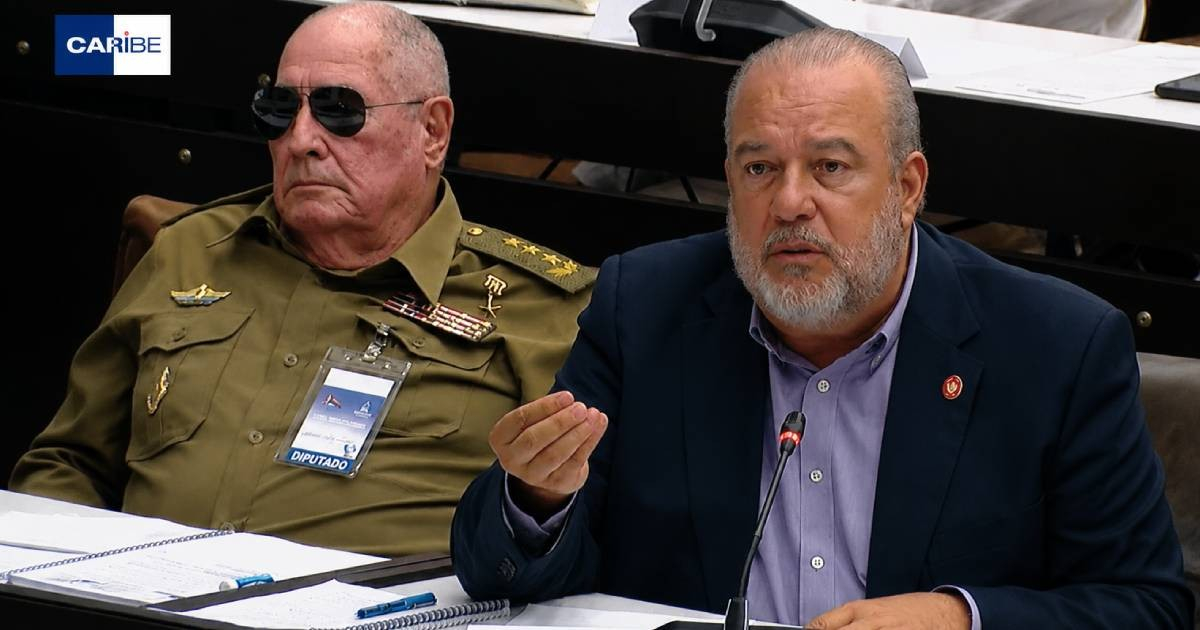
The Cuban Prime Minister Manuel Marrero Cruz stated this Wednesday that the economic transformations underway in Cuba will be “one hundred percent Cuban” and carried out “with full sovereignty,” dismissing the notion that the regime is copying the reform models of China or Vietnam.
According to the coverage by the official Juventud Rebelde, Marrero stated that Cuban socialism "cannot be a rigid theory" but rather a practice of adaptation, and that the ongoing measures reflect Castro's approach to update the model without renouncing its principles.
He said this during his speech at the panel "Fidel and the World Economy," held at the I International Colloquium "Fidel: Legacy and Future" at the Palace of Conventions in Havana.
The forum, which brings together more than 1,500 delegates from 63 countries and runs from August 10 to 13, was called to commemorate the centenary of Fidel Castro's birth, whose anniversary falls on this Thursday, August 13.
The regime uses it as a political stage to frame its economic reforms within the ideological legacy of the deceased leader.
The phrase "It’s not China, it’s not Vietnam" summarizes the prime minister's stance against those who point out the similarities between the reforms and the economic openings of those Asian countries.
The statement comes two months after the National Assembly approved, in an extraordinary session held on June 18 and 19, a package of 176 economic and social transformations grouped into 23 axes.
Among the most striking measures are the authorization of private banking under the supervision of the Central Bank, the establishment of private exchange houses, the removal of the 100-worker limit for small and medium enterprises (SMEs), the possibility for an individual to own more than one company, the opening up to foreign franchises, and the conversion of state-owned enterprises into joint-stock companies.
It is not the first time that the government has denied any connection to Asian models. On July 6, the Deputy Prime Minister Óscar Pérez-Oliva Fraga had already rejected that Cuba was reproducing "the model of any country", although he admitted that the Chinese and Vietnamese experiences had been analyzed.
In March, Miguel Díaz-Canel himself had promised before the Mexican newspaper La Jornada a "unique model" inspired by those experiences but with "Cuban peculiarities."
On July 30, Marrero appeared before the National Assembly to report progress: 110 out of the 121 measures planned for the June-July period had already been approved, which is 90.9% of the total.
In that same session, he warned that "the most important and perhaps the most difficult stage is beginning" in the implementation of the transformations, and reiterated that the government "is not straying" from socialism.
The economist Pedro Monreal noted in May that Cuba was late to the Chinese-style reforms and that structural obstacles, political issues, and U.S. sanctions make it very difficult to replicate that model.
The daily reality of Cubans—marked by prolonged blackouts, shortages of food and medicine, and an unprecedented exodus—contrasts sharply with the official optimism surrounding the colloquium and its statements on sovereignty and socialist adaptation.
The package of 176 measures also includes a reduction of the state structure from 27 to 21 ministries and an increase in the minimum wage in the budgeted sector, from 2,100 to 3,210 pesos starting this month, a figure that remains insufficient in the face of inflation accumulated in recent years.
Related videos:
Filed under: