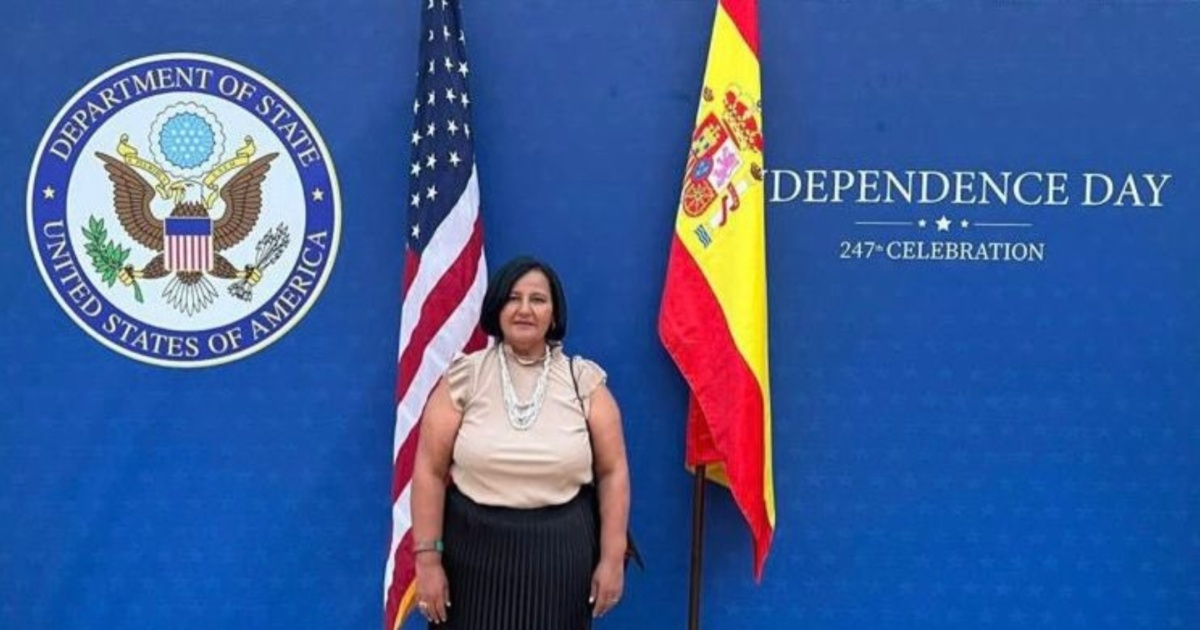
Dinorah Figuera, president of the National Assembly elected in 2015, landed this Wednesday in Venezuela from Spain to resume talks with the chavista regime as part of the democratic transition process promoted by Washington.
The opposition delegation that arrived at the General José Antonio Anzoátegui International Airport, in the eastern part of the country, also included former deputies Marco Aurelio Quiñones, Juan Miguel Matheus, Ramón López, and Jorge Millán.
The commission is expected to arrive in Caracas on the night of this Wednesday.
The negotiation process was officially launched on August 1 through a phone call between Figuera and Jorge Rodríguez, a representative of the Venezuelan government led by interim president Delcy Rodríguez. During the communication, both parties agreed on the general agenda and the start of in-person rounds in the capital.
The work agenda revolves around three key areas: support for the victims of the double earthquake on June 24, 2026, which left over 6,125 deceased, 16,740 injured, and nearly 18,000 people without housing; the strengthening of democratic institutions, including the restructuring of the National Electoral Council and the re-institutionalization of the Supreme Court of Justice; and the guarantee of political and civil rights.
Regarding assistance for the victims, Figuera stated to El Diario: "This will have a priority agenda that will signify acknowledgment of the area, the impact of this tragedy, how we will support the victims of this situation, and what we are committed to providing."
The opposition member specified that the process will extend until December 2026, when "all the product" of the work will be presented "formally."
The dialogue is set within the three-phase plan for Venezuela proposed by U.S. Secretary of State Marco Rubio: stabilization, economic recovery, and political reconciliation leading to a transition towards democratic elections.
The State Department supported the process on August 3 through its spokesperson Tommy Pigott, who stated that Washington is "confident that this work can yield tangible results for the Venezuelans."
Figuera publicly thanked Rubio for his support, and the official statement from the National Assembly in 2015 noted that "this beginning marks a new chapter in the struggle to build a dignified future for all Venezuelans."
The Venezuelan politician and doctor is a former deputy and a key figure of the National Assembly, recognized institutionally by the opposition and the international community as the last legitimate parliament of Venezuela.
Figuera left Venezuela in 2018 and settled in Valencia, Spain. She left the country due to reports of threats, harassment, and political persecution related to her role in the opposition, especially after serving as a spokesperson in the case of Fernando Albán, an opposition member who died in the custody of SEBIN in 2018.
The political context in which these negotiations are taking place is unprecedented: Nicolás Maduro has been imprisoned in the United States since January 3, leaving the Venezuelan government under the leadership of Delcy Rodríguez.
This is considered the ninth attempt at dialogue between chavismo and the opposition, notably having the explicit and active support of Washington.
María Corina Machado and Edmundo González Urrutia were excluded from the negotiation table, as Washington chose the National Assembly of 2015 as the formal channel.
Both issued a conditional support statement for the process, clarifying that they did not participate in its "design, construction, and functioning," and made their support contingent on the release of political prisoners, the restoration of democratic institutions, and a presidential electoral timeline.
The State Department expressed its satisfaction with the progress of the negotiations and emphasized that the process "significantly contributes" to the three-phase plan to achieve stabilization, economic recovery, and political reconciliation in Venezuela.
Related videos:
Filed under: