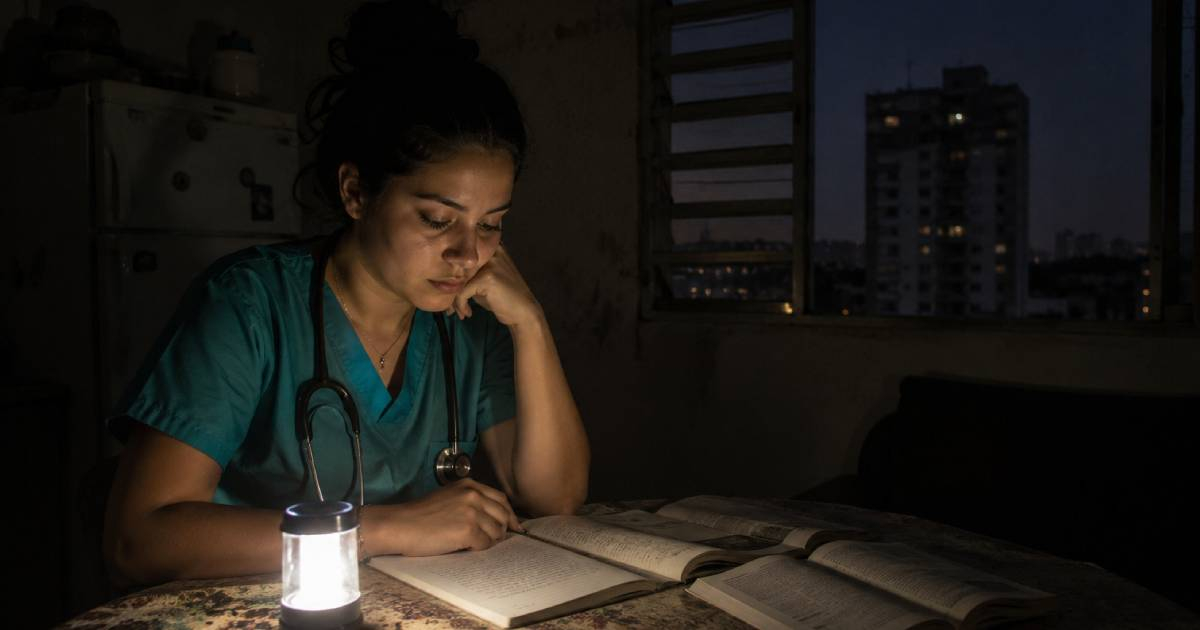
The young Cuban doctor Laura Adalys Guillén León, a cardiology resident at the Ernesto Che Guevara Cardiocenter in Santa Clara, turned her 26th birthday into a powerful testimony about what it means to practice medicine amid the crisis facing Cuba.
In a post on Facebook, accompanied by a photograph taken almost in the dark, he described this anniversary as "the darkest of my life, with barely 2 hours of electricity."
Guillén León, who also serves as a professor at the University of Medical Sciences of Villa Clara, stated that she reached the age of 26 without reasons to celebrate: enduring prolonged blackouts, difficulties accessing water, internet connectivity issues, and an insufficient salary to meet her basic needs.
"In today's Cuba, it hurts a lot to be 26 years old, to have a degree and not have a decent salary, running water, cold water, or internet connection," he wrote.
The young woman summed up her experience with a phrase that reflects the accumulated exhaustion: "26 years of mandatory resistance and survival."
One of the most powerful points in his reflection highlights the gap between the years spent studying Medicine and the living conditions he now faces as a professional.
"In Cuba, turning 26 and being a doctor makes you realize that you’ve wasted 6 years of your life struggling to obtain a degree that is worth the same as the salary: NOTHING," he stated.
The doctor also questioned a system that, in her words, "rewards silence, keeping one’s head down, mediocrity, nepotism, and corruption," while more and more young people see emigration as the only alternative to build a future.
"It hurts more to be 26 years old than to have the back of a 62-year-old person, to see yourself without a present and even more so without a future, and to be condemned to spend the rest of your life in a madhouse called Cuba," she added.
Guillén León also questioned the idea that the medical vocation should indefinitely justify the shortcomings and sacrifices imposed on healthcare professionals.
"Having a vocation is not synonymous with endless masochism; sacrifice and resilience are temporary, not permanent, and they end and wear out," she warned.
Doctors who are leaving and salaries that are insufficient
His testimony reflects a significant loss of professionals in the Cuban healthcare system. According to figures from the National Office of Statistics and Information (ONEI), Cuba lost more than 30,000 doctors between 2021 and 2024, decreasing from 106,131 physicians to 75,364.
The salary situation offers little relief as well. The salaries for medical staff established by Resolution 17/2026, in effect since July 1, set the monthly income of a resident at 8,115 pesos, approximately 13.2 dollars based on the informal exchange rate used as a reference. Meanwhile, the estimated basic basket for two people in Havana exceeds 41,000 pesos per month.
Economic hardship is compounded by an energy emergency. In the early days of August, Cuba experienced two national blackouts in less than 24 hours, amidst power outages that last for much of the day in many regions.
Guillen León's post generated dozens of supportive messages and testimonials from other professionals who said they could relate to his words.
"I arrived here at 38, look at how much life and how many dreams the revolution stole from me," remarked a nephrologist who emigrated from Cuba.
Another colleague recalled the precarious situation that healthcare professionals face and stated that in Cuba “a doctor is worth less than anyone”.
Guillen León concluded his reflection with a call to stop accepting shortcomings as an inevitable part of everyday life.
"It is time to open our eyes, stop romanticizing the situation, normalize misery, and at the very least, make use of something as basic as freedom of expression."
Related videos:
Filed under: