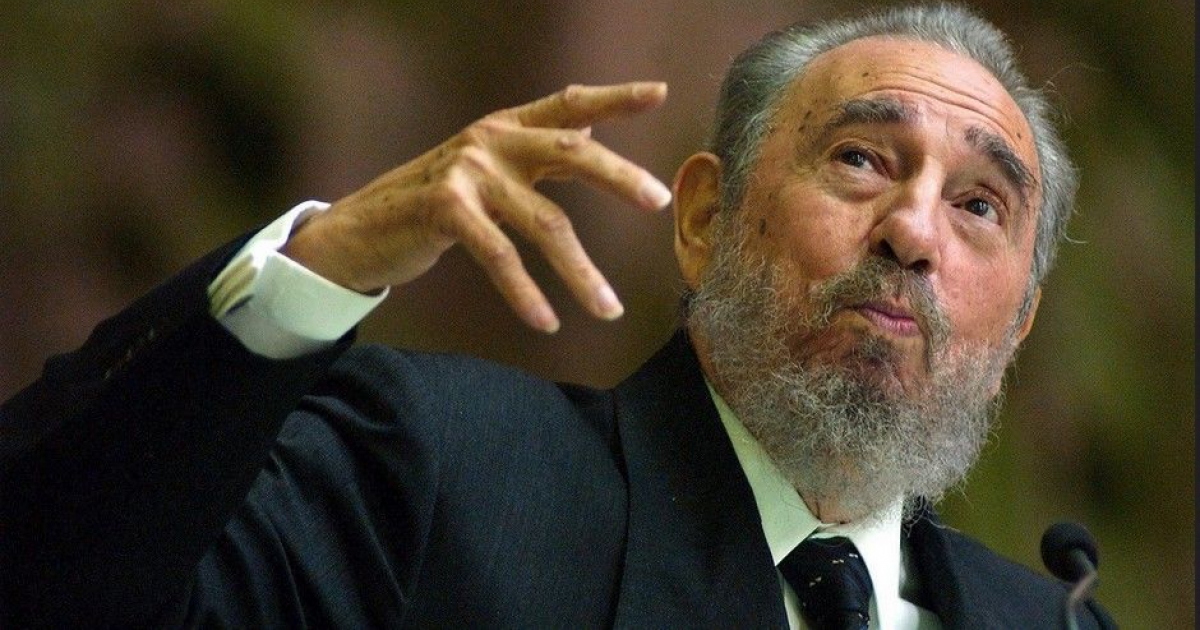
Fidel Castro was not the leader that his increasingly dwindling supporters claim him to be. He was a long-time fraud, a man whose story was built on systematic deception, calculated betrayal, and an insatiable thirst for power devoid of limits or scruples.
From adolescence to old age, his trajectory reveals not the hero of official propaganda, but a manipulator who always charged excessively—whether for a simple slap or the most innocent criticism—and who ultimately destroyed the country he swore to redeem.
The project that was sold as the redemption of the homeland quickly revealed itself to be one of the greatest political scams of the 20th century: it promised sovereignty, prosperity, justice, and equality; instead, it delivered misery, repression, mass emigration, and a dictatorship that survives only through its effective and criminal repressive machinery, while prostituting the "principles" it claimed to defend for years.
The signs of his true character manifested very early. At eleven, he threatened to set the family house on fire if he was not sent back to La Salle school. At fourteen, he wrote to Franklin D. Roosevelt offering the “biggest iron mines in the country” and asking for a ten-dollar bill; in that letter, he was already lying about his age, claiming to be twelve. He was not a dreamy child; he was someone who learned early on that others could be bent to his convenience.
By the age of twenty, he was already immersed in the gangster world of the University of Havana. He became involved with the Revolutionary Insurrectional Union (UIR), a rival of the Revolutionary Socialist Movement (MSR). Credible sources link him to the murder of Manolo Castro and the assassination attempt on Leonel Gómez, both members of the MSR. Violence was never foreign to him; he always used it as a tool to achieve his ambitious goals and to take revenge on his opponents.
That thirst for revenge and the need to instill terror in others recurred throughout his life. It is said that during the failed expedition of Cayo Confites, aimed against Trujillo, Eufemio Fernández dealt him "a good slap." On April 20, 1961, Fernández was executed by firing squad. Juan Manuel Capote Fiallo, head of the Modelo Prison in Isla de Pinos, who had treated the Moncada assailants with relative leniency, also ended up executed. The same fate is attributed to the common criminal nicknamed “Cebolla,” who was hostile towards the "moncadistas." Castro did not forget, nor did he forgive. He turned any slight, no matter how minor, into a matter of blood debt.
His political trajectory is a monument to deceit. In 1947, he joined the Partido del Pueblo Cubano (Orthodox) led by Eduardo Chibás, a nationalist, populist, and notably anti-communist movement. Years later, in 1961, he declared himself a Marxist-Leninist. In 1995, at the Aula Magna of the University of Havana, he stated that it was there he converted to communist ideology. So, why did he never join the Partido Socialista Popular (PSP), headed by Blas Roca, which was legal at that time? The answer is simple: because he was always a fraud.
He used the Orthodox as a platform, appropriated their moral capital, took advantage of many, and once in power, betrayed each of the promises that had allowed him to rise. It wasn't a sincere ideological evolution, but rather a power calculation. Castro was never faithful to a doctrine; he subordinated doctrines to his ambition for absolute control.
The outcome of that project can be summed up in a brutal contradiction between what was promised and what was delivered. It promised national sovereignty but ended up surrendering the country to Soviet dependence. It promised prosperity and produced chronic scarcity. It promised social justice and built a society divided between those with access to foreign currency and those surviving on miserable wages. It promised a "new man" and generated a manipulable and amoral citizen.
In economic terms, the disaster was systematic. Castro largely eliminated private initiative, collectivized agriculture, nationalized businesses, commerce, and services, and took that logic to the extreme with the Revolutionary Offensive of 1968. The result was rationing, low productivity, and external dependency.
The Ten Million Harvestsymbolized his suicidal voluntarism: it mobilized the entire country, disorganized other productive sectors, and did not even reach the goal he had proclaimed with fanfare. Cuba shifted from the sphere of influence of the United States to relying almost entirely on the Soviet Union. When the Soviet subsidy disappeared, his model revealed its complete fragility.
The subsequent paradox is devastating and reveals the moral bankruptcy of its project. The very regime that denounced capitalism for decades as a perverse exploiter of the working class, ended up desperately seeking foreign investment, promoting Western tourism, reluctantly authorizing small private businesses, sending athletes to professional leagues, and selling medical services abroad to obtain foreign currency. They ended up using the mechanisms they had condemned as intrinsically evil. Despotic socialism could only survive by compromising with the market it vowed to destroy.
In political terms, the failure was equally deep and bloody. Castro promised to restore the Constitution of 1940, hold free elections, and return the freedoms abolished by Batista. Instead, he destroyed pluralism, banned independent parties, subordinated the press, nullified any possibility of genuine elections, and built a one-party system where power was concentrated in his person and, later, in his family. Thousands of Cubans were imprisoned for political reasons, many were executed. Hundreds of thousands faced long sentences in their infernal prisons and forced labor camps. Acts of repudiation, constant surveillance, and persecution became widespread.
Millions ended up leaving the country, and many others are still going to other lands in search of freedom and opportunities. Their "revolution" did not liberate Cuba, as their heirs and fanatics claim; rather, it turned the island into their fiefdom and a vast open-air prison.
It also failed to fulfill the promise of a reconciled and equitable society. Cuba ultimately became deeply divided, between rulers and the ruled, between those who have access to hotels, foreign currency stores, and privileges, and those who can barely obtain basic food; between those who can travel and those who live trapped. Equality turned into equality in misery for the majority and into privileges for a select few.
The historical balance is unequivocal: Fidel Castro enslaved an entire nation and destroyed a prosperous country. He built a system that claimed to have surpassed capitalism and that, decades later, needs private initiative, the market, remittances, tourism, and foreign investment to avoid total collapse.
That is the definitive symbol of the failure of a man's project who presented himself as a redeemer and ended up as the architect of the ruin of the entire nation. It was not a miscalculation; it was the logical outcome of the unchecked ambitions of a sinister figure who admired Hitler, Stalin, and Mao Zedong. He even copied the most famous phrase from the German National Socialist and gestured like Mussolini.
From the letter to President Roosevelt to the belated declaration of Marxist-Leninism, from the settling of scores and political vendettas to the systematic destruction of the economy and basic freedoms, Fidel Castro remained consistent with himself: a criminal con artist who left in his wake a shattered country, immense suffering, a deeply damaged society, and a historical lie that his heirs still try to uphold with propaganda and repression.
History does not absolve Fidel Castro, just as it does not absolve Hitler. On the contrary, it condemns him to life imprisonment in his eternal garbage dump.
Related videos:
Filed under:
Opinion article: Las declaraciones y opiniones expresadas en este artículo son de exclusiva responsabilidad de su autor y no representan necesariamente el punto de vista de CiberCuba.