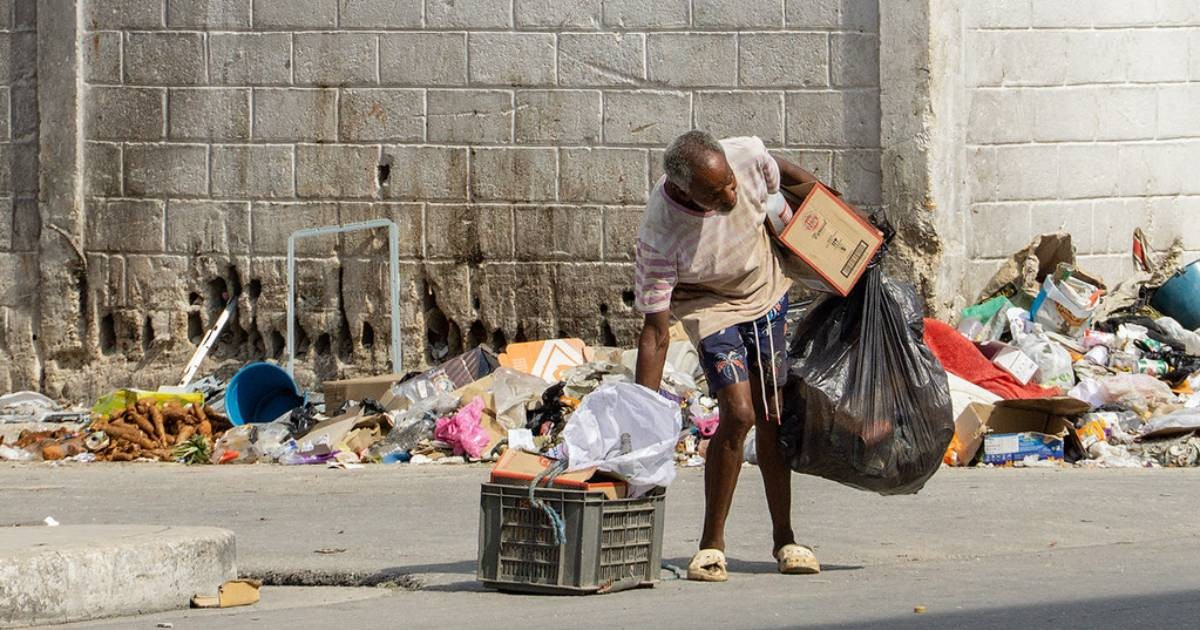
Extreme poverty now affects 94% of Cubans, while eight out of ten people have had to skip a meal due to a lack of money or food, according to the IX Report on the State of Social Rights in Cuba, which depicts one of the most critical social landscapes on the island in recent years.
The study, conducted by the Cuban Observatory of Human Rights (OCDH) and the Cuba Social Rights Observatory, reflects a further deterioration compared to previous measurements by the organization and identifies economic precariousness, food insecurity, and power outages as the main concerns of the population.
The research is based on 1,318 interviews conducted between June 27 and July 29, 2026, across 79 municipalities in all Cuban provinces. According to its authors, the survey has a margin of error of ±2.8 percentage points and a confidence level of 95%.
To calculate extreme poverty, OCDH used a reference line of $1.90 per day per person and a median exchange rate of 510 Cuban pesos (CUP) per dollar, recorded between October 2025 and June 2026.
With those parameters, a household of three people would need to have at least 87,210 CUP per month to surpass the threshold used in the study.
The gap between that figure and the real income reported by families is significant: 68% of Cuban households receive less than 20,001 CUP per month, which is less than a quarter of the income deemed necessary under that calculation.
Eight out of every ten Cubans have skipped a meal
One of the most striking pieces of data from the report pertains to nutrition.
Eight out of ten respondents stated that they have missed breakfast, lunch, or dinner at least once in the past six months due to lack of money or food shortages.
The situation is even more serious among those over 61 years old, where the ratio is close to nine out of ten people.
63% of households also acknowledge that they have difficulty even purchasing the most essential products, while only 6% can afford expenses that go beyond their basic needs.
The results thus reveal a crisis that extends beyond the loss of purchasing power: for a significant portion of the population, the lack of income is already directly affecting something as fundamental as being able to eat every day.
Blackouts, garbage, hospitals, and water: public services at a minimum
The deterioration is also reflected in the perception of public services and infrastructure.
The electrical grid receives the lowest rating. 95% of respondents believe it is in poor condition, in a year characterized by prolonged blackouts and days when some areas of the country have reported up to 25 hours without electricity.
Garbage collection follows, rated negatively by 87%; internet and phone services by 86%; water supply and sewage systems by 84%; hospitals by 82%; and roads by 80%.
It is therefore not surprising that when Cubans are asked about their most pressing problems, power outages rank first, identified by 70% of the participants.
The food crisis ranks second, at 52%, followed by the cost of living, mentioned by 45%.
95% disapproves of the economic and social management
The deterioration of living conditions is also reflected, according to the study, in a strong disapproval of government management.
95% of respondents view the economic and social management of the government led by Miguel Díaz-Canel and Manuel Marrero Cruz negatively, with 73% describing it as "very negative."
Only 3% gives a positive rating. According to the report, that support does not exceed 2% in any of the age groups analyzed.
The expectations regarding the latest economic measures are not favorable either.
Eighty-four percent distrust that the package of 176 measures presented by the government in June 2026 will improve the situation in the country. Among young people aged 18 to 30, skepticism rises to 88%.
Despite this, approximately half of the respondents hope for some positive change in the next six months, although this expectation does not necessarily imply trust in the authorities.
In fact, 77% demand simultaneous political and economic transformations, while support for maintaining the current situation is virtually nonexistent.
Unsafe housing and elderly people living on the streets
Precariousness also extends to housing.
According to the report, 21% of the population is in housing insecurity, a category that includes those who lack ownership or permission to occupy the housing they live in, reside in shelters, or are homeless.
In addition, 7% of the housing would be at risk of collapse.
One of the most concerning data points again affects the elderly: individuals over 70 years old make up 44% of those living on the street, according to the results gathered by the OCDH.
The situation coincides with a profound demographic crisis. In 2025, Cuba recorded 136,214 deaths compared to only 68,064 births, meaning that approximately two people died for every one born.
The effective population of the country fell to 9,434,593 inhabitants, over 313,000 fewer than in 2024, amid a combination of low birth rates, aging, and migratory exodus.
From 61% to 94% extreme poverty in four years
The IX Report reflects a new setback compared to the previous study by OCDH, published in September 2025, when the organization estimated that 89% of Cubans lived in extreme poverty and placed the disapproval of government management at 92%.
In just four years, according to the organization's series of studies, the proportion of the population considered to be in extreme poverty rose from 61% to 94%.
For Yaxys Cires, director of Strategies at OCDH, the results show that the discontent of the population goes beyond immediate economic difficulties.
"The majority demand for political and economic transformations confirms that Cubans do not want superficial changes or new promises, but rather a profound change that brings political, economic, and social rights," he stated during the report presentation.
The numbers depict, in any case, a reality that is particularly harsh for millions of families: incomes that are insufficient to cover basic needs, individuals who go without food due to a lack of resources or money, elderly adults who are particularly vulnerable, and public services that receive negative ratings from an overwhelming majority of the population.
Related videos:
Filed under: