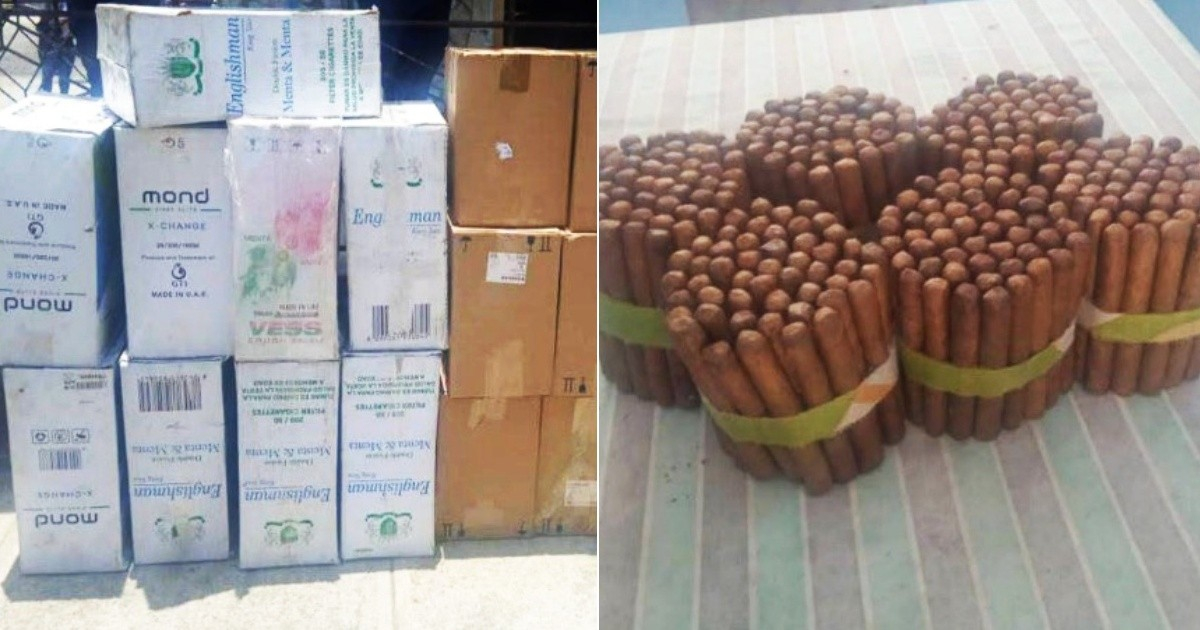
Agents of the National Revolutionary Police (PNR) intercepted this week at the Control Point of Cristo, at the entrance of Santiago de Cuba, several individuals who were transporting more than 300 cigars and a substantial number of boxes of Popular cigars in a private vehicle.
The detainees did not carry documentation that verified their legal origin, according to reported by the official Facebook profile "Héroes del Moncada."
According to the publication, the merchandise was intended for sale at high prices in the informal market.
“Some people who were nearby watched in astonishment as the police acted, carrying out their routine inspection of the vehicle and detecting the illegal cargo,” noted the official source.
The seizure that solves nothing
The operation, presented by the government-controlled channel as a police success, sparked a public reaction in the comments that goes far beyond the specific event.
The predominant tone was not one of applause, but rather of irony and distrust.
"That's great. Now I can go buy them at the store!" wrote a user, in a sentence that encapsulates the widespread skepticism.
The question that was asked repeatedly and with the most insistence was a single one: where did that merchandise come from?
"The million-dollar question: where did all that come from?" wrote another commenter.
Y another added: “We must investigate thoroughly until we reach the supplier. It is incomprehensible that there are no cigarettes in the stores while they appear in the black market in whatever quantity one desires.”
The contradiction pointed out by Cubans is glaring: the rationing system reduced the cigarette allowance to two units per person in 2025, when in 2024 it was already only four packs per month.
The official price of a box of Populares in the store is 30 Cuban pesos, but in the informal market, it can reach between 450 and 600 pesos, meaning up to 20 times more.
"They just changed owners."
Several commentators expressed doubts about the final destination of the confiscated items.
"In the end, those cigars just changed hands, because they will probably end up being sold at the same price they have on the street," one of them pointed out.
Another was more direct: "Only if production and distribution are organized will the situation normalize. Production seems to be functioning; the problem lies in distribution."
That perception is supported by documented facts.
In April 2026, a worker from EMPA in Jiguaní was arrested for stealing thousands of packs from a state warehouse, causing damages exceeding 10 million pesos.
In July, authorities intercepted the illegal transport of quintals of dry tobacco leaves from Pinar del Río to Havana.
And that same month, Customs seized over 4,200 cigars at José Martí airport in Havana on a flight to Panama.
The Cristo Control Point is not unfamiliar with this type of operations.
In January 2025, at the same inspection point, the PNR intercepted a motorcyclist carrying over 85 rolls of locally-made cigarettes without legal documentation.
The pattern repeats itself: goods that never arrive at the warehouses show up in the hands of individuals ready to sell them at black market prices.
Related videos:
Filed under: