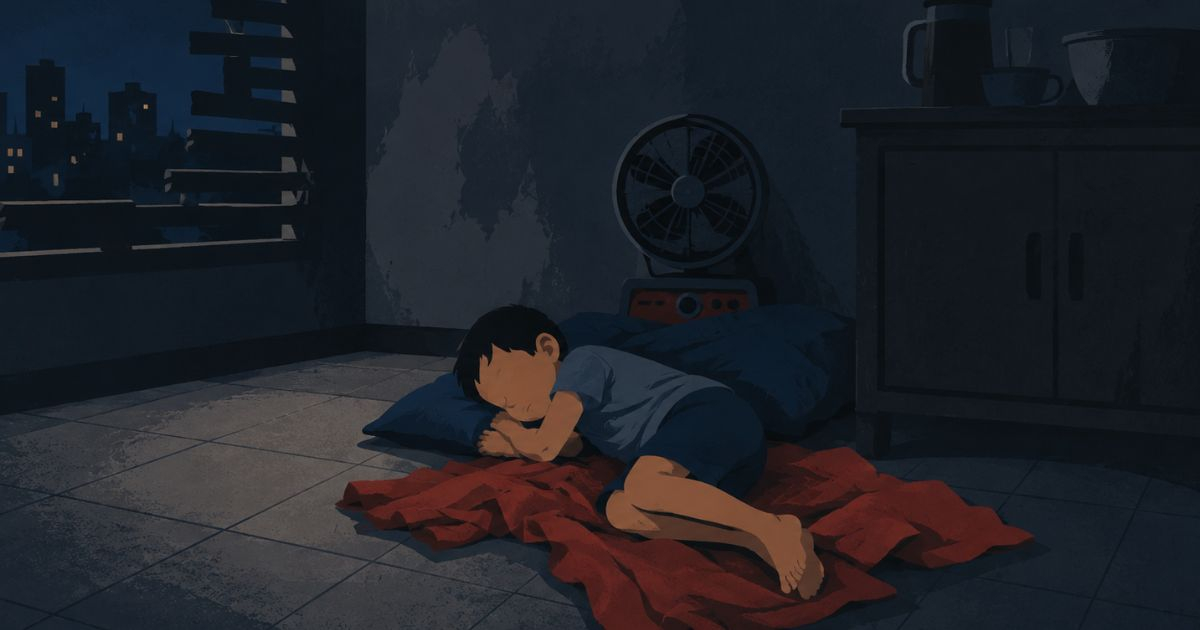
A mother from Havana made a desperate call regarding the prolonged blackouts and the difficulties in obtaining food and water, while stating that her sick son is directly suffering the consequences of the crisis: “Turn on the power, I have my sick son. We don't know what it's like to sleep with electricity in Juanelo. Enough already,” she demanded.
Gaby Milan Zequeira Hernandez shared her testimony in the Facebook group Cuban Fighting Mothers 2 Support, where she described the exhaustion accumulated from nights without electricity and expressed her frustration over a situation that, she claims, is affecting her entire family.
"An electric generator does not solve my life or my son's," wrote the woman, who accompanied her complaint with images of the child lying on the floor of their home during one of the power outages.
His message quickly shifts from being merely a complaint about the lack of electricity to a heartfelt outpouring about the living conditions his family faces.
"I am going to die in the agony, the despair, the hopelessness, the disappointment of a dead government that does not know how to lead," said the distressed woman, whose plea joins those of other mothers who have erupted against the regime.
The Cuban woman assured that she increasingly hears the same advice: to leave the country because demanding change within Cuba does not lead to solutions.
The best option is to leave this country because neither talking nor shouting will solve anything," he quoted, before questioning the conditions in which millions of people live.
"We're like we're imprisoned, but in our own homes. We have no electricity, no water, no food," he added.
He also lamented depending on what relatives can send from abroad to meet basic needs. His desire, he explained, is to be able to work and support his children with his own income, without emigration being seen as the only option.
"I don’t want to live like this. I want to work and, with the sweat of my brow, provide everything my children and my family desire. Why do I have to leave Cuba to survive when this is my country, where I was born?" questioned the young woman, presenting the same dilemma faced by thousands of others.
The concern for her son occupies a significant portion of the report. In addition to his current health condition, the mother expressed fear for his future and voiced her opposition to the possibility of him having to serve in the military on the island.
For Gaby, behind all those problems lies a weariness that doesn't show up in the statistics: families physically and emotionally exhausted after so many nights without rest.
“Gentlemen, if you wish, kiss your family, hug them, because this is slowly killing us,” the young woman said, adding: “Not sleeping well all the time is already something that kills you slowly.”
The mother concluded her message by making it clear that it was, above all, a venting of her feelings regarding a situation she finds increasingly difficult to endure: "This is my outlet as a mother," she wrote, before also mentioning the burden of inflation and high prices on the family's economy.
The testimony adds to a series of complaints from families that reveal how power outages have transcended being merely an issue of lighting.
Prolonged outages impact rest, food preservation, the ability to cook, and the capacity to alleviate high temperatures inside homes.
Just a few days ago, another mother broke down in tears after losing milk and meat after being without electricity for 48 hours, products she had obtained with great effort to feed her children.
The problem does not end with the families living on the island either. Efforts to find alternatives to the power outages have led Cubans residing in South Florida to spend large amounts of money on power stations, batteries, and solar panels to assist their relatives.
Children are among the most affected by this reality. Earlier this month, the image of a baby drenched in sweat during a blackout once again highlighted the consequences of the heat inside homes where fans and other electric appliances cannot be used.
Other cases have shown even graver consequences: a mother displayed her child covered in welts from mosquito bites while reporting sleepless nights, and in Santiago de Cuba a nine-month-old baby suffered burns while his family was cooking with charcoal during an extended blackout.
Families have also been seen looking for any space to escape the night heat. In July, several children were photographed sleeping in a doorway in Havana during power outages.
Related videos:
Filed under: