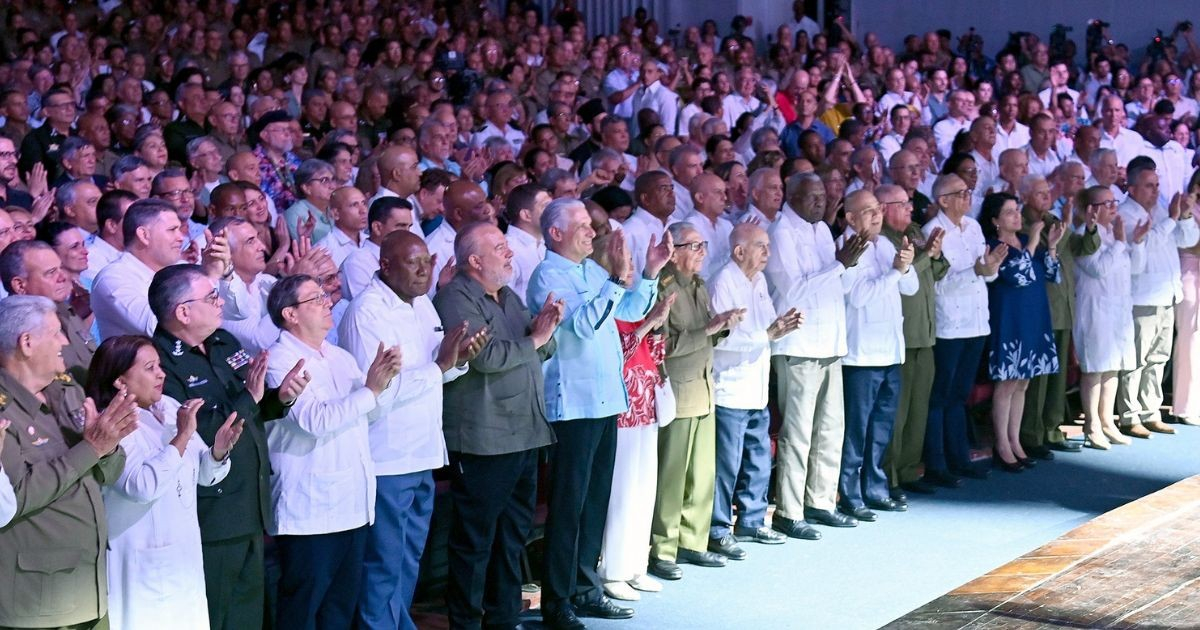
Current Cuba reproduces some of the inequalities characteristic of feudalism: a relatively protected elite from deprivation while the average citizen bears the burden of scarcity, blackouts, lack of food, and the deterioration of basic services.
The analysis was published by the food security monitoring organization in Cuba Food Monitor Program (FMP) under the title "Contemporary Feudalism: Protected Elites and Sacrificed Citizenship in Cuba."
The text argues that, although European feudalism and 21st-century Cuba are different historical realities, there are similarities in how power shifts the costs of its decisions onto those with less ability to avoid them.
The comparison begins with a simple idea: in the feudal system, peasants were required to provide labor, harvests, and tributes to sustain a power structure that offered them little protection from the consequences of wars.
FMP believes that something similar is happening today in Cuba, although the sacrifice is no longer measured in harvests delivered to the feudal lord, but rather in the daily loss of basic living conditions.
"The war no longer takes the form of a sword battle, but rather a prolonged economic, political, and social wear." This analysis highlights that at the center of this wear are the issues directly affecting Cuban households: food, medicine, fuel, electricity, and drinking water.
According to FMP, while major political decisions are made far removed from those deprivations, the citizenry acts as a sort of buffer against the crisis.
The average Cuban does not decide the government's strategy or the pressure policies coming from abroad, but ultimately experiences their consequences directly.
An elite that does not experience the same crisis
One of the most critical points of the text is what FMP refers to as a "class immunity".
The organization maintains that the Cuban power structure enables certain state-linked sectors to access resources, supplies, security, and services under conditions that are very different from those faced by the majority of the population.
While many families rely on the supply booklet, remittances, or markets with prices that are difficult to afford, the analysis indicates that sectors close to the state apparatus have supply networks and backup mechanisms that cushion problems like power outages or shortages.
The politician does not experience deprivation in the same terms as the citizenry: they manage it, the document summarizes.
The food situation creates an especially grave context for that comparison.
A survey presented in May by FMP and Cuido60, based on 2,513 valid responses from all 16 provinces, found that 33.9% of the consulted households had at least one person who went to bed without eating during the studied period.
Moreover, 79.4% spent 80% or more of their monthly income on food.
The organization has also previously scrutinized the management of resources.
In May, FMP accused GAESA of contributing to the worsening of the food crisis through its concentration of foreign currency, imports, and distribution chains.
The report questioned why strategic sectors maintain privileged access to resources while a growing portion of the population struggles to buy food.
The criticism also extends to sectors of the exile community
The analysis does not limit its questioning to power within Cuba. FMP argues that certain political sectors of the exile community can also be part of this asymmetry by promoting pressure strategies from environments with greater economic, legal, and personal security than those in which the island's population lives.
For the organization, although the government and those sectors of the exile pursue completely opposing goals, there is a point of agreement: those who design or defend certain political strategies do not always directly suffer their material consequences.
The citizen, on the other hand, can end up reduced to a victim or symbol in a dispute over which they have little decision-making power.
The document also questions the permanent construction of absolute enemies. According to its analysis, the government uses the confrontation with the United States to justify sacrifices and restrictions under the idea of "resistance", while the more polarized sectors of the exile community may resort to an equally rigid logic surrounding the need to defeat the regime.
FMP believes that this dynamic sidelines the immediate human cost.
A crisis that reaches even the dinner table
The parallel with feudalism emerges as food deterioration extends far beyond the mere lack of products.
Another recent analysis by FMP warned that Cuba is losing its ability to produce, transport, preserve, and distribute food, to the extent of describing the supply chain as "broken."
That study indicated that 97.65% of the households surveyed had experienced difficulties accessing essential products and described how carts, adapted bicycles, and family or informal networks are partially replacing logistical structures that are no longer functioning regularly.
For Food Monitor Program, the problem ultimately goes beyond a series of economic mistakes.
His conclusion is that the crisis may ultimately become a way of functioning within the system itself: power no longer necessarily guarantees well-being, but rather manages precariousness while keeping the population mobilized around a constant threat.
From there arises the question with which the analysis practically concludes: not only when will the Cuban crisis end, but who gains power, legitimacy, or influence from its continuation, and who becomes the individuals forced to bear its consequences.
Related videos:
Filed under: