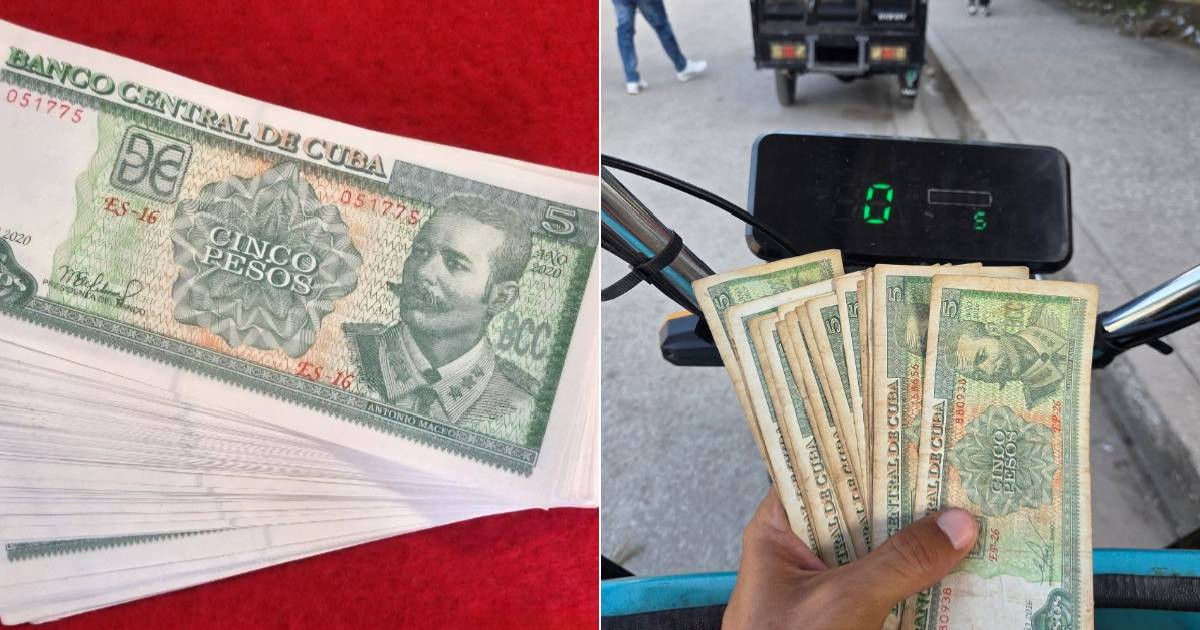
The content creator and administrator of the Facebook page Holguín en fotos launched this Saturday an initiative to purchase goods or services using five-peso bills and redistribute them among those in need, following reports of the rejection of that denomination.
The proposal emerged after receiving hostile comments on one of its posts about the issue shared the day before. One of the users wished for all of his clients to pay him in five peso bills, to which he responded by turning the comment into the starting point of his initiative.
"As I can be somewhat stubborn, just look at what I'm going to do with them," he wrote.
The proposal involves calling on entrepreneurs or ordinary individuals who have a useful product or service to offer it in exchange for five-peso bills.
Subsequently, that item will be given to someone who needs it, who shall pay for it with another bill of the same denomination.
"Each bill will be used to purchase something useful or necessary for someone in need, giving the money a value even if it's symbolic," explained the creator, who aims for the recipients to receive the products without perceiving them as a simple donation.
The initiative also calls on other content creators to contribute to its dissemination. "I refuse to believe that solidarity and love for one's neighbor have been lost in this town," he stated.
The proposal arose after the creator himself mentioned that someone asked him if they could pay for the hospital fare with five peso bills.
In that previous post, he pointed out that private businesses refuse low-denomination bills because their wholesale suppliers do not accept them either.
According to their complaint, the rejection extends even to 10, 20, and up to 50 peso bills. The creator also warned that refusing to accept a payment constitutes a violation of the law.
The issue particularly affects those who receive cash directly from state banks, including retirees and workers who may receive their income in low-denomination bills.
This cascading rejection hits retirees and workers who receive cash directly in state banks particularly hard, often in low-denomination bills.
The Bank of Credit and Commerce warned that this practice constitutes a "blatant violation of citizens' rights" and that "no economic actor has the authority to choose which denominations to accept." Despite the warnings, the practice has not stopped.
The phenomenon is a direct consequence of the collapse of the Cuban peso, which lost more than 95% of its value against the dollar between 2020 and 2026.
In that context, low-denomination bills become unwieldy in volume for commercial transactions, and no one wants to hold onto them.
The post generated extensive debate on social media, with most comments expressing support. "Excellent proposal, it is demonstrated that often the value lies not in the production cost but in the purpose behind it," wrote a follower.
Another pointed out that "the lack of sensitivity and love for others" is one of the most serious problems facing Cuban society today.
There were also those who wondered, with genuine concern, whether the five-peso bills had lost all their legal value.
While the government issues 2,000 and 5,000 peso bills without addressing the underlying monetary chaos, a creator from Holguin is attempting to show that a five peso bill can still make an impact when there is a will to circulate it.
Related videos:
Filed under: