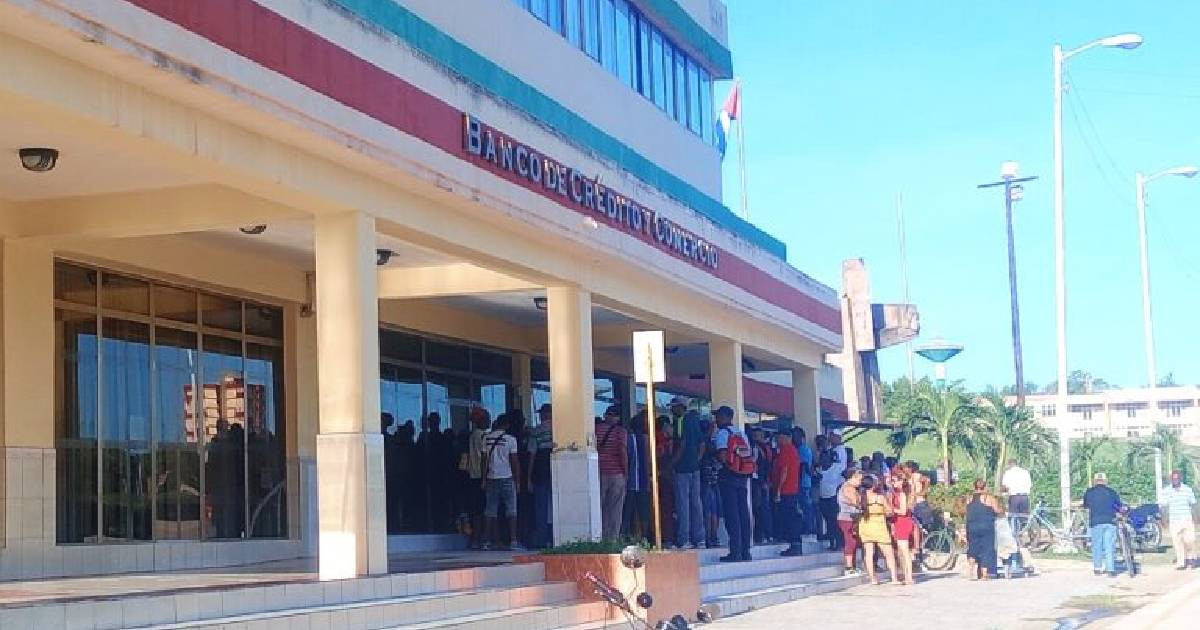
The Banco de Crédito y Comercio (Bandec) in Guantánamo announced this Friday that it is progressing in the hiring of private businesses as financial agents to directly pay pensions to retirees in cash at their establishments, while offering a package of incentives to those who voluntarily participate.
The announcement was made by Júder Ortiz González, the accounting deputy director of the Provincial Directorate of Bandec in the easternmost of the Cuban provinces, who also specified that the distribution of checkbooks for August will begin on Monday, August 18, and will extend into the first days of September, with five days of prioritized service.
Ortiz clarified that participation from economic actors is not mandatory, but he made it clear that those who cooperate will receive preferential treatment from the bank, noted a report from the station Radio Guantánamo.
Among the promised benefits are financial bonuses for each "extra cash" transaction made by retirees, priority in banking services, expedited loan applications, and preference for accessing cash for their own business operations.
The deputy director was explicit about the consequences of not participating: "It's not the same for someone who becomes a financial agent, helping the bank carry out the payment, as for an actor who does nothing. So all those analyses will be taken into account when interacting with an economic actor."
The official argument for transferring this function to the private sector is to alleviate the long lines that retirees face at bank branches. "By being closer to the actor, of course, they don't have to wait in as many lines; they don't have to spend one, two, or three days to cash their checks," Ortiz stated.
At the time of the announcement, the hiring process was still in the analysis phase, without any details on how many businesses have been incorporated or when they will start operating effectively as payment points.
This initiative in Guantánamo replicates a national scheme that has been underway for months. The pilot plan started in April in four municipalities of Havana and expanded in May to Holguín, where about 20 micro, small and medium enterprises began to pay pensions to nearly 5,000 retirees.
In July, the Central Bank of Cuba formalized it as a nationwide measure within the package of 176 economic measures approved by the National Assembly.
The background is a structural liquidity crisis, with more than 50% of the country's ATMs being out of service or empty, while retirees wait several hours in line to withdraw their money.
Cuba has over 1.7 million retirees whose minimum pension is 4,000 pesos per month, less than 10 dollars at the informal exchange rate, while a person would need more than 30,000 pesos per month to purchase a basic basket of goods.
The economist Elías Amor has been the most outspoken critic of this framework. According to his analysis, the payment of pensions is a state responsibility that should not be shifted to the private sector.
He also warned that the measure could become a pretext to sanction or close businesses that are unable to meet the cash demand.
"The first thing I propose is to immediately eliminate this madness. This is just another one of the many ideas that the Castro regime has, which later go wrong, and they then blame the blockade and the embargo for what fails," stated the economist.
The situation in Guantánamo is particularly tense. In July, the provincial government admitted that the banks did not have enough cash, with a daily shortfall of at least three million pesos.
Meanwhile, local authorities threatened to impose fines on businesses that do not accept electronic payment transfers, creating simultaneous pressure on the private sector from various fronts.
Related videos:
Filed under: