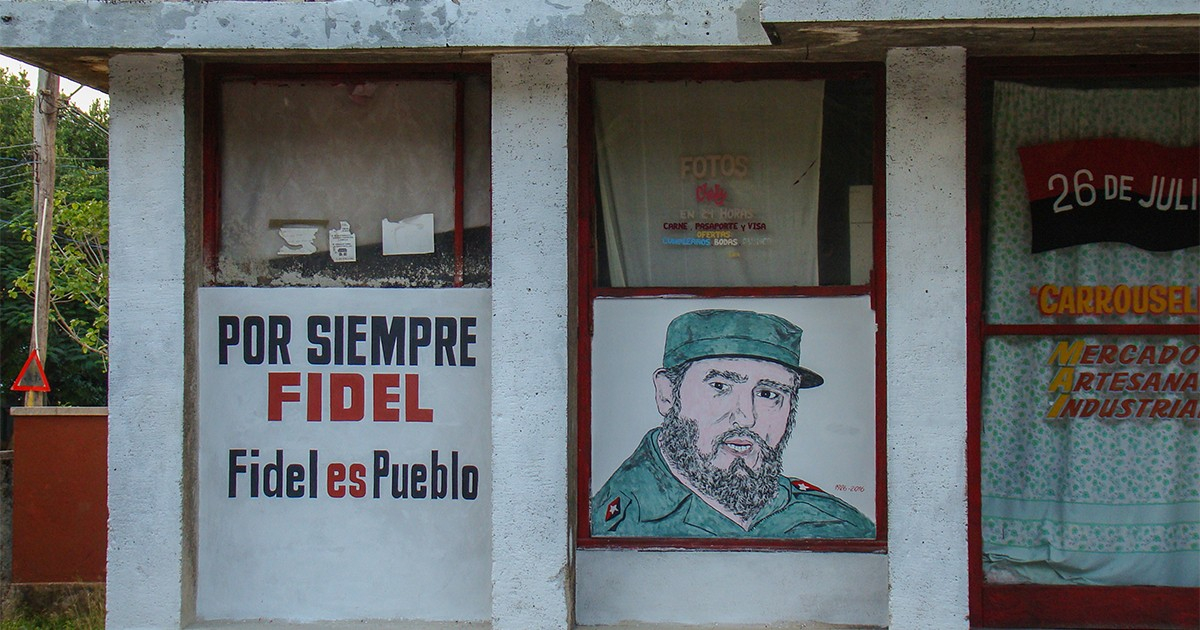
The official portal of the Presidency of Cuba published on Wednesday, on the centenary of Fidel Castro's birth, a text that reaches the "brilliant" heights of revolutionary rhetoric: according to an article signed by journalist Alina Perera Robbio, the presence of the deceased dictator among Cubans is nothing less than "a quantum privilege, where we bet on ourselves, on a unique intelligence and sensitivity, that shine in the darkest night."
The piece, titled "The Best Tribute to Fidel: Living with Dignity," was published as part of the propaganda campaign that the regime rolled out throughout 2026, officially declared at the proposal of Miguel Díaz-Canel before the National Assembly in December 2025.
Perera Robbio's text has the involuntary virtue of acknowledging, amidst lyrical metaphors, the catastrophe experienced by Cuba: it mentions "the night almost always in the midst of the heat" and "the terrible blackout," although it quickly clarifies that this blackout is "calculated in imperial laboratories" and that its effect aims at "our dehumanization, even the definitive break."
Reality, however, does not require imperial laboratories for explanation: this Friday, Cuba forecasted an electrical demand of 3,300 MW against an available generation of only 1,160 MW during peak hours, with a projected deficit of 2,140 MW, which would result in an impact of 2,170 MW during this time, according to data from the Electric Union. So far in 2026, the National Electric System has experienced several total collapses, and in provinces like Matanzas, reports of outages exceeding 80 consecutive hours have been documented. In Havana, blackouts average between 15 and 24 hours daily.
But none of this is misery, according to official propaganda: it is epic. Perera Robbio honors Castro by describing "the defiant women with their arms akimbo, standing in front of the firewood and the boiling pot," and elevates to the status of revolutionary achievement the moment when "the children shout that the light has come." Cooking with firewood and celebrating the return of electricity, in the regime's narrative, are not symptoms of a collapsing country; they are acts of epic resistance worthy of "an Homeric poem that could be called the Indomitable Island."
The regime organized an international colloquium for the centenary with more than 1,500 delegates from 63 countries, of which over 1,000 were foreigners, in addition to bicyclo caravans in Santiago de Cuba, 100 piñatas for children in Holguín, blood donations, and the publication of 23 volumes of Selected Works of Castro. The official program extends until December 4th.
Cubans on social media responded to the article with the only weapon they have left: sarcasm. One asked if they were given electricity to celebrate the birthday. Another summed up the legacy of the honoree with surgical precision: "A true Liberator... liberated Cuba from food, electricity, development, and freedom." A third voice highlighted the central contradiction of the text with a phrase that needs no elaborate embellishments: "The night is not closed, it is OFF."
Another internet user, more concise, summed up in four words the reaction of those who read that Fidel "shines in the darkest night" while they have been without electricity for months: "What did he say? Oh my God."
Related videos:
Filed under: