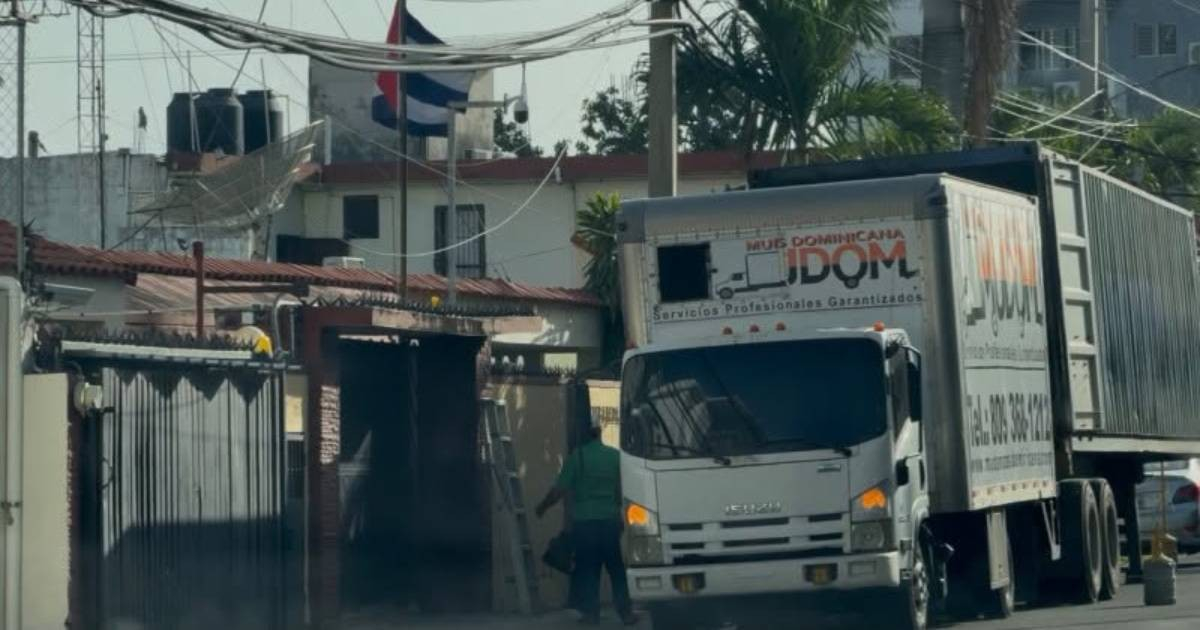
The staff of the Cuban Embassy in Santo Domingo spent a good part of Saturday among boxes, furniture, and appliances, during an intense moving day just hours before the deadline set by the Dominican government for the departure of nine Cuban officials from the country.
Trucks loaded with belongings entered and exited the diplomatic headquarters, located in the El Millón sector of the National District, during an operation that extended until after 8:30 at night, as confirmed by Diario Libre with a team on-site.
As the transfer progressed, agents from the Dominican National Police remained in the vicinity of the location. The diplomats avoided answering questions from journalists, and each time the press tried to get close, they returned inside the premises without making any statements.
The scene reflected the tension surrounding one of the most delicate diplomatic episodes in recent years between Havana and Santo Domingo.
The Dominican Foreign Ministry ordered the departure of officials on August 13, citing Article 9 of the Vienna Convention on Diplomatic Relations, which allows a state to declare members of a foreign mission as persona non grata without being required to publicly explain the reasons.
The deadline given to the diplomats expires this Sunday at 11:59 p.m.
According to the Dominican Ministry of Foreign Affairs (MIREX), the measure affects nine Cuban officials and their families, totaling 21 people. The version from the Havana regime differs in the number, claiming that ten officials were notified.
The Cuban ambassador, Ángel Arzuaga Reyes, did not confirm whether he is among those who must leave the Dominican Republic. When questioned by reporters, he simply stated that it is up to the Dominican Foreign Ministry to provide that information.
Cuban independent media have identified among those affected Dimas Lima Orue, commercial adviser, and Luis Baró, minister counselor.
Havana reacted strongly to the decision and directly attributed it to pressures from Washington.
"There is no other explanation for this action than the submission of the government of the Dominican Republic to the pressures of the U.S. government, which, in its effort to isolate Cuba, aims to damage our diplomatic relations with countries in the region," stated the Cuban Ministry of Foreign Affairs in a statement.
Santo Domingo, for its part, has not publicly explained the reasons that led to the demand for the officials' departure. However, diplomatic sources indicated that alleged Cuban intelligence activities carried out under diplomatic cover may have been behind the decision.
The diplomat and former judge Ramón Horacio González Pérez supported the decision of the Dominican government and stated that the expulsion of the nine Cuban officials is fully supported by International Law. He explained that Article 9 of the Vienna Convention allows the receiving State to demand "at any time and without having to disclose the reasons for its decision" the departure of diplomatic staff, as he explained in an interview with the newspaper Hoy.
González Pérez also considered the deadline granted by Santo Domingo, which exceeds the usual 24 or 72 hours in such situations, to be "very reasonable and prudent." He termed Havana's accusations that the measure is a response to pressure from the United States as "merely speculative and lacking legal basis."
The crisis also occurs in a context of increasing political distance between the governments of Luis Abinader and Miguel Díaz-Canel.
In May, Abinader publicly stated that Cuba is "not a democratic State". Two months later, the Dominican Republic abstained in the United Nations General Assembly vote regarding the resolution against the U.S. embargo on Cuba, after having supported the initiative the previous year.
The Dominican episode adds to a succession of diplomatic setbacks for the Cuban regime in Latin America over the past few months.
In March, Ecuador ordered the departure of all personnel from the Cuban diplomatic mission in Quito and granted only 48 hours to leave the country. That same month, Costa Rica closed its embassy in Havana. In July, the new Colombian government announced the severance of diplomatic relations with Cuba and Nicaragua.
Despite the magnitude of the measure adopted by Santo Domingo, Dominican sources have clarified that it does not signify a break in diplomatic relations between the Dominican Republic and Cuba.
The Cuban embassy will continue operating in the Dominican capital with the staff that remains accredited. However, images of officials removing furniture, appliances, clothing, and boxes from the diplomatic headquarters, under police supervision and without responding to questions from the press, highlight the tense moment that a rapidly deteriorating bilateral relationship is currently experiencing.
Related videos:
Filed under: